Look a little closer
See the mechanism
One lift, two lever stages
Read every step
- Start the rupture. At the start, the nose bears against the lid while the lifted handle loads the rivet attachment upward. The metal flexes near the score and a small rupture vents the can. The rivet is part of the load being lifted, rather than a fixed seesaw pivot throughout the opening.
- Push the panel in. After the initial rupture, the attachment region supports the tab as its nose presses the panel inward. The score opens farther, but an unbroken hinge retains the panel. One lift has changed which contacts carry the load.
The lid, attachment and contact points deform during real opening. These are explanatory contact models, not a fixed-fulcrum simulation, force measurement or exact fracture sequence for every can end. The score and retained hinge are distinct from the tab attachment.
Diagram basis: Bill Hammack: changing lever roles; Can-end specification.
Sources: Reynolds Metals specification / United States patent, hosted by Google Patents · United States patent specification, hosted by Google Patents · Crown Holdings · Bill Hammack / engineerguy, University of Illinois engineering educator · Jacob W. Davis / United States Patent Office; document hosted by Google Patents · Selig Group
Read the lid before following the lift
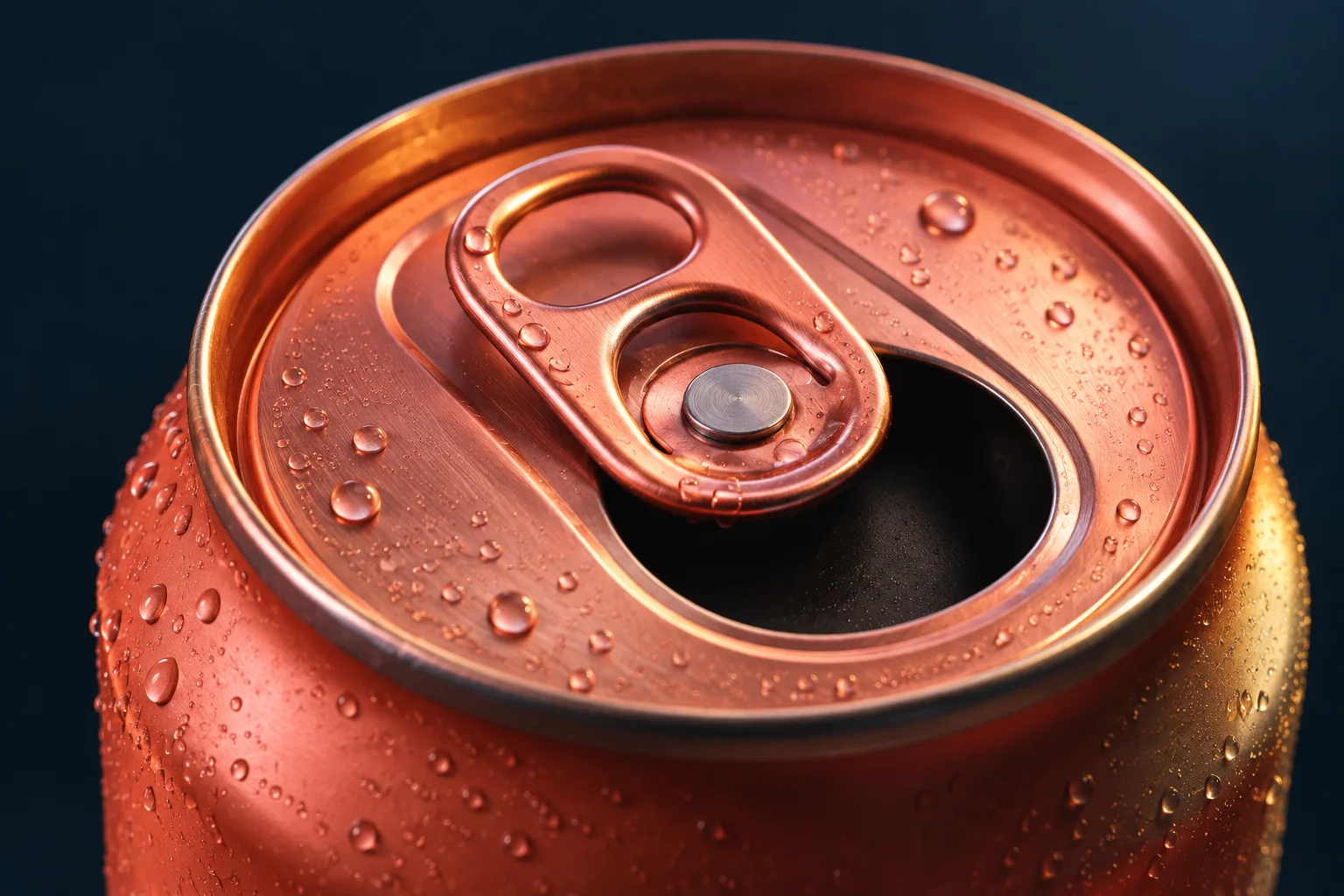
Three features do different jobs: the tab is your handle, its rivet is an attachment, and the score marks a deliberately weakened path in the lid. The outlined panel is still metal joined to the surrounding end before opening. It is not a plug placed in a ready-made hole.
Sources: United States patent specification, hosted by Google Patents · Reynolds Metals specification / United States patent, hosted by Google Patents
First, the attachment is part of the load
At the start of the lift, the tab's nose bears against the lid while your finger raises the handle. The tab loads its attachment upward. The metal near the score flexes and the first small rupture gives pressurized gas a way out. Bill Hammack describes the changing action as a transition from a second-class lever to a first-class lever.
Calling the rivet a fixed pivot from the first instant hides that initial job. In the first selected drawing, notice where the nose bears and where the attachment lifts. The can end deforms; it is not a perfectly rigid playground seesaw.
Sources: Bill Hammack / engineerguy, University of Illinois engineering educator · Reynolds Metals specification / United States patent, hosted by Google Patents
Then, the nose pushes the panel inward
Once the initial rupture has occurred, continued lifting makes the more familiar lever action clear: the attachment region supports the tab while its nose presses the panel down. The score guides the progressing tear. The drawing separates this stage from the earlier venting rather than keeping one fixed contact model for the whole lift.
The score is a weak path, not an open slot. Before use, it must still contain the drink. After rupture, moving the tab back cannot restore that continuous sheet of metal. Contact points and the detailed fracture sequence vary between can ends; the cited patent documents one construction rather than every commercial lid.
Sources: Reynolds Metals specification / United States patent, hosted by Google Patents · United States patent specification, hosted by Google Patents · Bill Hammack / engineerguy, University of Illinois engineering educator
Two connections remain after the opening
The rivet keeps the tab attached. A different connection keeps the panel inside the lid: the score stops short of a complete loop, leaving an unbroken strip that bends as a hinge. Retaining the handle alone would not prevent a detached panel from falling into the drink.
Jeans rivets also make a local mechanical connection, although the parts and purpose differ. At a pocket they join cloth layers; here the attachment must transmit the opening load while the lid changes shape. The shared idea is a connection through material, not an identical construction.
Sources: Reynolds Metals specification / United States patent, hosted by Google Patents · United States patent specification, hosted by Google Patents · Jacob W. Davis / United States Patent Office; document hosted by Google Patents
The finished lid tells you what stayed attached
On an already opened stay-on can, locate the tab attachment and then the remaining panel hinge. Looking is enough: opening edges can be sharp. They record different jobs, even though one lifting movement operated both.
Other closures solve a different problem. Crown lists ring-pull, full-aperture and dual-aperture designs alongside stay-on ends. A bottle cap liner instead seals by contact at the mouth. Do not read every handle or opening as this same tab-and-score mechanism.
Sources: Crown Holdings · Reynolds Metals specification / United States patent, hosted by Google Patents · Selig Group
Questions you might still have
Does folding the tab down reseal the can?
No. Opening has ruptured the scored metal. Moving the retained tab does not rebuild that continuous seal.
Sources: United States patent specification, hosted by Google Patents
Is the rivet always the fulcrum throughout opening?
The initial venting stage and subsequent panel-pushing stage have different lever behavior. Contact points change as the lid starts to open.
Sources: Bill Hammack / engineerguy, University of Illinois engineering educator
The thing to remember
The can opens by directing force into a planned weak path while preserving two connections: the tab's rivet and the panel's hinge.
What this example leaves out
Conventional stay-on beverage-can ends. The two lever drawings isolate changing load paths; their attachment shapes and deformations are exaggerated. Contact and fracture details vary. No exact geometry, opening force, resealing function or first-inventor claim is supplied.
Sources & further reading
Source access dates are listed below. Manufacturer descriptions and patents support the specific constructions described, not every product.
- US5711448A — Non-detachable tab can end with large oval opening ↗
Reynolds Metals specification / United States patent, hosted by Google Patents · Retrieved 2026-10-14 · Tab attachment, initial rupture of a scored panel, retained hinge and progressive displacement into the can.
A disclosed stay-on-tab design, not exact geometry or dimensions of every modern end. The lever schematic is deliberately simplified. - US6575684B2 — Die for stay-on-tab ↗
United States patent specification, hosted by Google Patents · Retrieved 2026-10-14 · Manufactured score, tab nose, rivet attachment and an unscored hinge retaining the opening panel.
Manufacturing design disclosure; no universal metal thickness, opening force or performance claim. - Beverage Ends ↗
Crown Holdings · Retrieved 2026-10-14 · Stay-on-tab, ring-pull, full-aperture and dual-aperture ends are separate product designs.
Manufacturer's current portfolio; marketing savings and flow percentages excluded. - Pop can stay-on tab — slow-motion demonstration ↗
Bill Hammack / engineerguy, University of Illinois engineering educator · Retrieved 2026-10-15 · The author's published description identifies a transition from second-class to first-class lever behavior during stay-on-tab opening.
Original engineerguy Vimeo description read on 2026-10-15; no full video viewing, independent experiment, force measurement or exact product geometry claimed. Two drawings are qualitative contact models. The university summary at https://grainger.illinois.edu/news/media-mentions/25149 separately describes the initially lifted rivet load. - US139121A — Improvement in fastening pocket-openings ↗
Jacob W. Davis / United States Patent Office; document hosted by Google Patents · Retrieved 2026-10-14 · May 20, 1873 patent; inventor and assignment; pocket-opening seam failure; metal fastener through joined fabric to reduce strain on sewing thread.
Historical specification establishes the disclosed design and intended purpose. It does not establish measured modern garment strength or invention of denim. The second-load-path analogy and reader inspection prompts are editorial analysis. - FAQs & Troubleshooting ↗
Selig Group · Retrieved 2026-10-14 · Contact at bottle land, liner rigidity, cap torque and incompatible sealing faces can affect sealing.
Packaging-line troubleshooting primarily for induction seals. Not a home retightening prescription or material-safety assessment.