Look a little closer
See the mechanism
The base finishes the fastener
Read the diagram
A downward driver moves the staple into the sheets. When the protruding legs meet the anvil grooves, they turn inward; the final fastener encloses the paper between crown and legs.
Two schematic stages, not synchronized animation or an exact stapler cutaway. The magazine feed and handle linkage are omitted. Inward clinching is shown; other anvil settings differ.
Diagram basis: Stapler driver and anvil; Salco: clinching settings.
Sources: Henry Ruskin / United States patent specification, hosted by Google Patents · United States patent specification, hosted by Google Patents · Bostitch Office · Salco, Inc. — stapling equipment manufacturer and distributor
The staple arrives as a U, not a finished loop
Before use, an office staple has a crown across the top and two legs pointing downward. That open shape can enter paper from one side. After stapling, the legs are bent underneath, creating a connection that cannot simply slide back out in the same straight path. The stapler changes the fastener's shape as part of fastening.
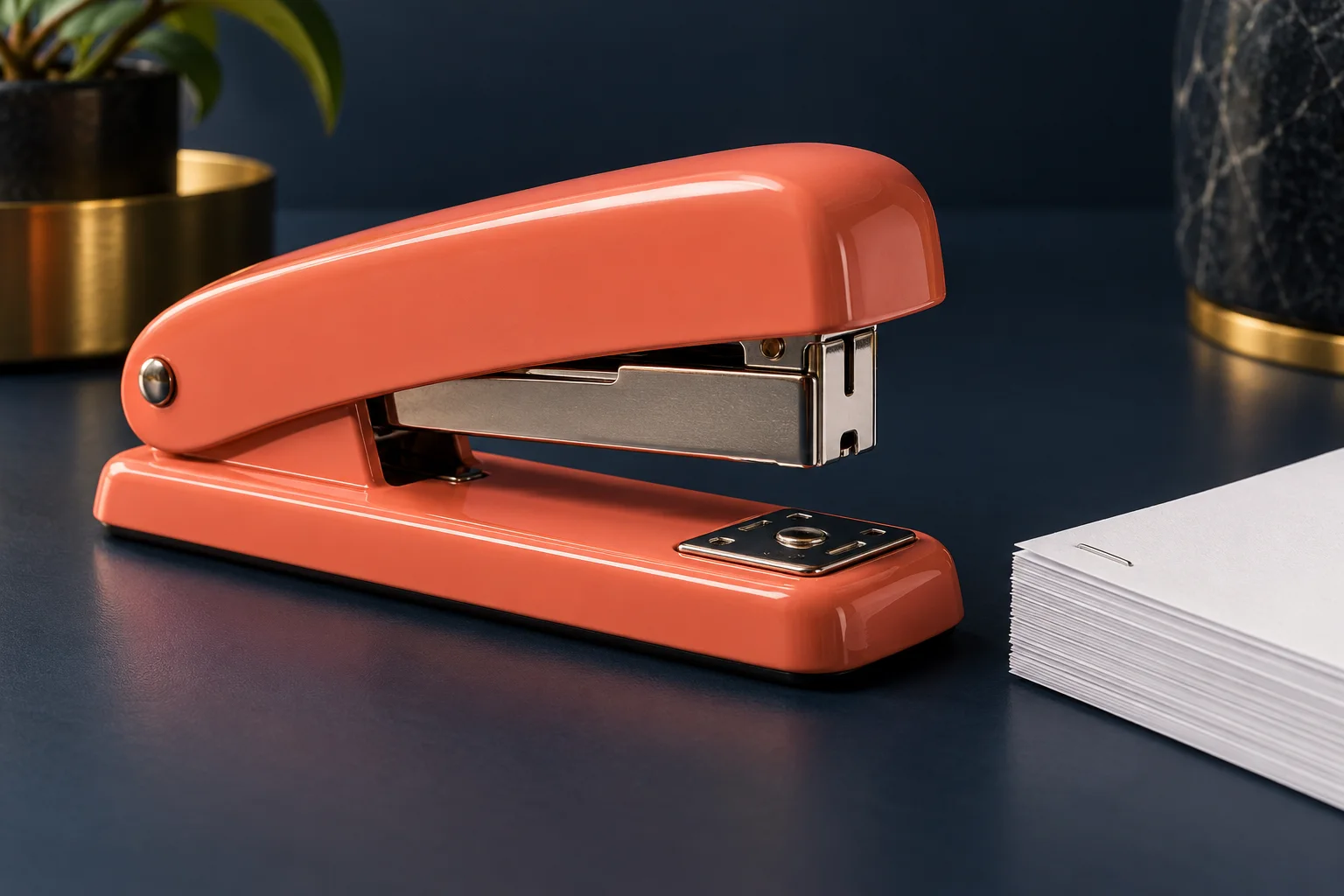
This makes two stages necessary. The wire must first penetrate the sheets, and then its exposed ends must be formed. A tool that only performed the first stage would leave straight legs sticking out below the paper. The base is therefore part of the working mechanism, not just a stand to keep the top at a convenient height. Its anvil supplies the second half of the operation.
Sources: Henry Ruskin / United States patent specification, hosted by Google Patents · Salco, Inc. — stapling equipment manufacturer and distributor
A narrow driver acts on one staple at a time
Inside the head, staples wait in a magazine. A driver is aligned with the leading staple and moves through the front opening. The magazine stores and guides the strip; the driver delivers the downward stroke. Your hand moves a broad handle, but the working contact with the staple is localized at the front.
That arrangement explains why a strip of joined staples does not all leave at once. The magazine guides the strip toward one driving position, and the driver acts there. The front staple's crown receives the stroke while the remaining staples wait behind it.
Sources: United States patent specification, hosted by Google Patents
The anvil bends legs that are already through the paper
As the legs emerge below the sheets, they meet the anvil's shaped recesses. Continued downward movement directs the legs sideways and back against the underside of the stack. The upper driver supplies the movement; the lower grooves determine the bending direction. The paper is caught between the crown above and the formed legs below.
Think of pushing a flexible strip into a curved channel. You supply motion along one direction while the channel redirects the strip as it advances. The analogy explains guided bending, not the exact force or wire properties. The anvil does not reach upward through the paper to pull the legs down. The driver pushes them into a constrained path, and that path turns their motion into a clinch.
Sources: Henry Ruskin / United States patent specification, hosted by Google Patents · Salco, Inc. — stapling equipment manufacturer and distributor
The second groove can change the kind of fastening
On common reversible-anvil models, one groove arrangement turns the legs inward for a firm clinch. Another splays them outward for temporary pinning that is easier to remove. Salco's explanation describes those two purposes. The change is in the lower forming surface; it does not turn the staple into a different piece of wire before it enters the paper.
Turn a stapled document over and the difference is visible. The crown can look similar from above while the legs underneath point inward or outward. Their final direction follows the selected grooves. Not all staplers provide an alternative setting, and how the anvil switches is product-specific.
Sources: Salco, Inc. — stapling equipment manufacturer and distributor · Henry Ruskin / United States patent specification, hosted by Google Patents
Feeding and driving use different movements
A pusher and spring keep the remaining staples moving toward the front. That feed runs along the magazine, while the driver travels toward the anvil. Keeping those directions separate helps explain the cycle: after the driver returns, the next staple can occupy the front position for another downward stroke.
The feed spring does not have to punch the staple through paper. Its task is positioning. In other designs, a separate spring can store energy for the driving stroke itself. A spring-powered stapler therefore may contain a spring doing a quite different job from the familiar follower spring. Naming the motion and the destination is a better way to identify a part than assuming that every spring inside a device has the same purpose.
Sources: United States patent specification, hosted by Google Patents · Bostitch Office
The shared principle survives different outer designs
Bostitch distinguishes desktop, plier, reduced-effort and flat-clinch models. A plier model changes how your hand operates the mechanism; a flat-clinch model changes the final shape beneath the paper. The driver-and-forming-surface idea remains useful, but those differences mean the feel, loading arrangement and finished fastener need not be identical.
Staple compatibility is also part of the mechanism. A magazine, driver slot and anvil are designed around particular wire dimensions and leg lengths. A strip that happens to fit inside the cover is not automatically suitable. Use the maker's specified staple type and capacity for actual work. Understanding the cycle explains the object; it does not diagnose every jam or justify forcing a damaged driver back into alignment.
Sources: Bostitch Office · United States patent specification, hosted by Google Patents
Questions you might still have
What is the small metal plate in a stapler base?
It is the anvil. Its grooves form the legs after they emerge through the paper, determining the finished clinch.
Sources: Salco, Inc. — stapling equipment manufacturer and distributor
Why do some staplers have two anvil positions?
One bends legs inward for a firmer fastening; the other bends them outward for temporary pinning. That option is model-dependent.
Sources: Salco, Inc. — stapling equipment manufacturer and distributor
Does the feed spring fire the staple?
The follower spring advances the strip along the magazine. Spring-powered designs can use another spring to deliver the driving stroke.
Sources: United States patent specification, hosted by Google Patents · Bostitch Office
The thing to remember
A staple becomes a fastener when the driver pierces the paper and the anvil redirects its emerging legs into a clinch.
What this example leaves out
The schematic isolates a conventional desktop staple path. It is not an exact cutaway, loading guide or jam-repair method. Power sources, anvil states, staple dimensions and capacity vary by model.
Sources & further reading
Source access dates are listed below. Manufacturer descriptions and patents support the specific constructions described, not every product.
- US4463890A — Staplers ↗
Henry Ruskin / United States patent specification, hosted by Google Patents · Retrieved 2026-10-14 · Driver penetrates paper, anvil clinches staple legs; spring-impelled designs differ from direct manual drive; two anvil shapes can bend inward or outward.
Patent background and disclosed alternatives. Not every stapler uses the patent's spring release. - US8297485B2 — Stapler ↗
United States patent specification, hosted by Google Patents · Retrieved 2026-10-14 · Magazine, front driver, anvil and spring-supported pusher position staples for successive strokes.
Specific embodiment establishes a feed principle, not a universal loading or repair procedure. - Staplers & Accessories — Common Types and Flat Clinch FAQ ↗
Bostitch Office · Retrieved 2026-10-14 · Desktop, plier, spring-powered and flat-clinch designs differ; staple compatibility depends on the product.
No marketing effort percentage or generic sheet-capacity promise adopted. - Why Do Staplers Have Two Settings? ↗
Salco, Inc. — stapling equipment manufacturer and distributor · Retrieved 2026-10-14 · Inward clinching versus outward temporary pinning and anvil-groove selection.
Common reversible-anvil office models; not all staplers have two settings.