Look a little closer
See the mechanism
A small fastener across two layers
Read the diagram
The rivet passes through both cloth layers. A head on each side holds them together beside the stitching. Opposing arrows show the tendency of the layers to pull apart at a pocket opening; the fastener provides an additional load path.
Illustrative cross-section, not to scale. Cloth, thread and rivet are exaggerated for visibility. Arrows indicate direction, not measured force. This is not a strength test or a claim that the cloth cannot tear.
Diagram basis: Jacob Davis, US139121A.
Sources: Jacob W. Davis / United States Patent Office; document hosted by Google Patents · Levi Strauss & Co. — company archive account, January 12, 2017
Why the end of a seam matters
A pocket has an opening so you can put things into it. That opening also leaves the joined edges with definite end points. Pulling at the pocket mouth asks the connection at those points to resist separation. Reinforcing a small area can therefore solve a problem that simply adding more fabric elsewhere would miss.
The original patent describes seams beginning to rip under repeated pressure, including the strain caused by putting hands in pockets. Its target is precise: the edges of the pocket opening. It does not claim that denim itself was a newly invented material.
Sources: Jacob W. Davis / United States Patent Office; document hosted by Google Patents
What the metal actually connects
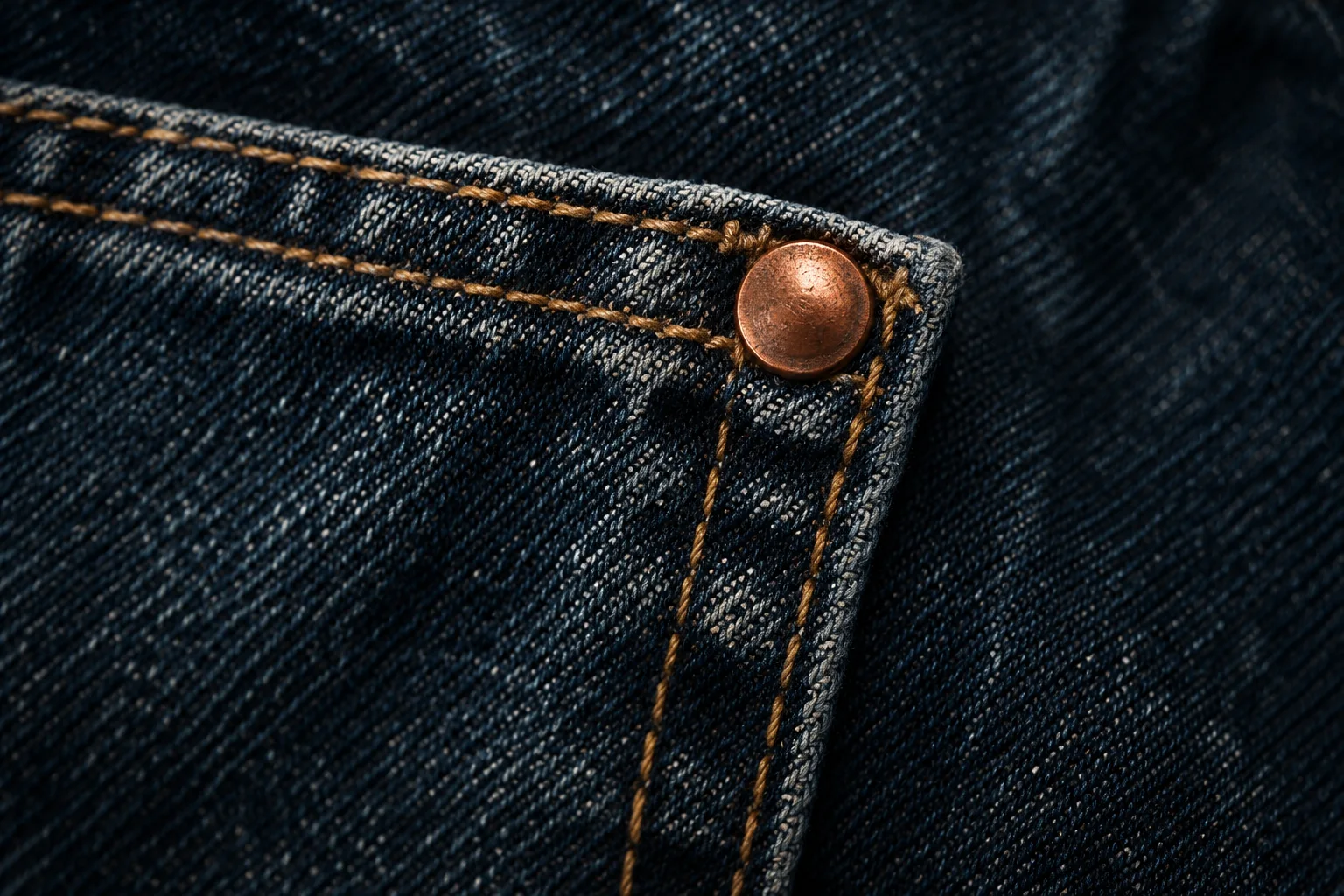
Jacob Davis's specification describes passing a rivet or equivalent metal fastener through a hole at the seam end, then forming its head so the two cloth parts are secured together. The thread still joins the seam; the metal supplies another connection at the vulnerable end.
Think of the reinforcement as a second route for a local load. That is an explanatory analogy, not a measurement of how much force a particular pair of jeans can withstand. A shiny cap alone tells you little: the connection through the layers is the detail that matters.
Sources: Jacob W. Davis / United States Patent Office; document hosted by Google Patents
A date with a specific meaning
U.S. Patent 139,121 was issued on May 20, 1873. It names Jacob W. Davis and identifies his assignment to himself and Levi Strauss & Company. The title concerns fastening pocket openings, which is a more exact description than saying somebody patented all blue trousers.
Levi Strauss & Co.'s account of its original pants describes rivets on the pockets, including a back pocket. The company's archive-based history is useful for its own garments. It should not be stretched into a complete history of every tailor, fabric or trouser design.
Sources: Jacob W. Davis / United States Patent Office; document hosted by Google Patents · Levi Strauss & Co. — company archive account, January 12, 2017
Useful details still have tradeoffs
Metal reinforcement can introduce a different problem. Levi Strauss & Co. reports covering its rear-pocket rivets in 1937 after complaints about scratching furniture and saddles. The company says those rivets were removed in 1966 because they continued to wear through the covering fabric.
Look at your own pocket corners without assuming they must match that historical pair. Where are the fasteners? Which seams end beside them? The interesting question is how the garment reinforces an opening, rather than whether a fixed number of metal dots proves that it is authentic or durable.
Sources: Levi Strauss & Co. — company archive account, January 12, 2017
The thing to remember
A rivet is a small connection placed where repeated pulling can start a larger seam failure.
What this example leaves out
The patent establishes a documented design and purpose, not a strength rating for modern jeans. Rivet materials, placement and alternatives vary. The historical changes cited here concern Levi's garments, not every jeans maker.
Sources & further reading
Source access dates are listed below. Manufacturer descriptions and patents support the specific constructions described, not every product.
- US139121A — Improvement in fastening pocket-openings ↗
Jacob W. Davis / United States Patent Office; document hosted by Google Patents · Retrieved 2026-10-14 · May 20, 1873 patent; inventor and assignment; pocket-opening seam failure; metal fastener through joined fabric to reduce strain on sewing thread.
Historical specification establishes the disclosed design and intended purpose. It does not establish measured modern garment strength or invention of denim. The second-load-path analogy and reader inspection prompts are editorial analysis. - Pockets Full of History ↗
Levi Strauss & Co. — company archive account, January 12, 2017 · Retrieved 2026-10-14 · Company account of original riveted pockets; rear-pocket rivets covered in 1937 after scratching complaints and removed in 1966.
Primary corporate history for Levi's own garments, not independent proof of every jeans maker's practice. No company photographs or advertising graphics reused.