Look a little closer
See the mechanism
Watch the joined length grow, then shrink
Read every step
- Start. Above the slider, the rows are separate. Below it, matching teeth already interlock. The change between those two arrangements sits at the slider.
- Close. The slider has moved toward the open rows. More of the length is now joined behind it. The Y-shaped passage guides the next elements together; the already joined teeth do the holding.
- Open. Reverse the slider toward the joined length. Its divider sends the elements into separate branches. The joined length becomes shorter again.
Original path model, not to scale. Teeth and the Y passage are exaggerated to separate guiding from holding. These are selected positions, not a simulation of exact tooth contact. Slider locking is a separate feature and is not drawn.
Diagram basis: YKK: zipper structure.
Sources: YKK Corporation · YKK Corporation · YKK Americas · Velcro Companies
The slider moves. The joined teeth stay behind it.
Two fabric tapes carry rows of joining elements. The slider travels along those rows. It guides only the elements passing through it at that moment, leaving an interlocking chain behind. YKK identifies the tape, elements and slider as the three main components.
That division of work answers the small puzzle: one short moving part can close a long opening. The slider changes the arrangement locally; the already joined elements maintain the connection along the length it has passed.
Sources: YKK Corporation
Follow the Y in both directions
Inside the slider, the separate rows enter two branches and meet in a shared channel. Matching shapes mesh as the guide brings them together. In the selected states below, moving the slider upward leaves more joined chain beneath it. The location of the slider changes, and so does the boundary between separate and joined rows.
Reverse that movement. The joined chain reaches the divider and separates into the two branches. Opening therefore happens at a moving boundary too. Read the drawing as a map of these paths; the enlarged teeth do not reproduce one manufactured metal, moulded or coil profile.
Sources: YKK Corporation
Holding the rows and holding the slider are different jobs
Interlocking elements join the two sides, but some zippers also need to prevent the slider from creeping along them. In the jeans example documented by YKK, a small pin catches the elements when the puller is lowered; lifting it releases the pin. Automatic-lock designs release their lock as the tab is pulled.
So the tab can act as a handle and a release control during the same pull. A nonlocking slider does not gain that second mechanism merely because its teeth mesh. The state drawing isolates row guidance and leaves the slider lock out.
Sources: YKK Corporation · YKK Americas
Look for the change, then the connection
On a working zipper, follow the point where the rows meet or separate. It follows the slider. Then look at the joined length the slider has left behind. Those are two parts of one action, with different jobs.
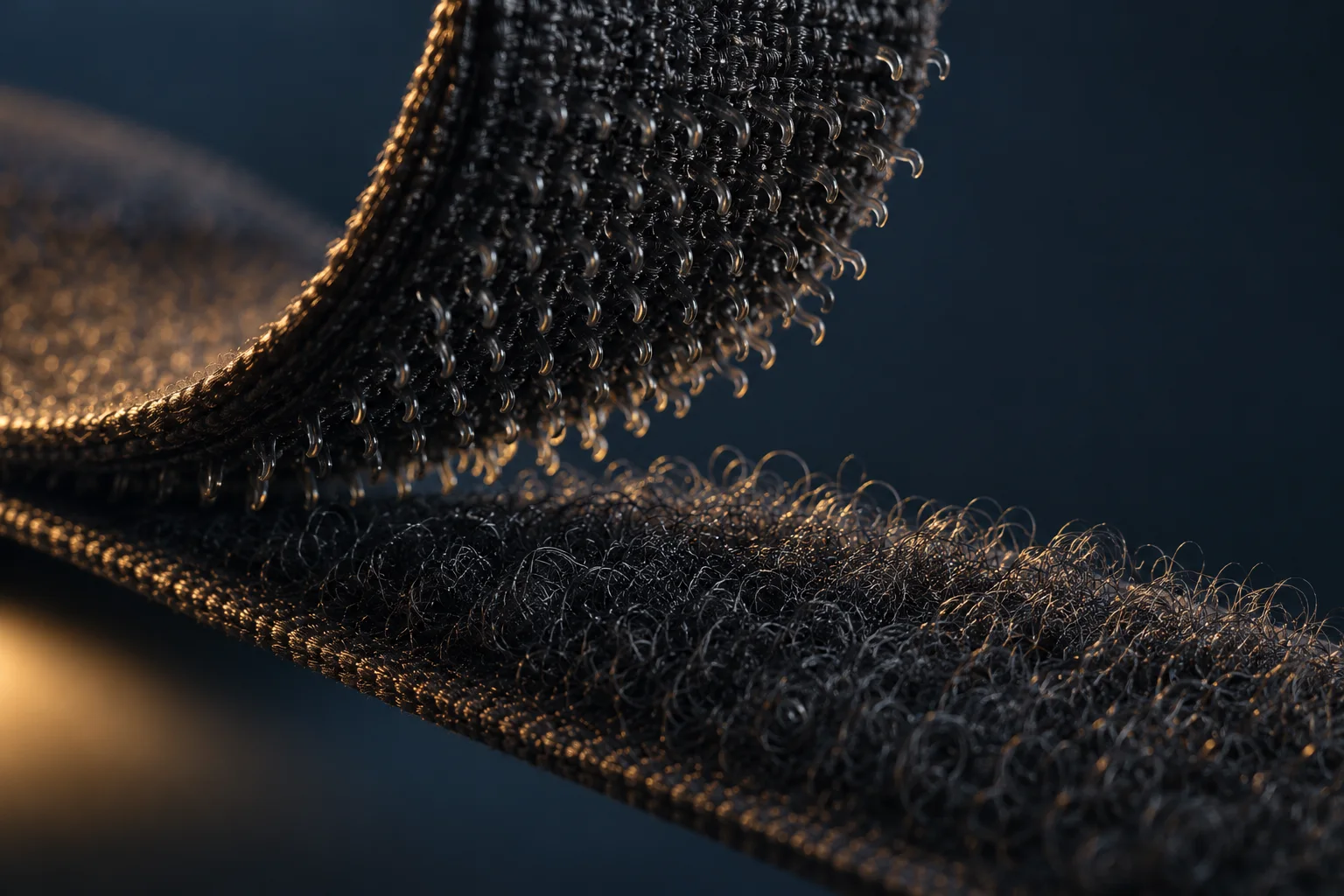
Compare a hook-and-loop fastener: its small catches can release progressively as a strip peels away. The moving release boundary is a useful connection between the examples, but the hook-and-loop strip has no zipper slider guiding two rows through a Y-shaped channel.
If a slider catches, stop rather than pulling harder to demonstrate the mechanism. YKK warns that forcing it can damage the elements. Check for caught fabric without dismantling the fastener.
Sources: YKK Corporation · Velcro Companies · YKK Americas
The thing to remember
The slider moves the joining boundary. Interlocking elements hold the length it leaves behind; a slider lock is another mechanism.
What this example leaves out
This is a simplified explanation of a conventional zipper. Metal, molded and coil elements differ in detail. The schematic does not show an exact tooth profile, a waterproof seal or every slider-lock design.
Sources & further reading
Source access dates are listed below. Manufacturer descriptions and patents support the specific constructions described, not every product.
- To begin with, what's the structure of a zipper? ↗
YKK Corporation · Retrieved 2026-10-15 · Tape, elements and slider; the Y-shaped slider passage; meshing elements and the importance of their fit.
Manufacturer explanation of the basic mechanism. No exact tooth geometry, universal repair diagnosis or strength measurement is inferred. Reader observation and moving-versus-holding framing are editorial analysis. - Why zippers don't come open on their own ↗
YKK Corporation · Retrieved 2026-10-14 · A slider lock is a separate function; jeans pin-lock example; lifting the puller and automatic-lock release.
Examples of locking sliders, not a claim that all zippers lock or use one release angle. Historical first-invention claims are omitted. - FAQs — Information about Zippers and Sliders ↗
YKK Americas · Retrieved 2026-10-14 · Distinction between pin-lock and automatic-lock sliders; forcing a sticking slider can damage elements.
Manufacturer guidance supports the warning and design distinction. Lubricant recommendations, global quality claims and company statistics are not reproduced. - How do VELCRO Brand Fasteners Work? ↗
Velcro Companies · Retrieved 2026-10-14 · Peel, shear and tension loading definitions; progressive row release in peel; product-specific cycle life.
No numerical strength or lifetime generalized to household fasteners. Load-path explanation is qualitative.