Look a little closer
See the mechanism
The splits clear the boundary of the plug
Read the diagram
The upper drivers remain in the case and the lower pins remain in the plug. Their junctions align at the shear line, leaving no pin bridging the boundary.
A longitudinal conceptual section with three symbolic stacks. It explains normal operation only; no pin dimensions, bypass sequence or complete door-lock assembly.
Diagram basis: Yale: pin-tumbler components; UTC: normal pin alignment, slides 6–8.
Sources: Yale / ASSA ABLOY · University of Tennessee at Chattanooga · Yale · Smith College
The moving part is inside the fixed part
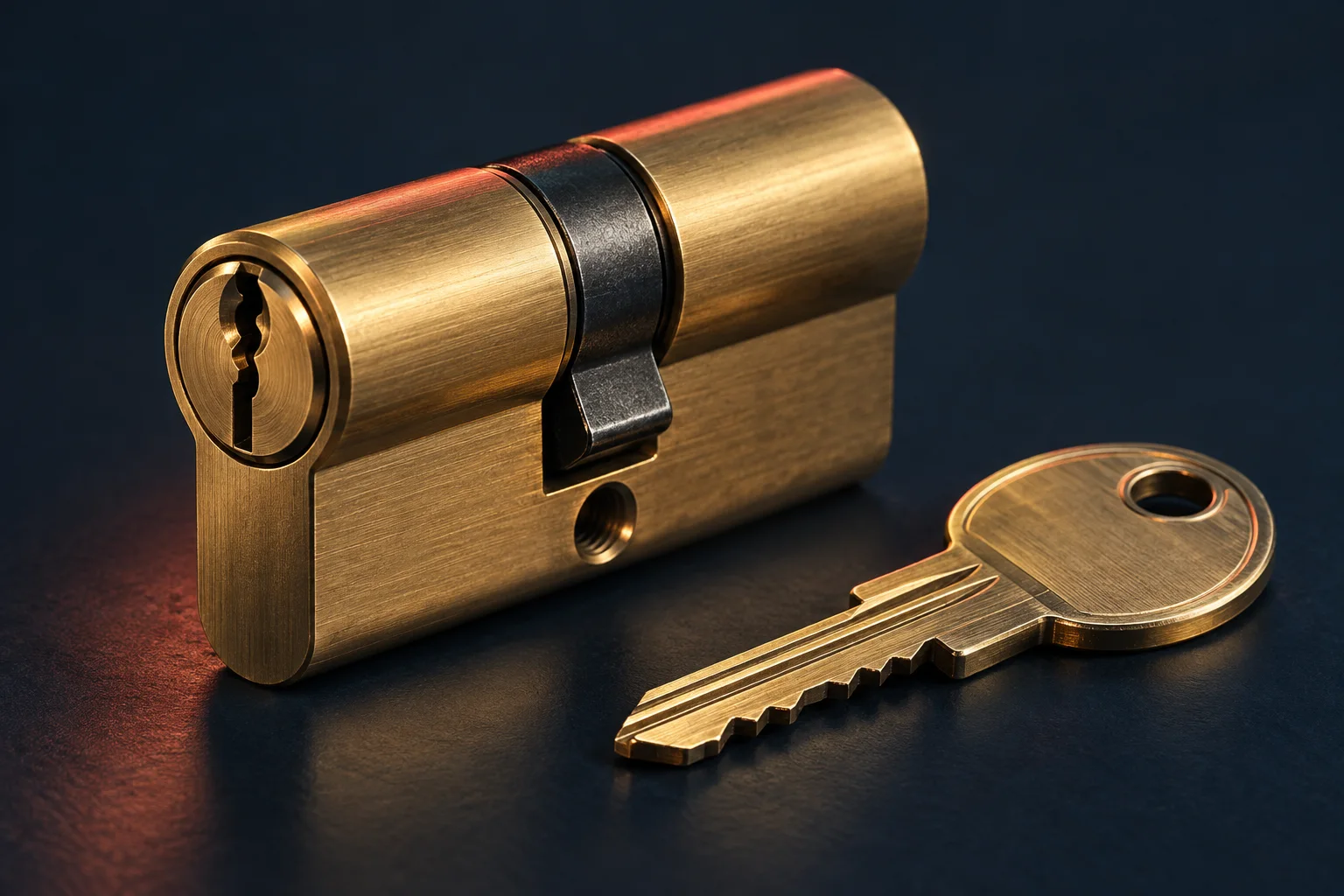
From outside, a keyhole looks like an opening in a solid piece of metal. Inside a conventional pin cylinder, the opening passes into a plug that can rotate within an outer casing. The casing remains fixed while the plug turns. A connection at the rear translates that allowed rotation into operation of the particular lock.
Pin chambers cross the boundary between plug and case. A pin extending into both parts prevents the plug from rotating independently. The shear line is the surface around the plug where those parts meet; every required pin position must clear that boundary before the plug can turn.
Sources: Yale / ASSA ABLOY · University of Tennessee at Chattanooga
Why each pin position has a split
Yale's basic account describes a lower pin, an upper driver pin and a small spring at each position. The spring presses the stack toward the keyway. With no correct key in place, a pin extends across the plug-to-case boundary. A piece of metal occupying both parts prevents their independent movement.
The split lets the lower pin move with the plug while its driver stays in the casing. They can separate along that junction without being removed from their chambers. If either solid piece still bridges the boundary, the plug remains blocked.
Sources: Yale / ASSA ABLOY · University of Tennessee at Chattanooga
The key is a row of different lifting heights
A correctly shaped key presents a particular height to each lower pin. The lower pins need not all have the same length. The combination of pin length and local key height determines where that stack's split ends up. When all the relevant splits meet the shear line together, no pin bridges the boundary and the plug is free to rotate.
The key's edge is a height pattern, not a set of gears. A lower pin's length and the height beneath it work together to place its top at the required level. The spring keeps the stack following that profile; pushing the key farther upward is not the goal.
Sources: University of Tennessee at Chattanooga · Yale / ASSA ABLOY
A key can fit and still fail to clear the line
Two keys can have the same blade profile—the grooves and cross-sectional shape that let them enter a particular keyway—yet different cuts along their edges. Yale's product FAQ distinguishes keyway arrangements; the height pattern that operates the pins is a separate requirement. Fitting through the entrance is only the first condition.
Picture two similar keys on a key ring. Both might be brass, equally wide and grooved to fit the same keyway. Their different notches are easy to overlook. Yet those edge heights decide where the pin splits land. A familiar-looking key can fit the entrance without being the key that clears the shear line.
Consider a key whose profile fits, but whose edge is too low at one pin position. That lower pin stops short of the shear line, leaving its driver across the boundary. The key can enter and seat normally, yet the plug cannot turn. A cut that lifts a stack too high can leave the lower pin bridging the boundary instead. Both failures concern height, not whether the blade fits the opening.
Sources: Yale · University of Tennessee at Chattanooga
Clearing the pins is only one stage of unlocking
The pins determine whether the plug can turn; they need not be the bolt that secures the door. Once rotation is permitted, a rear connection acts on other locking hardware. Different lock bodies can use that motion differently. A key fitting and turning is therefore the cylinder's part of an operation completed elsewhere in the lock.
Sources: Yale / ASSA ABLOY · Yale
A pin idea can belong to a different mechanism
Smith College's Museum of Ancient Inventions presents an educational wooden tumbler-lock reconstruction. Its pins obstruct a sliding bolt, and a matching key lifts them clear of that path. The modern cylinder uses a related obstruction principle, but changes both the moving part and the boundary: split pins control the rotation of a plug within its casing. Recognizing pins alone is not enough to identify how a lock moves.
Sources: Smith College · Yale / ASSA ABLOY
Questions you might still have
What is the shear line?
It is the boundary between the rotating plug and fixed casing. In the basic mechanism, the pin splits must align there so neither pin bridges it.
Why does a wrong key sometimes fit but not turn?
Its profile may enter the keyway, while its cuts place one or more pin splits above or below the required boundary.
Sources: Yale · University of Tennessee at Chattanooga
Are the lock pins the door bolt?
They normally control whether the plug can rotate. The permitted rotation operates connected locking hardware, which is a separate part of the system.
Sources: Yale / ASSA ABLOY
The thing to remember
The correct key places every required pin split on the same moving boundary, allowing the plug to rotate within its fixed case.
What this example leaves out
A simplified conventional split-pin cylinder, with symbolic pin heights. Sidebars, security pins, master-key systems and electronic cylinders are outside scope. No bypass, key-cutting dimensions, repair procedure or security rating is supplied.
Sources & further reading
Source access dates are listed below. Manufacturer descriptions and patents support the specific constructions described, not every product.
- The Yale Pin-tumbler invention ↗
Yale / ASSA ABLOY · Retrieved 2026-10-14 · Rotating plug in a casing, lower pins, upper driver pins, springs and a correctly profiled key.
Basic cylinder family; no security ranking, bypass method, pin measurements or universal pin count. - Physical Security — CPSC 4620/5620, slides 6–8 ↗
University of Tennessee at Chattanooga · Retrieved 2026-10-14 · Driver pins bridge casing and plug without a key; correct key aligns pin splits at the shear line; wrong key leaves blocking pins.
Only the normal-operation educational slides used. Attack techniques and unrelated historical dates omitted. - Mechanical Hardware (Non-Electronic) Product FAQs ↗
Yale · Retrieved 2026-10-14 · Yale product families use different keyways and pin counts; key compatibility is a separate design constraint.
Yale's listed mechanical ranges, not a locksmithing or key-cutting guide. Relevant text retrieved through current search; direct page parser returned no text. - Tumbler Lock — Museum of Ancient Inventions ↗
Smith College · Retrieved 2026-10-14 · Educational reconstruction of a wooden lock with pins blocking a sliding bolt and a matching key lifting them.
Reconstruction illustrates the difference from a modern rotating plug. Disputed dates, first-invention and absolute historical claims excluded.