Look a little closer
See the mechanism
Different signals can request restraint
Read the diagram
The spool manages stored webbing. Motion-sensitive inputs can request a stop to further payout. Pretensioning and load limiting are additional functions, not synonyms for the lock.
Functional topology only. The symbolic lock is not a real pawl geometry, sensor cutaway, repair location or diagnostic test.
Diagram basis: Autoliv: retractor functions; Toyota: ELR and ALR.
Sources: Autoliv · Toyota Owners manual · National Highway Traffic Safety Administration · Autoliv
The belt is stored, not stretched out of the pillar
The visible belt changes length as webbing winds onto or off a spool. Autoliv describes that rotating storage element inside the retractor. The spool arrangement keeps unused length packaged away and allows the belt to follow normal occupant movement. It is a way to manage slack without requiring the occupant to shorten the strap manually after every small change of position.
Start by distinguishing movement of the webbing from stretching of the material. The retracting system takes up available length; it does not need to make the fabric shrink. That is the first job of the mechanism. The locking job adds a constraint when normal freedom of movement would be dangerous. One component can be part of both jobs, but winding the belt neatly is not the same thing as stopping payout during an emergency.
Sources: Autoliv
Vehicle motion and webbing motion are different signals
Autoliv distinguishes car-sensitive and webbing-sensitive sensing. One responds to vehicle motion, including sudden acceleration, deceleration or tilting. The other responds when the belt is pulled out too quickly. These are different inputs to a system that can lock the reel. They are not measurements of the same thing, and a vehicle's exact arrangement depends on its restraint design.
A quick belt movement in a stationary car and sudden vehicle deceleration are different events. A system sensitive to both can respond without waiting for the occupant to make one particular movement. Both inputs can request the same result: stopping further webbing payout.
Sources: Autoliv · Toyota Owners manual
Emergency locking changes the permission to unwind
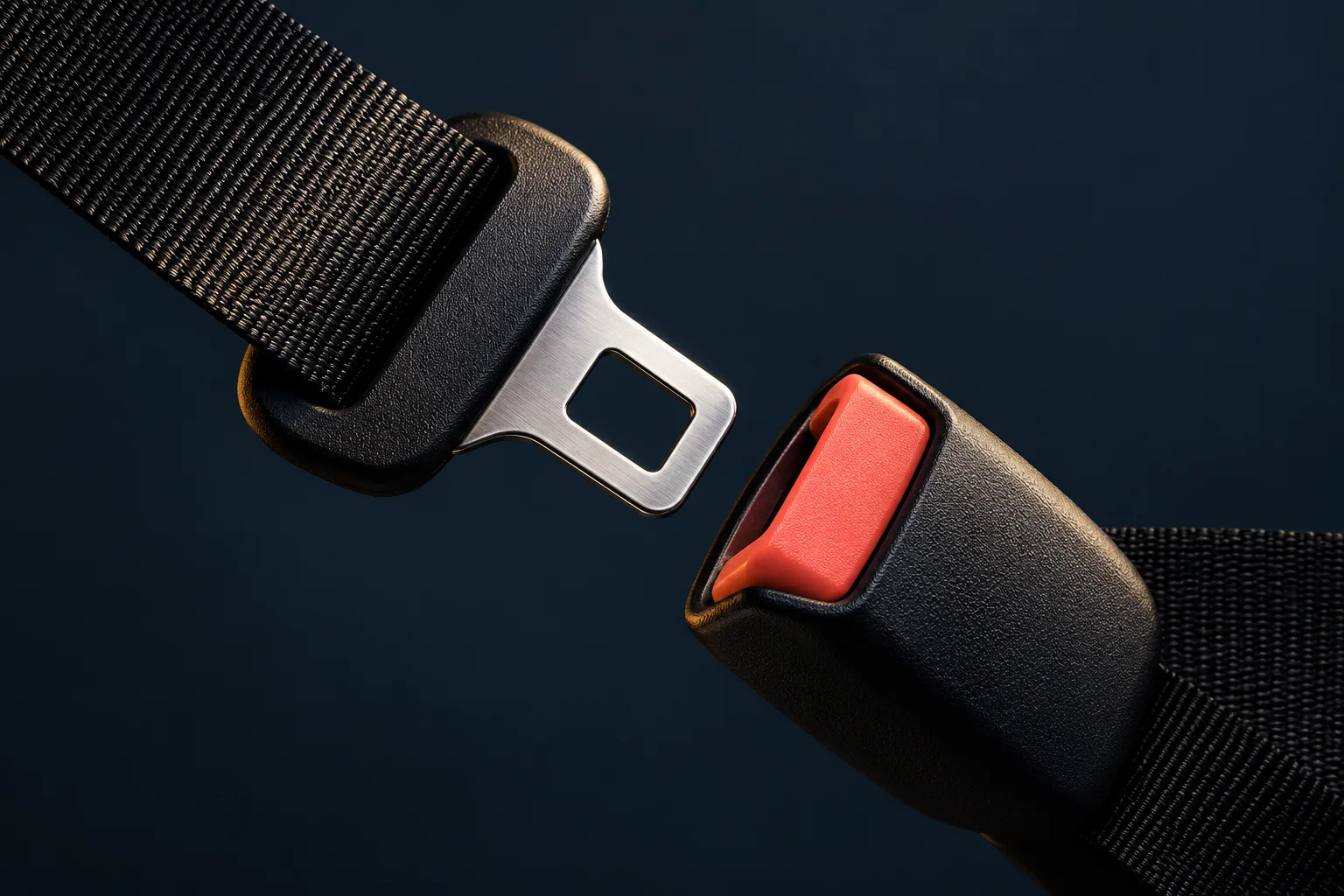
Toyota's Tundra manual describes an emergency locking retractor that permits ordinary movement but locks during a sudden stop or impact. The key change is the permission to pay out more belt. Normal comfort requires motion; restraint during an emergency requires limiting that motion. The retractor is designed to move between those conditions.
This explains why describing a belt as simply loose or fixed misses its behavior. The spool can be free in one operating state and constrained in another. The drawn lock is symbolic so that the difference is visible, not a model of a repairable catch. Nor is casually tugging a belt a complete proof of restraint-system health. A real safety system includes webbing, anchorage, buckle, sensing and other components that a single observation cannot certify.
Sources: Toyota Owners manual · Autoliv
Automatic locking is another named mode
NHTSA defines a switchable retractor as one that can change from emergency locking to automatic locking for child-restraint installation. Toyota's model manual also describes the automatic-locking function on applicable passenger belts. That named mode differs from an emergency response to sudden movement: it can prevent additional extension as part of holding an installed restraint in place.
Automatic locking does not necessarily mean a computer has detected a crash. It names a different restraint function from emergency locking, which permits ordinary movement until its specified conditions occur. Whether a seat has a switchable retractor, and how a child restraint must be installed, depends on the exact vehicle and restraint manuals.
Sources: National Highway Traffic Safety Administration · Toyota Owners manual
Stopping payout, tightening and limiting force are three jobs
Autoliv describes pretensioning as tightening the belt during a crash event, while load limiting helps manage force on the occupant. Compare that with emergency locking, whose basic role is to stop further uncontrolled payout. Taking up existing slack is not identical to preventing new slack, and managing a restraint load is another requirement again.
A system can restrain spool motion and then manage belt force through its designed load-limiting behavior. That controlled response is different from a lock simply failing to hold. The sequence and implementation are vehicle-specific, but the three jobs remain distinct: prevent unwanted payout, remove slack and manage the restraint load.
Comfort is a sensing problem as well as a winding problem
Autoliv's commercial-vehicle brochure discusses nuisance locking caused by vibration and a sensor design intended for that environment. The example reveals a real engineering tradeoff: sensing must react to the relevant event while ordinary vehicle movement should not constantly frustrate the occupant. It does not establish why any particular passenger-car belt feels stiff or locks unexpectedly.
The useful takeaway is a map of responsibilities: the reel stores, sensing requests restraint, the lock limits payout, and crash features can tighten or manage force. Keep that map separate from servicing. A persistent belt problem calls for the vehicle manufacturer's guidance or qualified inspection. Disassembly, adjustment of sensing parts or interference with a pretensioner is not part of understanding the mechanism.
Sources: Autoliv · Toyota Owners manual
Questions you might still have
Is a retractor the same thing as a pretensioner?
No. Retraction stores webbing and manages slack. Pretensioning actively tightens a restraint during its designed crash response; the functions may be integrated in an assembly.
Sources: Autoliv
What does ELR mean?
Emergency Locking Retractor: a system permitting normal belt movement while locking payout during specified sudden-motion conditions.
Sources: Toyota Owners manual
Do all belts have the same locking modes?
No. Switchable emergency/automatic locking is a design-dependent feature. Check the exact vehicle manual rather than generalizing from another seat or model.
Sources: National Highway Traffic Safety Administration · Toyota Owners manual
The thing to remember
Retraction manages slack in ordinary use; emergency locking controls payout, while pretensioning and load limiting add separate crash functions.
What this example leaves out
Functional overview of manufacturer-described restraint systems. No exact sensor geometry, activation threshold, repair method or vehicle-specific diagnostic test. Child-restraint installation and servicing require the relevant manuals and qualified help.
Sources & further reading
Source access dates are listed below. Manufacturer descriptions and patents support the specific constructions described, not every product.
- Seatbelts — Retractors & Pretensioners ↗
Autoliv · Retrieved 2026-10-14 · Spool storage, car-sensitive and webbing-sensitive locking, pretensioning and load-limiting are distinct functions.
General manufacturer system overview; the diagram is functional, not a product cutaway or repair instructions. - 2022 Tundra — Seat belts ↗
Toyota Owners manual · Retrieved 2026-10-14 · ELR locks on sudden stops/impact; ALR is a different locking mode on applicable passenger belts.
Model-specific example only; no claim of identical behavior in every vehicle or diagnostic tug test. - Car Seat Glossary — Switchable retractor and webbing ↗
National Highway Traffic Safety Administration · Retrieved 2026-10-14 · Definitions of webbing and a retractor switchable between emergency and automatic locking for child-restraint installation.
Terminology, not child-seat installation guidance or updated legal requirements. - Commercial Vehicle Seat Belt Solutions — Heavy Truck Sensor ↗
Autoliv · Retrieved 2026-10-14 · Vibration-induced nuisance locking and vehicle-specific sensor design are acknowledged design issues.
Commercial-vehicle example; no passenger-car malfunction diagnosis.