Look a little closer
See the mechanism
Many catches, different pulling directions
Read the diagram
Hooks enter loops across the overlap. A sideways load acts along the faces; peeling bends one strip back and releases catches progressively at the separation front.
Illustrative macro geometry, not a product profile or strength rating. Hook and loop fibres are greatly enlarged. Other reclosable fastener designs differ.
Diagram basis: Velcro Companies: forces.
Sources: Velcro Companies · Velcro Companies · 3M · Velcro Companies
The rough side and the fuzzy side have different jobs
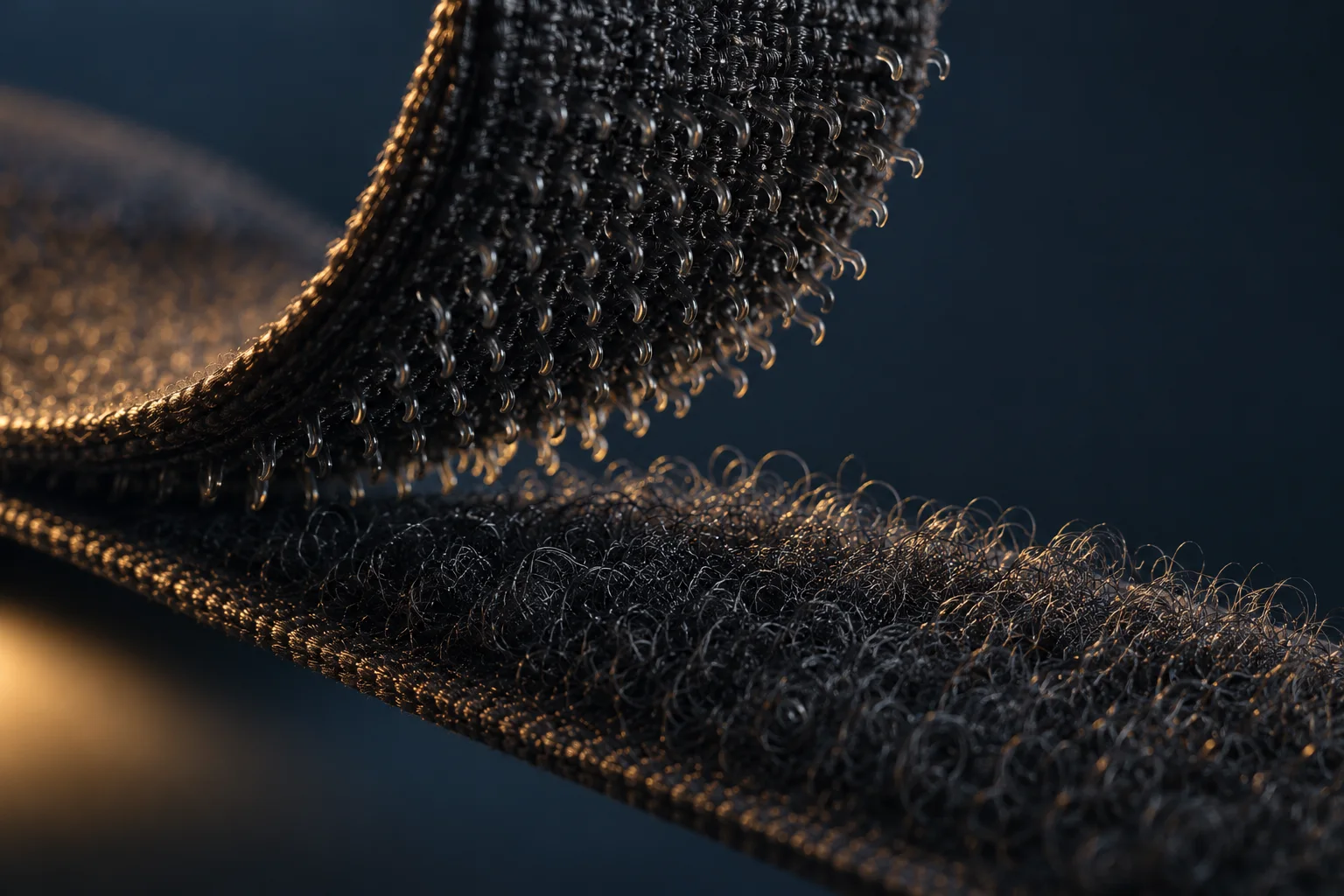
Open a fabric strap and the two faces do not feel alike. One is rough because it carries small, comparatively stiff hooks. The softer face presents loops that the hooks can enter. Their textures are the working parts, rather than a finish placed over a hidden latch. Press the faces together and some hooks find loops; separate them and those catches disengage.
Think about a single curved hook holding a loose thread. Now repeat the arrangement across a strip, with each catch much smaller than your fingertip. That mental picture is more useful than treating the closure as one uniformly sticky surface. There is no single central catch to locate, and the strips need not meet at exactly one prescribed position. The available overlap becomes the region in which connections can form.
Sources: Velcro Companies
Peeling gives the connections a moving exit
The familiar opening action starts at an edge. As the upper strip bends back, the separation front travels across the closure. Rows of catches release near that front rather than every engaged hook being pulled free at once. Velcro Companies describes this loading direction as peel. It is why a small tab at the edge can be a practical release handle.
Compare that with trying to move the joined strips sideways past each other. This is shear: the force runs broadly along their contacting faces. A direct pull away from the surface is tension. These words describe directions, not three different fastening materials. A closure can feel secure under the force it normally carries yet open conveniently when you change the direction of your hand. Any numerical strength still belongs to a particular product and test.
Sources: Velcro Companies
The fastening surface is only half the assembly
A hook strip also has to remain attached to the object beneath it. That attachment may be a seam or an adhesive backing. The manufacturer FAQ lists several ways to secure the textile to a product. None changes the basic act of hooks catching loops, but each introduces another place where the complete assembly can fail.
Picture a removable sign on a wall. The hook-and-loop faces might stay joined while the adhesive backing lifts from the wall. Or the backing might stay put while the faces peel apart. Both situations release the sign, but they are different failures. Looking at which surfaces have separated tells you more than calling the whole fastener weak. The same distinction applies to a sewn strap: the closure and the stitching are separate links in its load path.
Sources: Velcro Companies · 3M
Why overlap matters without guaranteeing a load rating
Many little catches explain the value of putting the faces together over a useful area. An almost-missed strap cannot use the hooks and loops that never meet. But that observation is not a formula for the weight it can carry. Hook profile, loop construction, material, direction of force and the way the strips attach all matter.
Manufacturer ranges include thin tapes, back-to-back straps and different hook constructions. The textile closure on a pocket is therefore not a miniature version of every industrial reclosable fastener. Some systems even use self-engaging shapes rather than a conventional hook face paired with a fuzzy loop face. Those constructions do not acquire the same strength simply because they look like a reclosable strip.
Sources: 3M · Velcro Companies
Lint occupies space meant for loops
Hooks are designed to catch fibres, so unwanted fibres can catch too. The manufacturer FAQ describes debris collecting in the hook face and recommends keeping the two faces engaged during washing to limit lint pickup. A hook occupied by stray material cannot meet the intended loop in the same way. That gives a concrete explanation for a closure whose surface looks furry on both sides.
Repeated opening also puts the working shapes through repeated deformation. Velcro Companies treats cycle life as a product property, measured by a specified loss of closure strength. That does not provide a universal lifetime for a shoe, bag or cable tie. Nor does every weak closure have the same cause. Debris, worn catches and failure of the backing are different possibilities; the useful first observation is which part has actually stopped doing its job.
Sources: Velcro Companies · Velcro Companies
A brand name became shorthand for a mechanism
VELCRO is a trademark. Hook-and-loop is the generic mechanism described here, including fasteners made by other companies. Keeping the distinction helps when reading a label: a brand name alone does not identify the hook geometry, backing or load rating. It also keeps us from attributing one manufacturer's details to an unmarked strap.
Next time you open one, follow the edge that is separating. Then look at the two textures and the attachment on their reverse sides. Those three observations connect the object to the drawing: catches meet across the overlap, peeling gives them a release front, and the textile must be anchored to something. The whole closure works because its small connections cooperate; your hand opens it by choosing a path through them.
Sources: Velcro Companies · 3M
Questions you might still have
Is hook-and-loop the same as VELCRO?
Hook-and-loop is a fastening mechanism. VELCRO is a brand that makes products using it; other manufacturers make hook-and-loop fasteners too.
Sources: Velcro Companies
Why is peeling different from pulling sideways?
Peeling releases catches progressively at a moving edge. A sideways pull loads the joined faces in shear, so the same closure responds to a different arrangement of forces.
Sources: Velcro Companies
Why does lint reduce the grip?
Debris catches in the hook face and occupies space where the hooks should engage the intended loops. Wear or a detached backing can cause separate problems.
Sources: Velcro Companies · Velcro Companies
The thing to remember
The direction of your pull changes how many catches resist together and how they disengage.
What this example leaves out
The figure shows a conventional hook-and-loop pair. It is not a load rating, a universal lifespan or an explanation of every mushroom-head or self-engaging fastener.
Sources & further reading
Source access dates are listed below. Manufacturer descriptions and patents support the specific constructions described, not every product.
- Hook and Loop 101 ↗
Velcro Companies · Retrieved 2026-10-14 · Distinct stiff hook and flexible loop faces; mechanical interlocking; materials and generic-versus-trademark distinction.
Manufacturer mechanism description. No universal strength or waterproofness claim. Single-hook analogy and inspection prompts are editorial explanations. - How do VELCRO Brand Fasteners Work? ↗
Velcro Companies · Retrieved 2026-10-14 · Peel, shear and tension loading definitions; progressive row release in peel; product-specific cycle life.
No numerical strength or lifetime generalized to household fasteners. Load-path explanation is qualitative. - 3M Hook and Loop Fasteners ↗
3M · Retrieved 2026-10-14 · Adhesive backs are separate from mating closure; available thin and back-to-back products; removable assemblies.
Specific 3M cycle-count and promotional performance claims omitted. Two-interface failure comparison is editorial analysis. - VELCRO Brand Frequently Asked Questions ↗
Velcro Companies · Retrieved 2026-10-14 · Attachment by sewing, adhesives and other manufacturing processes; nontraditional self-engaging designs; lint in hooks and engaging faces during washing.
Mechanism and manufacturer's qualitative maintenance context. No industrial adhesive application or solvent instructions reproduced.