Look a little closer
See the mechanism
A liquid changes into a chain-built solid
Read the diagram
Cyanoacrylate monomers link into polymer chains after moisture-associated initiation. The cured material forms a solid bond line between suitable close-fitting surfaces.
Conceptual before-and-after, not a chemical structural formula or manufacturing cutaway. Molecular shapes, layer widths and reaction timing are not represented. No accelerator or application instruction.
Diagram basis: ACS: glue chemistry; Henkel: cyanoacrylates.
Sources: American Chemical Society · Henkel / Loctite · Henkel / Loctite · Henkel / Loctite
The liquid becomes a different kind of material
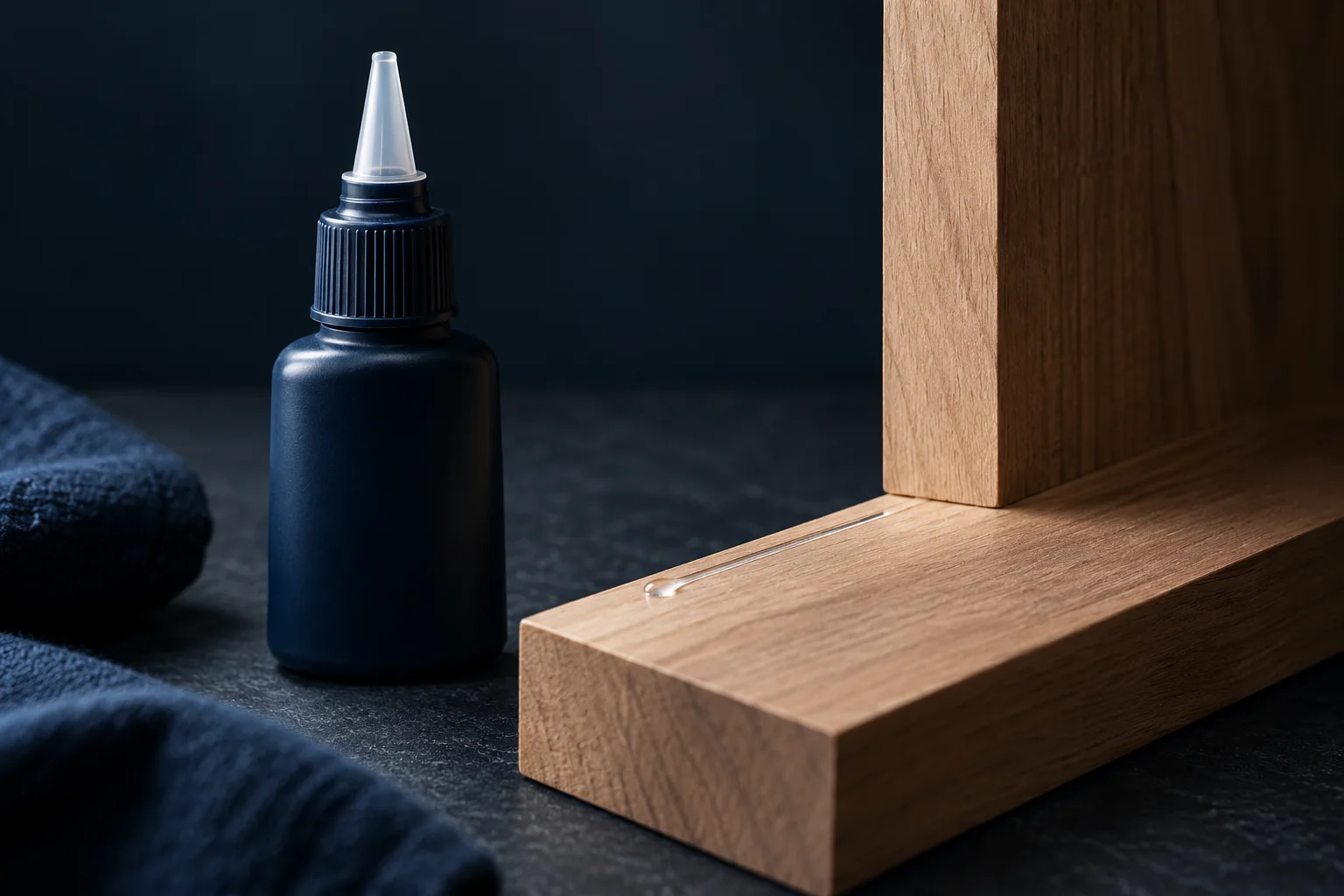
A bottle of super glue contains reactive molecules called cyanoacrylates. In the liquid, these small units have not yet become the long chains that form the solid adhesive. Curing links them together. A thin film that initially flows into a joint becomes a polymer capable of remaining between the joined pieces.
That change is different from a wet layer merely losing water or solvent. The main event is the growth of molecules, not the departure of a carrier liquid. It explains why describing every glue as something that dries can obscure its mechanism. Different adhesives reach a useful solid state by different routes. Here, the liquid contains much of what will become the connection itself, and the environment supplies a trigger for the reaction.
Sources: American Chemical Society · Henkel / Loctite
A surface can look dry and still supply moisture
The moisture involved is not necessarily a visible drop. Under ordinary conditions, surfaces exposed to humid air can carry a thin layer of water molecules. The ACS explanation identifies water, including the small amount of hydroxide associated with it, as a way to initiate cyanoacrylate polymerization. A surface that appears dry to your eyes can therefore be chemically different from a moisture-free environment.
Think of the reaction as a chain beginning to extend, rather than water filling the joint and turning into glue. The growing polymer is made from cyanoacrylate units. Moisture helps the process start; it does not supply the bulk of the solid bridge. This description is a molecular explanation, not an instruction to add water. Actual formulations and manufacturer directions govern how a product should be used.
Sources: American Chemical Society · Henkel / Loctite
The joint needs a bridge, not a large puddle
Henkel's bonding manual describes cyanoacrylates curing rapidly in a thin bond line between close-fitting surfaces. A bond line is simply the adhesive layer left in the joint. For a broken piece that fits neatly against its mate, that layer can connect two faces without having to behave like a large structural filler.
A wider gap changes the task. Now the adhesive must occupy and support a larger space, and a quick-setting liquid is not automatically the right material for it. The word super does not remove that geometric constraint. A generous-looking bead can be less informative than a careful look at how the parts meet. The mechanism depends on the adhesive reaching both faces and becoming a useful solid between them, not on how impressive the visible amount looks.
Sources: Henkel / Loctite · Henkel / Loctite
A fast set is not every property of a bond
A glue can hold parts in position quickly while still having product-specific limits. Initial set, later strength, resistance to movement and compatibility with the surfaces answer different questions. Henkel's manual describes conventional cyanoacrylates as forming rigid thermoplastics. That rigidity helps explain why the resulting connection should not be imagined as a flexible hinge.
The useful comparison is between the job and the material. Does the joint need to remain still, bend repeatedly, span a gap or tolerate a particular environment? An instant adhesive solves some combinations of those requirements, not all of them. Formulas differ in their ability to tolerate movement, temperature and moisture.
Sources: Henkel / Loctite · Henkel / Loctite
The bottle is designed to delay the same reaction
If moisture can start curing, why does the glue remain liquid in its container? The ACS account describes an acidic stabilizer that suppresses polymer-chain formation before use. Packaging also limits the adhesive's contact with its surroundings. A useful product needs both: chemistry that reacts when used and enough stability to wait on a shelf.
Gel and liquid labels concern another variable: how the uncured adhesive flows. Henkel describes gel formulations as resisting drips, including on vertical surfaces, whereas liquid products flow more readily. The distinction does not make gel a different fastening principle. Both can rely on cyanoacrylate curing. Additives and formulation choices make a reactive liquid manageable, but the exact ingredients cannot be inferred from a bottle's shape or from the word gel alone.
Sources: American Chemical Society · Henkel / Loctite
A cured adhesive still has to attach to the surfaces
Hardening and adhesion are related jobs, not identical ones. A solid piece of adhesive is useful only if it remains connected to the materials on either side. One Loctite liquid product, for example, specifically excludes polyethylene, polypropylene, PTFE and several other substrates from its stated bonding range. Those exclusions belong to that formula; they show why a broad household label is not evidence of universal compatibility.
When you read a repair description, separate three questions: what starts the cure, what material the adhesive becomes, and which surfaces the finished joint can connect. That sequence turns a seemingly magical drop into an understandable system. The small molecules form a solid bridge, but the bridge still needs the right geometry and two suitable banks.
Sources: Henkel / Loctite · Henkel / Loctite
Questions you might still have
Does super glue dry by evaporation?
Its main setting mechanism is polymerization: cyanoacrylate molecules join into long chains. Calling this curing distinguishes it from adhesives that primarily lose a solvent.
Sources: American Chemical Society · Henkel / Loctite
Why does it stay liquid in the bottle?
Stabilizers suppress premature polymer formation, and the packaging limits exposure. That stability allows a moisture-sensitive adhesive to remain usable before application.
Sources: American Chemical Society
Does super glue bond every plastic?
No. Compatibility depends on the formulation and plastic. Manufacturer exclusions for a liquid product include polyethylene, polypropylene and PTFE; check the specific product rather than assuming all plastics behave alike.
Sources: Henkel / Loctite
The thing to remember
Super glue's speed comes from reactive molecules; a successful joint also depends on its surfaces and geometry.
What this example leaves out
This is a mechanism explanation of common cyanoacrylate adhesives, not repair, medical or chemical-experiment guidance. Formulations have different substrate and performance limits.
Sources & further reading
Source access dates are listed below. Manufacturer descriptions and patents support the specific constructions described, not every product.
- Glues — ChemMatters, December 2006 ↗
American Chemical Society · Retrieved 2026-10-14 · Cyanoacrylate monomers polymerize after moisture-associated initiation; traces of surface moisture; acidic stabilizer in packaging.
Chemical mechanism only. Medical uses, removal methods, reaction demonstrations and numerical temperature claims omitted. Uses generic cyanoacrylate family rather than implying all formulas contain methyl cyanoacrylate. - Loctite Frequently Asked Questions ↗
Henkel / Loctite · Retrieved 2026-10-14 · Solvent-free cyanoacrylate resin; surface moisture triggers chain formation; liquid-versus-gel flow distinction.
Manufacturer description of its adhesive range. No application quantities, skin bonding, heating, solvent removal or accelerator guidance. - Bonding Manual 6.2.1 — Cyanoacrylates ↗
Henkel / Loctite · Retrieved 2026-10-14 · Rapid cure in thin bond lines; formation of rigid thermoplastics; manufacturing and packaging stability challenge.
Public introductory text read; gated remainder not used. No formulation-independent strength, cure time or performance rating. - Loctite Super Glue Liquid Professional ↗
Henkel / Loctite · Retrieved 2026-10-14 · Ethyl cyanoacrylate product for close-fitting repairs; specific excluded substrates including PE, PP and PTFE.
A single formula's exclusions illustrate compatibility limits, not a claim about every cyanoacrylate. Promotional superiority, medical uses and handling instructions omitted.