Look a little closer
See the mechanism
Paper, with space built in
Read the diagram
Two flat liners are bonded to the tips of a fluted paper sheet. The corrugated middle keeps the liners apart and connects them, so the layers act together as a board rather than as three loose sheets.
Illustrative cross-section, not to scale. A smooth sinusoid stands in for manufactured fluting; real profiles vary. Glue marks are enlarged. No dimensions, material grades or strength values are represented.
Diagram basis: FEFCO: production process.
Sources: FEFCO — European Federation of Corrugated Board Manufacturers · FEFCO — European Federation of Corrugated Board Manufacturers · FEFCO — European Federation of Corrugated Board Manufacturers
Read the edge, not the surface
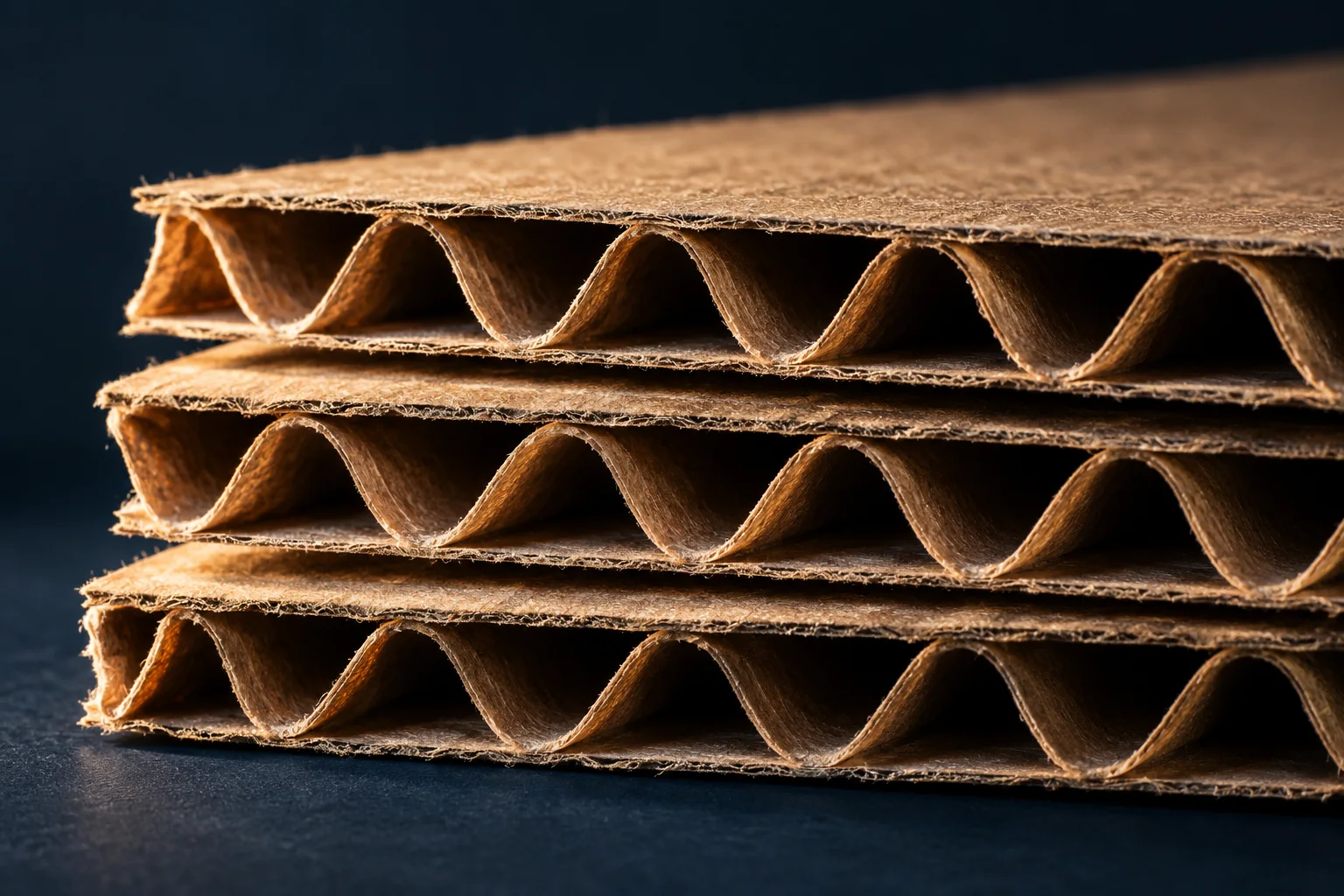
A box's smooth face hides its most distinctive feature. At an exposed edge, single-wall corrugated board has two flat liners and a corrugated medium between them. FEFCO describes these layers as being joined with starch glue. The spaces between the waves are real gaps, rather than a printed pattern.
The naming can be confusing. Single wall means one corrugated layer between two liners, not one sheet of paper. Single-face board has only one liner attached to its fluting. Double-wall and triple-wall constructions add further corrugated layers; they are different structures, not just different box sizes.
Sources: FEFCO — European Federation of Corrugated Board Manufacturers
The waves are supports
FEFCO compares the fluted structure to connected arches and attributes the board's rigidity and resistance to that construction. Each repeating wave connects to a liner at its tips, creating a supported layered panel rather than a loose stack of sheets.
For a mental picture, compare three sheets lying together with sheets arranged around a supported gap. The second arrangement uses depth as well as paper. This is a qualitative explanation of the geometry, not a promise that every thicker board is stronger. To compare actual boxes, their materials and construction would also have to be specified.
Sources: FEFCO — European Federation of Corrugated Board Manufacturers
How paper gets that shape
A corrugator brings rolls of liner paper and medium together. Heated, grooved metal rolls press the medium into its fluted profile. Starch adhesive at the flute tips connects it to the liners. The machine produces a continuous board that can then be cut to size.
Making the panel and making the box are separate stages. FEFCO calls the later transformation converting: printing, cutting, creasing, folding and joining turn the flat board into packaging. A crease deliberately creates a fold line in a panel whose wider faces are meant to remain useful structural surfaces.
Sources: FEFCO — European Federation of Corrugated Board Manufacturers
What an old box can show you
Use an already exposed edge to identify the liners, waves and gaps. Then compare that edge with a fold. You are looking at the same material used in two different ways: a panel and a hinge-like crease. No load experiment is needed to recognize the distinction.
Count corrugated layers before judging by thickness alone. A cereal carton with no fluted middle is not this structure. Nor does an editorial drawing tell you a box's carrying capacity. The diagram isolates the arrangement so you can identify it; a shipping specification has a different task.
Sources: FEFCO — European Federation of Corrugated Board Manufacturers
The thing to remember
The useful feature is a bonded structure with depth, not simply a large amount of paper.
What this example leaves out
The schematic shows single-wall board without an exact flute grade or scale. It supplies no stacking-load rating, humidity performance or drop-test result. Real packaging needs a specification appropriate to its contents and handling.
Sources & further reading
Source access dates are listed below. Manufacturer descriptions and patents support the specific constructions described, not every product.
- What is Corrugated? ↗
FEFCO — European Federation of Corrugated Board Manufacturers · Retrieved 2026-10-14 · Two liners with a fluted medium; starch bonding; single-face, single-wall, double-wall and triple-wall distinctions.
Industry body's structural definition. No numerical strength, environmental superiority or insulation guarantee is used. - Product protection ↗
FEFCO — European Federation of Corrugated Board Manufacturers · Retrieved 2026-10-14 · Connected-arches explanation of fluted structure and rigidity; different flute sizes and profiles produce different characteristics.
Qualitative structural explanation only. Manufacturer-industry promotional absolutes, transport share and freshness claims omitted. The loose-sheets comparison is an editorial mental model, not a reported laboratory test. - Production process — The Corrugator and Converting ↗
FEFCO — European Federation of Corrugated Board Manufacturers · Retrieved 2026-10-14 · Heated grooved rolls shape the medium; adhesive at flute tips; continuous board production and later printing, cutting, creasing, folding and joining.
Manufacturing sequence, without plant-specific machinery dimensions or box performance claims. Suggested edge and crease observation has not been run as a reader test.