Look a little closer
See the mechanism
Deformation changes the stopping pathway
Read the diagram
Inflated cells provide thickness that can deform as an object slows. Extending the stopping interval can reduce average force for a given momentum change. Empty or fully collapsed cells have less working travel.
Conceptual states, not a drop test. The compressed cells are not promised to recover fully, and no force curve, drop height or material rating is represented. The rest of the package matters.
Diagram basis: OpenStax: impulse; Sealed Air: cushioning thickness.
Sources: Sealed Air · Sealed Air · OpenStax, Rice University · The Metropolitan Museum of Art
The useful material is a structure of film and air
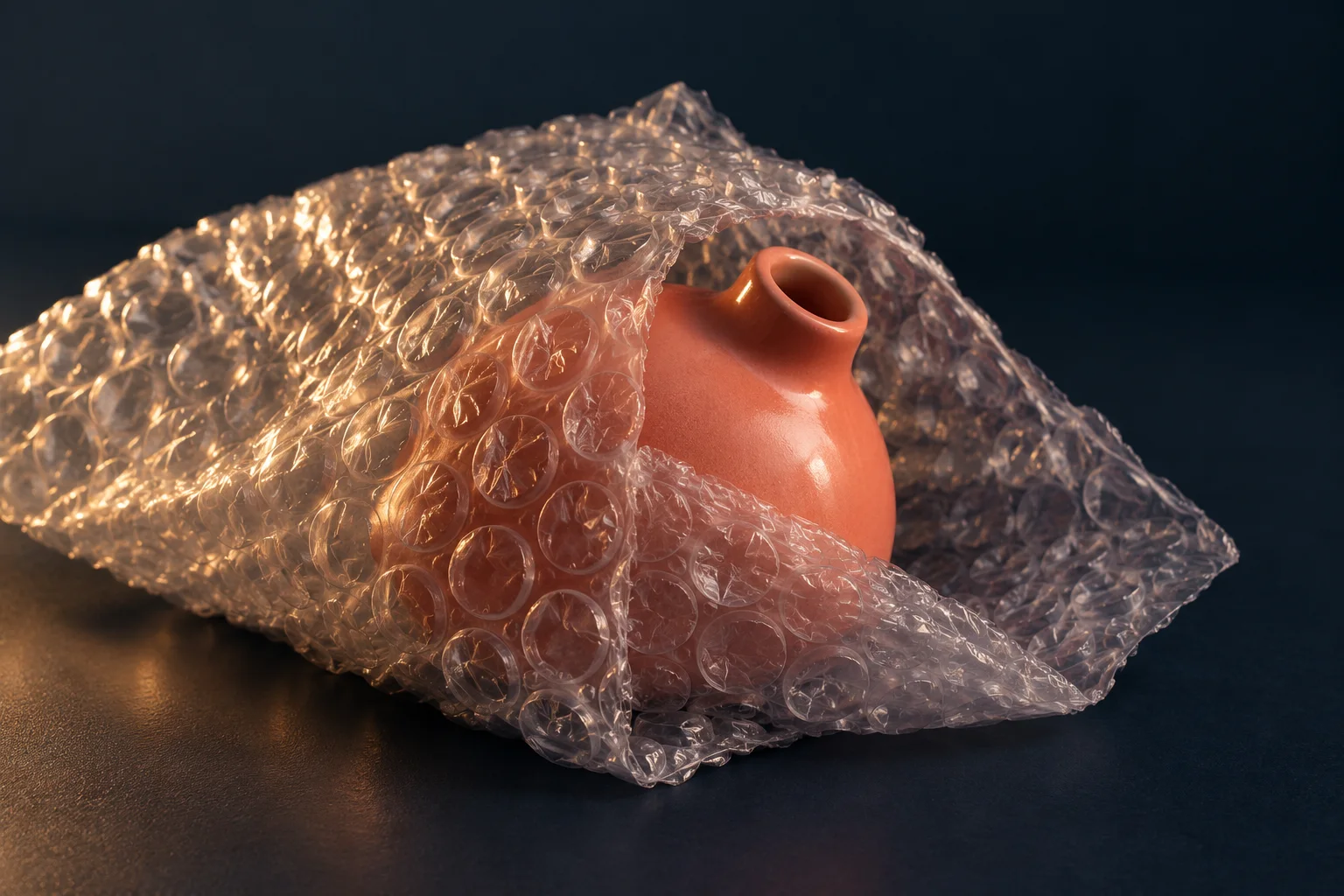
A flat plastic film and a sheet of air-filled cells are very different cushions. The film encloses pockets that give the packaging thickness and room to deform. The Metropolitan Museum of Art's handling glossary describes bubble cushioning as fused flexible plastic layers incorporating air pockets. Sealed Air offers several formats and cell sizes because the structure matters alongside the plastic itself.
The brand BUBBLE WRAP belongs to Sealed Air; bubble cushioning is the broader material class explained here. The manufacturer's portfolio also includes air pillows and other packaging, so a brand page is not evidence that every product has independent round bubbles. An air cell combines flexible enclosing film with an air volume; it is not a solid rubber ball.
Sources: The Metropolitan Museum of Art · Sealed Air · Sealed Air
The object still has to lose its momentum
When a moving object comes to rest, its momentum changes. Physics connects that change with the net force acting over time: impulse equals momentum change. OpenStax explains why padding can reduce the force of a sudden stop by increasing the time over which the same momentum change happens.
Apply that idea to a package. A hard contact gives little room for the object to slow down. A deformable layer can provide additional travel before the stop is complete. The diagram compares those pathways without assigning either a measured drop height or a force reduction. A longer stopping interval can lower average force for the same momentum change; it does not erase the energy or guarantee that every instant of the impact has the same force. Average force and the detailed peak-force history are different descriptions.
Sources: OpenStax, Rice University
The cells must have space left to deform
An inflated cell changes shape under load, and the air and surrounding film resist that change. The available thickness gives the structure room to respond before the object meets a much less forgiving boundary. A flattened or empty cell has less of that working geometry left.
This is why air retention appears in Sealed Air's cushioning descriptions. The manufacturer's brochure links retained cushioning thickness with repeated handling and impact performance. A collapsed cell has less travel available. Recovery depends on the material and impact, and a popped sheet can still serve as a separator even after losing useful cushioning thickness. Its cushioning job has changed.
Sources: Sealed Air · Sealed Air
Bubble size is a packaging choice, not a universal ranking
Small and large cells give different structures and thicknesses. The manufacturer's ranges connect different formats with surface protection, cushioning and other tasks. A thicker-looking sheet is not automatically the best packaging for every object, because the object, load and available box space also change the problem.
Consider the distinction between protecting a surface from contact and managing a substantial shock. Both can involve a layer placed between objects, but the required deformation and coverage differ. The useful questions are where the object can move, what lies in its path, and whether the material has enough working thickness at the relevant contacts. Choosing a package requires more information than selecting the most visually impressive air cells.
Sources: Sealed Air · Sealed Air
A cushion works within an arrangement
A protective layer cannot intercept a contact that bypasses it. If an object can shift until a vulnerable part touches a hard surface, the nearby presence of bubble cushioning does not automatically protect that part.
Museum handling guidance distinguishes padding, stabilization, interleaving and surface protection. That vocabulary helps separate tasks often bundled into the word packing. Keeping objects from moving into one another, giving them room to slow down and preventing sensitive finishes from rubbing against plastic are related requirements with different solutions. The best explanatory picture follows the actual path of the object through the package. A decorative layer visible when a box opens tells you less than the material positioned where an impact or unwanted contact would occur.
Sources: The Metropolitan Museum of Art · OpenStax, Rice University
Cushioning does not answer every preservation question
Bubble material can protect against a mechanical event yet be unsuitable for direct contact with a sensitive surface. The Metropolitan Museum of Art warns that plastic bubble cushioning placed directly against artworks can cause problems including sticking or marring and describes separating layers. This is an important counterexample to the idea that softer packaging must always be gentler in every sense.
We therefore make no blanket recommendation for artwork, electronics or an unidentified fragile object. Nor do we turn a cushioning mechanism into a recycling claim; those depend on the specific film and local collection system. The physical explanation is narrower and more dependable: cells provide a deformable structure that can change the stopping pathway. Retained air, contact location and available space keep that structure useful. Popping a bubble is satisfying precisely because it destroys the pressure pocket whose geometry gave the sheet its cushioning role.
Sources: The Metropolitan Museum of Art · Sealed Air
Questions you might still have
Does bubble cushioning eliminate impact energy?
No. It changes how the object slows down through deformation and a longer stopping path. Protection is limited by the material and package arrangement.
Sources: OpenStax, Rice University · Sealed Air
Why are popped bubbles less useful?
A popped cell loses its enclosed air volume and much of its working thickness. It has less room and resistance available for the cushioning job.
Sources: Sealed Air
Can bubble cushioning touch every fragile surface?
No. Museum guidance warns against direct contact with vulnerable artworks, because plastic can stick, mar or imprint their surfaces. Cushioning and surface compatibility are different requirements.
Sources: The Metropolitan Museum of Art
The thing to remember
A cushion reduces the harshness of a stop by providing controlled deformation where contact actually occurs.
What this example leaves out
This is qualitative impact physics, not a drop-test result or shipping specification. Cell recovery, film behaviour, object mass and packaging geometry vary; sensitive surfaces need separate consideration.
Sources & further reading
Source access dates are listed below. Manufacturer descriptions and patents support the specific constructions described, not every product.
- BUBBLE WRAP Brand Packaging Solutions ↗
Sealed Air · Retrieved 2026-10-14 · Brand versus broader air-cell cushioning; several cell formats and sizes; protection across packaging tasks.
No market size, historical anecdote, sustainability benefit or promotional damage reduction imported. - The Original — Bubble Wrap Brand Cushioning Brochure ↗
Sealed Air · Retrieved 2026-10-14 · Retained air and working cushioning thickness; deformation/recovery across handling; differentiated small/medium/large cells and surface-protection tasks.
Substantive brochure text read through indexed source extraction; direct PDF open failed. Manufacturer comparative percentages and figures not reproduced or generalized. - College Physics 8.2 — Impulse ↗
OpenStax, Rice University · Retrieved 2026-10-14 · Impulse equals change in momentum; extending stopping time reduces average net force for the same change; padding example.
General physics applied editorially to air-cell packaging; no reported bubble-wrap test, peak-force curve or numerical benefit. - The Care and Handling of Art Objects — Practices in The Metropolitan Museum of Art, 2019 ↗
The Metropolitan Museum of Art · Retrieved 2026-10-14 · Glossary p.197: fused flexible plastic layers enclosing air; distinct padding/interleaving roles; direct contact can stick, mar or imprint vulnerable artworks.
Conservation boundary case supports distinction between shock cushioning and surface compatibility. Not a general packing tutorial or bubble-orientation prescription.