Look a little closer
See the mechanism
Compressed faces, tensile centre
Read the diagram
Rapid surface cooling leaves compressed outer regions and a tensile interior. At a surface flaw, compression opposes crack opening. Once failure defeats the stress pattern, release of stored stress drives extensive fragmentation. The separated polygon symbols represent that result without predicting the shape of any real fragment.
Qualitative final stress pattern and conceptual insets, not a thermal snapshot, exact crack-tip analysis or measured stress profile. Regions are enlarged, opposing arrows are alternative tendencies rather than a calculated equilibrium, and fragment shapes are illustrative. No load rating, break force or claim of harmless fragments.
Diagram basis: Pilkington: strengthening; Vitro: heat-treated glass.
Sources: Pilkington · Vitro Architectural Glass · Pilkington North America · Pilkington
The process changes stress inside the glass
Tempering does not require a pane to become a visibly different material. Its important change is a pattern of residual stress left inside it. The surfaces are held in compression, balanced by tension in the interior. Residual means that this stress pattern remains after the manufacturing process has finished and the pane has cooled.
Compression tends to press material together; tension tends to pull it apart. These are internal conditions rather than hands squeezing and stretching the finished pane. The actual stress profile depends on the glass and manufacturing process. The useful feature is the balance: the compressed faces and tensile core are parts of one manufactured object.
Sources: Pilkington · Vitro Architectural Glass
The outside and centre cool on different schedules
In thermal tempering, a hot pane is quenched with air so that the surfaces cool rapidly while the interior remains warmer for longer. Pilkington's technical sheet describes this sequence and the final surface-compression and core-tension arrangement. Cooling history matters because a thick object does not change temperature everywhere at once.
The important moment is not merely a cold surface surrounding a hot centre. That temporary temperature difference leads to a final stress balance as the whole pane reaches its cooled condition. Reading the process in stages prevents the misleading idea that tempered glass stays strong because its centre is permanently warm. The finished pane can be at room temperature while preserving the consequences of how it cooled. Residual stress and cooling airflow are different parts of the explanation.
Sources: Pilkington
A surface crack has compression to overcome
Glass failure is strongly affected by flaws and crack growth. A compressed surface makes it harder for a surface crack to open under an applied tensile effect. This is the reason for introducing surface compression, rather than assuming heating removes every possible defect from the glass.
Pilkington describes the process as raising the loads glass can bear. Vitro distinguishes different heat-treatment levels by their resulting surface compression. These accounts support a strength mechanism, not an assertion that a tempered pane cannot break. A point impact, edge flaw or unsuitable loading can still defeat it. The schematic compares a crack-opening direction with the opposing compressive condition at a face. It is a conceptual force picture, not a prediction of the force needed to break a specific table, door or enclosure.
Sources: Pilkington · Vitro Architectural Glass · Pilkington North America
The stored stress also changes the break
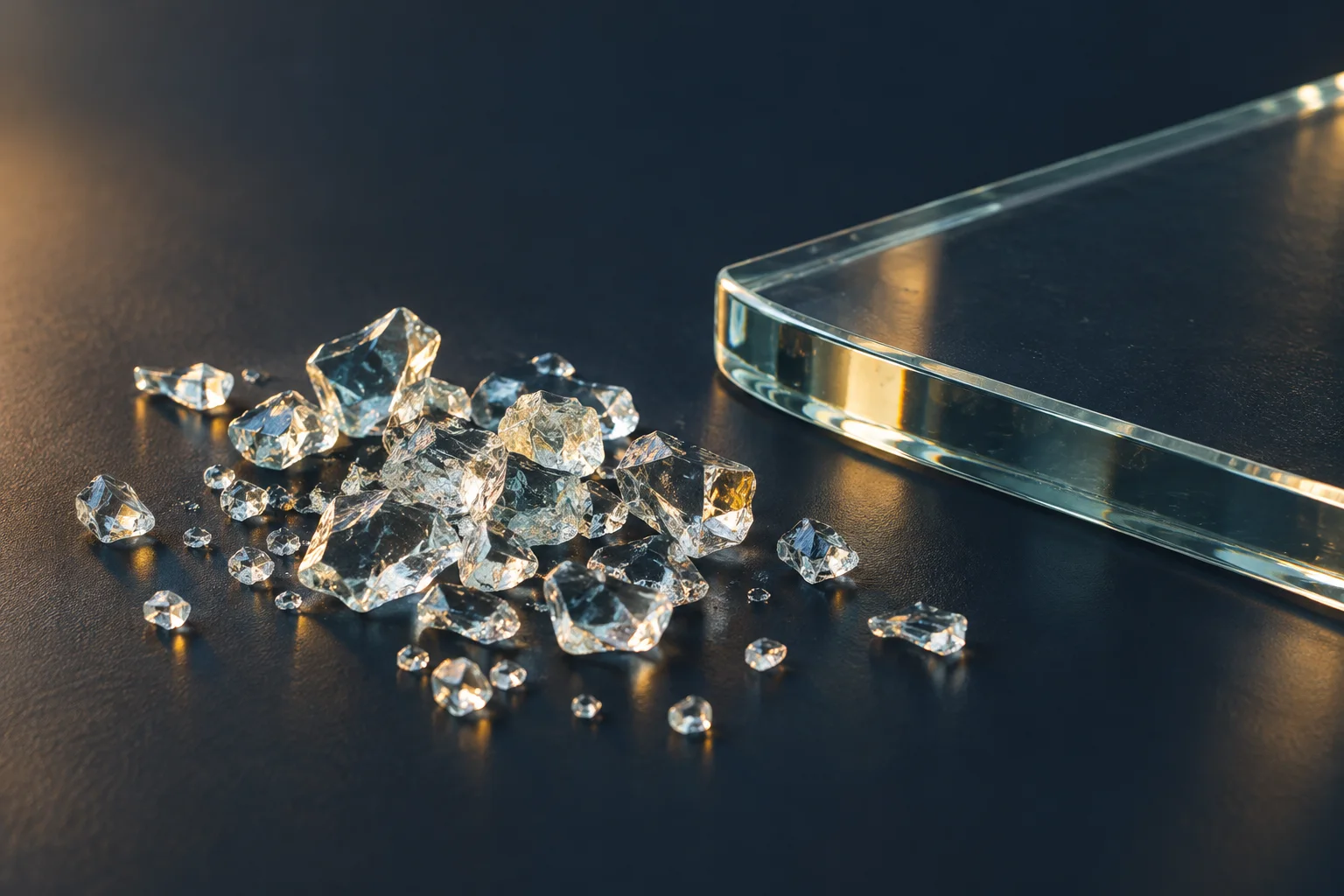
The tensile interior is the other half of tempering. Once a break develops through the stress pattern, the pane releases stored elastic energy and fragments extensively. Pilkington connects tensile core stress with many small pieces, and Vitro describes the characteristic small-piece fracture of fully tempered safety glass.
This is a trade built into the material rather than two unrelated claims: surface compression helps resist a crack, while the balanced internal stress changes what happens after failure. The resulting pieces should not be called harmless. A different fracture pattern can reduce particular cutting and piercing hazards compared with large annealed shards, but broken glass remains broken glass. The fragment inset is schematic: real pieces need not have identical shapes.
Sources: Pilkington · Vitro Architectural Glass
The edges remain part of the design
A pane is not just two broad faces. Its perimeter, holes and contact points affect how stress and defects are arranged. Pilkington's glazing guidance warns that chips and impacts at an edge can become origins of later breakage. It also states that finished tempered glass should not be modified by further cutting, seaming or grinding.
That guidance makes the manufacturing sequence easier to understand. An object's outline and required openings are part of its specification, not details freely added after strengthening. A cut that changes the stress-bearing object is different from trimming a sheet of an unstressed material. The lesson here is descriptive, not a fabrication tutorial: the final geometry and the final stress condition must work together. A visibly intact face does not tell you the condition of the edges hidden in a frame.
Sources: Pilkington North America
Tempered and laminated describe different strategies
Tempering changes a pane's stress pattern. Laminating uses layers joined with an interlayer, which can help retain broken glass. Vitro notes that fully tempered fragments are more likely to leave an opening after failure and recommends considering laminated arrangements where retaining the glass is important. Resistance before breakage and retention afterward are separate requirements.
Heat-strengthened glass is another distinction: it has less surface compression than fully tempered glass and a different fracture behaviour. Chemical strengthening can create surface compression through ion exchange rather than the air-quenching sequence illustrated here. These terms should not be collapsed into stronger glass. Each names a process or assembly with particular consequences. To understand a pane, identify which job its design addresses: resisting a crack, changing the fragments, retaining them, or combining more than one of those jobs.
Sources: Vitro Architectural Glass · Pilkington · Pilkington
Questions you might still have
Is tempered glass unbreakable?
No. Surface compression helps resist crack opening, but damage or sufficient loading can still cause failure. Tempering also changes the fracture pattern.
Sources: Pilkington · Vitro Architectural Glass
Why does it break into small pieces?
The tensile core balances compressed surfaces. When failure defeats that arrangement, release of stored stress leads to extensive fragmentation.
Sources: Pilkington
Is tempered glass the same as laminated glass?
No. Tempering creates residual stresses in a pane; lamination joins layers with an interlayer that can retain fragments. An assembly can combine these strategies.
Sources: Vitro Architectural Glass · Pilkington
The thing to remember
Tempering uses the same stored stress pattern both to resist surface cracks and to change how the pane fragments.
What this example leaves out
The diagram shows thermal tempering qualitatively, not exact stress or breakage measurements. It is not glazing, fabrication or safety-specification advice; chemical strengthening and laminated assemblies differ.
Sources & further reading
Source access dates are listed below. Manufacturer descriptions and patents support the specific constructions described, not every product.
- Technology Datasheet 6 — Shaping and Strengthening ↗
Pilkington · Retrieved 2026-10-14 · Heating/air quench with faster surface cooling; final surface compression balanced by core tension; fragmentation; chemical strengthening by ion exchange differs.
Qualitative process only. No home fabrication, breaking experiment, exact thermal recipe or strength multiplier; small fragments not described as harmless. - Heat-Treated Glass Processes ↗
Vitro Architectural Glass · Retrieved 2026-10-14 · Heat-strengthened versus fully tempered processes; surface compression; small-piece fracture; laminated alternative where fragment retention matters.
No building-code guidance or universal breakage guarantee. Does not repeat source's sweeping claim that fragments cannot injure; quantitative stress thresholds omitted. - ATS-192 — General Glazing Guidelines ↗
Pilkington North America · Retrieved 2026-10-14 · Edge chips/impacts can originate later breakage; finished tempered glass not modified by cutting, seaming or grinding.
Edge role and process-order explanation only. No fabrication or installation tutorial, lifting method, diagnosis or glazing specification. - Pilkington Optilam — Laminated Glass ↗
Pilkington · Retrieved 2026-10-14 · Two or more glass panes bonded by interlayer; fragments typically adhere after fracture; lamination distinct from heat tempering.
Example laminated product supports strategy distinction, not blanket safety or compatibility claim for every assembly.