Look a little closer
See the mechanism
Transmission can preserve or blur an image
Read the diagram
Clear glass absorbs little visible light and scatters little of it, allowing a directional image to pass. Surface reflection remains possible. A roughened surface can transmit illumination while scattering the paths that form a sharp image.
Qualitative optical paths. Ray widths, transmitted fractions, surface roughness and scattering angles are not measured. Normal-incidence paths are shown; the drawing does not calculate refraction or UV transmission.
Diagram basis: University of Illinois: transparency; West Texas A&M: reflection and transmission.
Sources: University of Illinois, Physics Van · Pennsylvania State University, Materials In Today's World · Christopher S. Baird, West Texas A&M University · The Open University, OpenLearn
Getting light through is only part of seeing through
A window must allow light from an object to reach your eyes while preserving useful information about its direction. Two processes can interfere with that job. Absorption transfers light's energy into the material. Scattering sends light in different directions. A material can allow substantial light through and still prevent you from seeing a clear image if it scatters that light on the way.
This distinction separates transparent from merely light-transmitting. A clear pane shows the objects behind it. A frosted pane can brighten a room while blurring those objects. The difference is not necessarily that one admits light and the other blocks it completely. The paths matter. Preserving the light’s paths preserves the image.
Sources: Christopher S. Baird, West Texas A&M University · The Open University, OpenLearn
Visible light is a poor match for many absorption routes in clear glass
Light can interact with a material's electrons, but absorption requires suitable ways for the material to take up the light's energy. Penn State's materials lesson explains the lack of accessible electronic transitions that would strongly absorb visible light in the clear-glass example. Visible light therefore passes through without most of its energy being consumed along the route.
That is a more useful explanation than saying light slips through the empty space between atoms. Plenty of opaque materials also contain atoms, and those atoms are also largely empty space in the elementary picture. Their response to an electromagnetic wave differs. Transparency concerns that response, not how many literal holes could be drawn between little atomic balls. Glass can still change light's speed and direction even when it does not absorb it strongly. Passing through is an interaction too.
Sources: Pennsylvania State University, Materials In Today's World · Christopher S. Baird, West Texas A&M University
An irregular atomic arrangement can be optically uniform
Ordinary glass is amorphous: its atoms do not form the long-range repeating arrangement of a crystal. Yet disorder at the atomic scale does not mean that visible light encounters large, sharply different optical regions at every step. The University of Illinois explanation emphasizes a refractive index that is sufficiently uniform over distances relevant to the wavelength of light.
The important scale changes the intuition. A close-up drawing of irregularly placed atoms can look messy to us while describing a material that is optically smooth for visible light. Conversely, many small boundaries or pores at a relevant scale can scatter light. Amorphous structure alone is not a universal recipe for transparency. Clear crystals also exist, including quartz, and the Illinois account explicitly uses them as a comparison. Both absorption and scattering still need to be considered.
Sources: University of Illinois, Physics Van
A pile of sand contains many optical boundaries
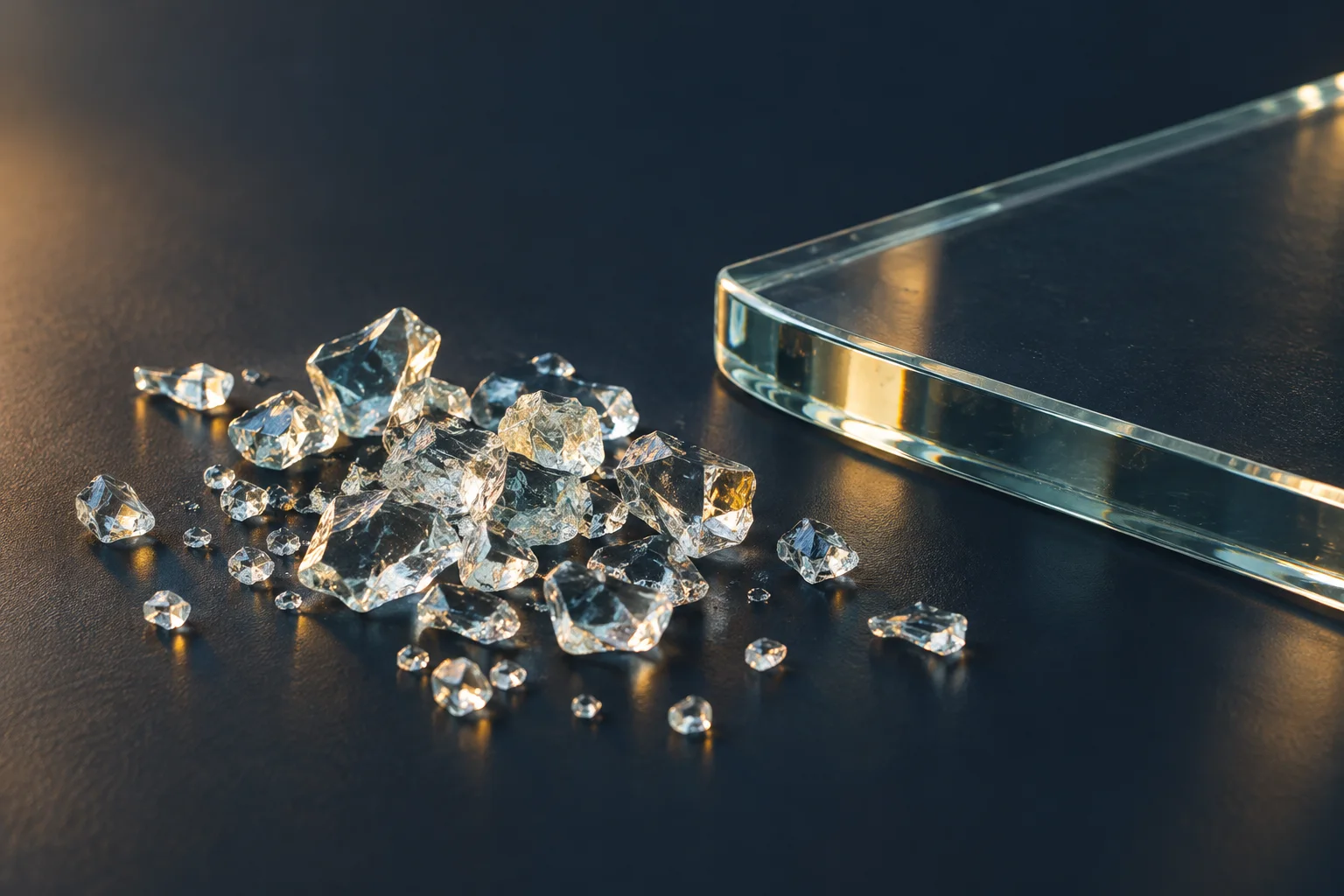
Quartz-rich sand and a pane of glass can share silicon dioxide as an important ingredient while looking completely different. The sand is a collection of grains, with surfaces, gaps and differing orientations. Light meets many changes along its path. Heating and processing the material into a continuous glass object changes that structure.
Penn State's lesson distinguishes the scattering associated with grains and defects from the comparatively uniform surface and body of glass. The lesson here is not that heating removes the need to explain absorption. It is that chemistry and structure answer different parts of the question. Two objects can contain similar chemical ingredients yet organize them into very different optical paths. The pile and the pane make that distinction visible without requiring the reader to imagine sand as naturally coloured glass broken into tiny, identical windows.
Sources: Pennsylvania State University, Materials In Today's World · University of Illinois, Physics Van
Transparency does not make a window invisible
A transparent pane can reflect the room behind you while transmitting the scene outside. These are compatible outcomes. West Texas A&M physicist Christopher Baird explains that even smooth, pure glass reflects some incident light at its surfaces. Reflection is not proof that the pane contains dirt, scratches or a hidden reflective coating.
The interface between air and glass changes the optical conditions. Light can divide into reflected and transmitted parts there, while the transmitted part is refracted. A window often makes the reflected view easier to notice when one side is much brighter than the other, but that visibility does not mean the glass suddenly acquired a different substance. The incident light need not all travel through unchanged.
Always finish the question: transparent to what?
Visible light is one part of the electromagnetic spectrum. A glass that transmits it well need not transmit ultraviolet or infrared in the same way. Its composition determines which wavelengths are absorbed. Added constituents can also absorb selected visible wavelengths and give glass a colour. The University of Illinois account distinguishes glass that absorbs selected frequencies from glass that transmits them.
So clear is a description of a particular optical task, not a guarantee that a material does nothing to every kind of light. When looking at a pane, ask three separate questions: how much light is absorbed, how much is redirected at surfaces, and whether the transmitted light retains a clear directional pattern. That approach explains a clear window, its reflection and a frosted panel within the same framework. It also keeps an everyday observation from turning into an unsupported claim about UV protection or specialized optical performance.
Sources: University of Illinois, Physics Van · The Open University, OpenLearn · Christopher S. Baird, West Texas A&M University
Questions you might still have
Is glass transparent because atoms are mostly empty space?
That does not explain why other solids are opaque. The material's electromagnetic response, absorption routes and optical uniformity determine what happens to the light.
Sources: Pennsylvania State University, Materials In Today's World · University of Illinois, Physics Van
Why does frosted glass let light through but hide an image?
Its roughened surface scatters transmitted light into different directions. Light reaches the far side, but the original directional pattern is blurred.
Sources: The Open University, OpenLearn · Christopher S. Baird, West Texas A&M University
Can a transparent window still reflect?
Yes. Reflection and transmission can occur together at a glass surface. Even very pure, smooth transparent glass reflects part of the incoming light.
The thing to remember
Clear glass preserves visible light's path well enough to carry an image, even while reflecting and refracting part of it.
What this example leaves out
The ray diagram is qualitative and only illustrates visible-light behaviour. Glass composition, wavelength, thickness and surface treatments change optical performance. It is not a UV-protection specification.
Sources & further reading
Source access dates are listed below. Manufacturer descriptions and patents support the specific constructions described, not every product.
- Why is Glass Transparent? ↗
University of Illinois, Physics Van · Retrieved 2026-10-14 · Limited scattering when refractive index is uniform at relevant length scales; some reflection; coloured glass absorption; transparent crystals refute amorphous-only explanation.
Qualitative optics, not all glass types or optical transmission measurements. Explicitly avoids suggesting empty atomic space or amorphousness alone is sufficient. - Why is Glass Transparent? — MATSE 81 ↗
Pennsylvania State University, Materials In Today's World · Retrieved 2026-10-14 · Visible absorption depends on electronic transitions; glass/sand structure and grain scattering comparison; silica and common glass constituents.
Uses electronic-energy and scattering concepts, not an absolute claim that only amorphous solids transmit light. No copied stadium analogy or instructional images. - How can glass produce glare without reflecting light? ↗
Christopher S. Baird, West Texas A&M University · Retrieved 2026-10-14 · Reflection, absorption and transmission are distinct; smooth transparent glass still reflects; refraction accompanies transmission; scattering distinguishes translucent transmission.
No reflectance percentages, measurement claim or special-angle derivation imported. Diagram ray widths are qualitative. - Manufacturing 7.8.3 — Scattering ↗
The Open University, OpenLearn · Retrieved 2026-10-14 · Rough surfaces scatter rays in different directions; frosted glass uses this principle; polished surfaces limit scattering.
Qualitative surface-scattering explanation, not spectral transmission or measured angular distribution. No manufacturing procedure reproduced.