Look a little closer
See the mechanism
Retention outside, sealing contact at the mouth
Read the diagram
The two highlighted points are sections through one circular rim contact. Threads hold the cap in position; the liner closes the opening at the rim.
Generic contact liner, not a diagram of induction bonding, a bore seal or a vented closure. Material, compression and thread profiles are symbolic.
Diagram basis: Selig: sealing contact; BERICAP: liner choices.
Sources: Selig Group · BERICAP · BERICAP · Selig Group
The cap must stay on and stop a leak
Turn a screw cap and you feel the thread taking hold. It is tempting to conclude that the winding thread is also the seal. In a lined closure, however, the thread's essential job is to keep the cap pressed against the bottle. The liner meets a sealing surface near the mouth. That contact creates a barrier across the route the contents would otherwise take out of the opening.
A useful comparison is a door held against a weather strip. The latch holds the door in position, while the strip addresses the gap. The comparison explains the division of work, not the material or exact sealing performance of a bottle. A threaded connection can be secure while a damaged or unsuitable contact seal still leaks. Holding and sealing are connected tasks, but they are not interchangeable.
Sources: Selig Group
Why a soft contact layer can matter
A bottle mouth and a cap are manufactured parts, rather than perfect mathematical surfaces. The rim has a definite sealing area, sometimes called the land. Selig's troubleshooting guide identifies uneven land surfaces, an excessively rigid liner and insufficient cap application torque among possible contributors to poor seals. The relevant question is whether the closure applies suitable, consistent contact where the package needs it.
The liner spans the mouth and touches the rim around it. Its central area covers the opening, but the circular contact at the rim completes the boundary. An interruption in that ring can create an escape path even when most of the liner looks intact.
Sources: Selig Group
A white disc does not identify a material
Liners can have different constructions because packages ask them to do different things. BERICAP lists several liner choices for its aluminum wine closures. That range is a reason to avoid calling every cap insert rubber, plastic foam or one particular polymer simply from its color. A package's design specifies the material; appearance is not a reliable chemical test.
The chosen seal may have to suit the contents, bottle finish and storage requirements together. A still drink and a carbonated package do not necessarily ask the same thing of a closure. Nor does a wine bottle's liner establish what is inside a water-bottle cap. The visible similarity is useful for recognizing a sealing component, but it is not evidence of identical barrier properties or interchangeability.
Sources: BERICAP
The peel-off membrane can be a different seal
Some packages combine a cap with a membrane sealed onto the bottle mouth. Selig's induction-seal troubleshooting describes the interaction among that liner's sealing face, the container, applied cap pressure and the sealing process. Those details concern establishing a bond at packaging time. They are not the same as simply squeezing a reusable contact liner against a rim every time the cap closes.
Separate the questions: what protected the package before its first opening, and what closes it afterward? Removing a bonded membrane changes the first-opening seal. Replacing the cap may still provide a reclosure function, depending on the design, without recreating the factory bond. Calling both components a liner can hide that difference. Identify where each part stays when the package is first opened.
Sources: Selig Group · BERICAP
A cap without a loose disc can still have a seal
A separate insert is one way to create sealing contact, not a universal requirement. BERICAP's Clean Cap 23, a beverage-carton closure, specifies a bore seal: the closure uses a shaped contact with the spout to provide reclosure. The example demonstrates the alternative principle without pretending that a carton spout is the same product as every bottled-water neck.
Look for geometry as well as separate pieces. An integrated sealing feature can be molded into the closure itself. The absence of a removable disc therefore does not establish that a cap is missing a part. A tamper-evidence band is another separate feature; its broken bridges can reveal first opening while the sealing feature continues to serve reclosure. The outside ring and the inside seal answer different questions.
Sources: BERICAP
Some packages deliberately control gas movement
A seal need not mean identical behavior for every liquid and every gas. Selig makes specialized vented liners and direct closure vents for compatible applications. These designs allow controlled gas exchange while managing leakage. They are engineered exceptions, rather than a reason to assume that an ordinary soft-drink cap is meant to let carbonation escape.
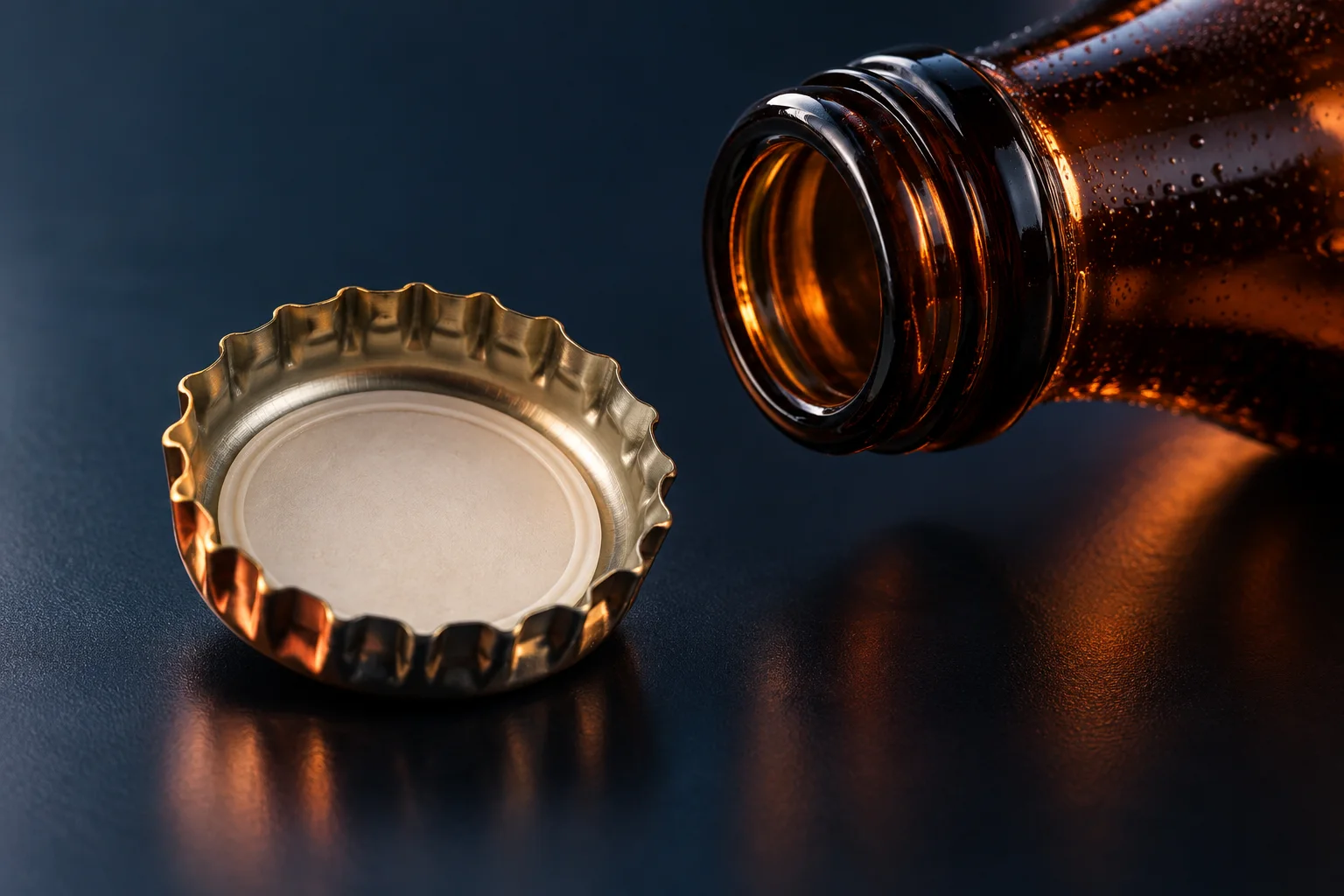
On an empty lined cap, you can see the division of work: threads around the outside of the neck, a disc inside the closure, and a rim where sealing contact occurs. A molded sealing feature can serve that last function without a separate disc. Which construction a package uses depends on the closure system, not simply whether its cap is metal or plastic.
Sources: Selig Group · BERICAP
Questions you might still have
Do all bottle caps have a separate liner?
No. Some closures form a seal with shaped, integrated features, such as a bore seal. A loose disc is only one design option.
Sources: BERICAP
Are all cap liners rubber?
No. Manufacturers specify different liner constructions and materials. A disc's color or softness does not identify its composition.
Sources: BERICAP
Is a tamper-evidence band the watertight seal?
It serves a different function. The band indicates opening through its connections; sealing contact is provided elsewhere in the closure system.
Sources: BERICAP
The thing to remember
Threads provide retention; a liner or molded sealing feature closes a particular escape path at the bottle mouth.
What this example leaves out
The drawing shows a generic lined screw closure. Crown caps, induction membranes, bore seals and engineered vents differ. Material safety, torque values, shelf life and reseal performance require package-specific evidence.
Sources & further reading
Source access dates are listed below. Manufacturer descriptions and patents support the specific constructions described, not every product.
- FAQs & Troubleshooting ↗
Selig Group · Retrieved 2026-10-14 · Contact at bottle land, liner rigidity, cap torque and incompatible sealing faces can affect sealing.
Packaging-line troubleshooting primarily for induction seals. Not a home retightening prescription or material-safety assessment. - Wine — closure selection ↗
BERICAP · Retrieved 2026-10-14 · Separate sealing discs and liner choices are used in aluminum wine closures to protect contents.
Product-family examples only; no assertion that all bottle caps contain the same polymer. - Clean Cap 23 ↗
BERICAP · Retrieved 2026-10-14 · A screw closure can provide reclosure using a bore seal and have a separate tamper-evidence band.
Beverage-carton closure example establishes an alternative sealing geometry; not an identical bottled-water cap. - Venting Technologies ↗
Selig Group · Retrieved 2026-10-14 · Engineered vented liners and direct closure vents can exchange gas without being ordinary open leaks.
Specialized products for compatible formulations; no claim that a soft-drink cap normally vents.