Look a little closer
See the mechanism
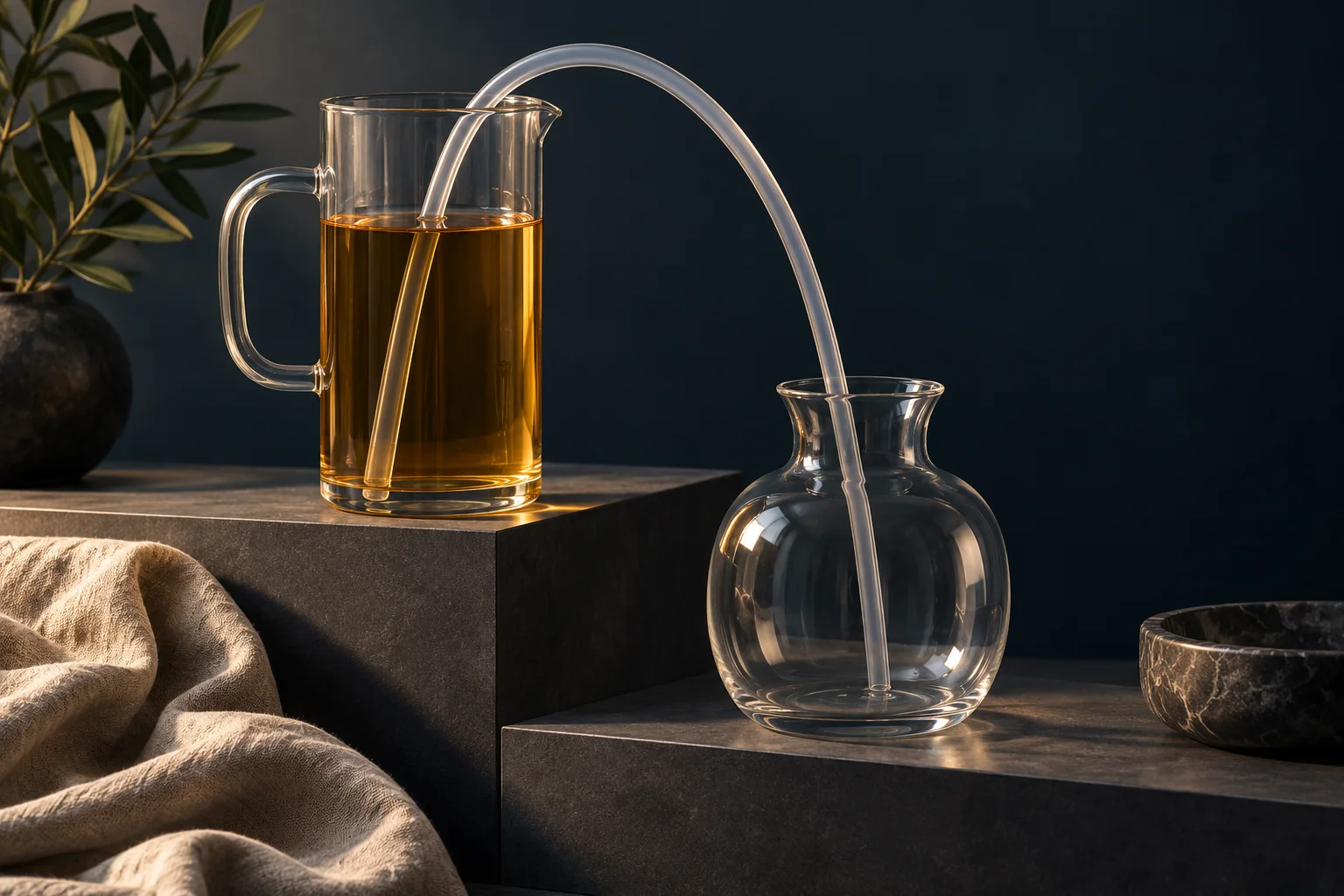
A height drop and a connected path
Read every step
- Lower outlet. The tube is already filled and its intake stays under water. The source surface is above the free outlet. That endpoint drop supplies the gravitational energy for sustained flow; pressure varies along the route, so water can rise over the crest on its way down.
- Equal heights. Raise the free outlet to the source surface level while keeping the same crest. The endpoint height drop is now zero. This open arrangement has no sustained gravity-driven flow from that height difference. The comparison concerns steady conditions, not a brief transient after moving a hose.
- Air at the crest. A lower outlet is not enough if air interrupts the connected liquid path. This selected state shows an air pocket at the crest; ordinary steady siphoning is interrupted and separate portions can drain. Establishing the filled path is priming, a starting condition rather than a continuing energy source.
Open source and freely discharging outlet, with no added pump pressure. Source surface and outlet are the relevant endpoints here; a submerged discharge requires a different boundary comparison. Arrows indicate direction, not flow rate or pressure. These selected conditions do not predict drainage timing. No mouth-priming or improvised transfer instructions are provided.
Diagram basis: Iowa State: continuous path; Harvard: siphon conditions; OpenStax: mechanical energy balance.
Sources: Harvard Natural Sciences Lecture Demonstrations · Iowa State University Physics Learning · OpenStax, Rice University · A. Boatwright, S. Hughes and J. Barry; Scientific Reports · Saint-Gobain Calmar, S.A. / European Patent Office
The uphill section is not the whole journey
Watch only the water climbing over a rim and a siphon seems to be lifting water for free. Follow the whole route instead: the liquid finishes lower than it started. Iowa State describes the continuous liquid path and the gravitational energy that supplies ordinary siphon flow.
A filled tube couples the rising and falling portions. Water can gain height on its way to the crest while losing more height by the time it leaves. Pressure differences act along that connected route. The first drawing shows the path already filled; it does not show a dry hose starting itself.
Sources: Iowa State University Physics Learning · OpenStax, Rice University
Compare the endpoints, not the length of each leg
For an open source and a freely discharging outlet, compare the source water's free surface with the outlet. The intake depth is not extra unlimited energy. Nor does a long horizontal coil add downhill height: it adds tube, with frictional losses, while leaving the endpoint levels unchanged.
The second drawing raises the free outlet to the source surface level. There is now no net endpoint height drop to supply sustained gravity-driven flow in this open arrangement. Keeping the crest in the same place does not restore that missing drop. This is a comparison of steady conditions, not a prediction of a brief transient while a hose moves.
If the outlet is submerged in a second open reservoir, compare the two free surfaces instead. The boundary conditions decide the relevant endpoint. A drawing of a free jet must not silently become an explanation of every submerged discharge.
Sources: OpenStax, Rice University
Priming establishes the path; it does not keep supplying energy
An ordinary hose with air occupying its crest does not yet provide the connected liquid route shown in the flowing state. Priming establishes that starting condition. Once the route and endpoint conditions exist, steady siphoning can continue without a running pump. If air interrupts the liquid column, separate portions can drain rather than maintain that same steady path.
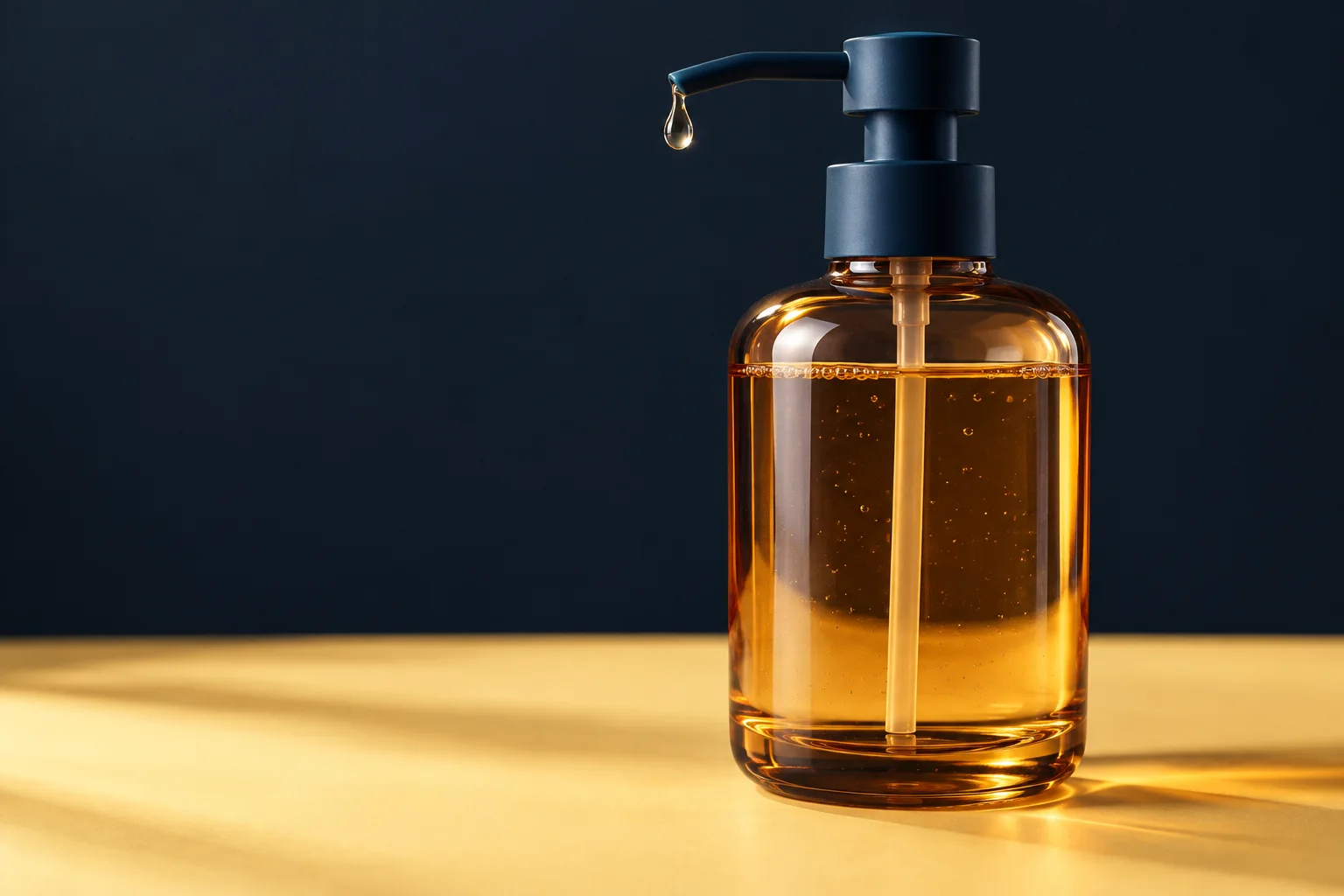
Compare the soap pump: a moving piston repeatedly changes chamber volume and pressure. A siphon uses the height drop of the connected liquid route for its continuing energy supply. Pressure matters in both examples, but the source of energy and the conditions for continuing flow differ.
These drawings compare conditions, not a practical transfer procedure. Use equipment suited to the liquid and task. Mouth priming risks exposure to the contents and is not part of this explanation.
Sources: Harvard Natural Sciences Lecture Demonstrations · Iowa State University Physics Learning · Saint-Gobain Calmar, S.A. / European Patent Office
What the route drawing cannot tell you about pressure
Pressure, speed and height enter a fluid's mechanical-energy balance. At the crest of an ordinary operating siphon, pressure is lower than at the open source surface. It is not the same at every point in the hose. Bernoulli's ideal relationship helps organize those quantities; a real tube also loses mechanical energy through friction.
As a source level falls or a receiving level rises, the available height difference can change. A rate estimate therefore needs actual endpoint levels, tube geometry, fluid properties and losses. The arrows in our drawing indicate direction only, not measured speed or pressure.
Sources: OpenStax, Rice University · Harvard Natural Sciences Lecture Demonstrations · Iowa State University Physics Learning
A lower destination does not permit an unlimited crest
Raising the crest lowers pressure there. Ordinary water siphons encounter practical limits associated with low pressure, vapour formation and dissolved gases interrupting the liquid path. A downhill destination does not let a household hose climb arbitrarily high.
There is a scientific qualification to an absolute atmospheric-height rule. Boatwright and colleagues report a specially prepared, degassed-water siphon beyond the usual barometric limit. Its controlled liquid conditions and cohesion are not a household performance promise. The everyday model still needs both the correct endpoint drop and a connected liquid route.
Sources: Harvard Natural Sciences Lecture Demonstrations · A. Boatwright, S. Hughes and J. Barry; Scientific Reports
Questions you might still have
Is atmospheric pressure the only thing making a siphon work?
No. Gravity provides the net energy, and pressure differences act along the route. Experiments with specially prepared liquids qualify simple atmospheric-only explanations. Those conditions do not remove ordinary household pressure and air-entry limits.
Sources: Iowa State University Physics Learning · A. Boatwright, S. Hughes and J. Barry; Scientific Reports
The thing to remember
Check two conditions separately: the endpoint height drop supplies energy, and the connected liquid path lets the siphon sustain flow.
What this example leaves out
This models an ordinary liquid siphon with open reservoirs or a free outlet. Pressurized systems, unusual fluids and prepared laboratory conditions require more analysis. No universal crest height or flow rate is supplied. Use purpose-built equipment rather than mouth priming or improvised fuel transfer.
Sources & further reading
Source access dates are listed below. Manufacturer descriptions and patents support the specific constructions described, not every product.
- Siphon ↗
Harvard Natural Sciences Lecture Demonstrations · Retrieved 2026-10-15 · Filled liquid path can rise over a crest before discharge lower down; ordinary height limits relate to pressure.
Teaching-scale water siphon. Its mouth-priming directions are deliberately omitted. - Siphon ↗
Iowa State University Physics Learning · Retrieved 2026-10-15 · Continuous water path, gravity and conversion of gravitational potential energy.
University demonstration, not an aquarium, plumbing or fuel-handling procedure. Mouth priming omitted. - 14.6 Bernoulli's Equation ↗
OpenStax, Rice University · Retrieved 2026-10-15 · Pressure, height and flow speed enter a mechanical-energy balance; ideal equation excludes friction.
Physics facts only. Real hose losses are acknowledged; no ideal calculated flow rate or copied textbook drawing. - The height limit of a siphon ↗
A. Boatwright, S. Hughes and J. Barry; Scientific Reports · Retrieved 2026-10-14 · Authors report a degassed-water siphon beyond the usual barometric height and discuss cohesion and cavitation.
Abstract and indexed introduction read; subsequent direct body fetch was unreliable. The paper was corrected in 2017 to acknowledge a related earlier experiment. Used only to qualify a universal atmospheric-height ceiling, not for methods, numerical results or priority claims. - EP1136135A2 — Fluid pump dispenser having product retraction feature ↗
Saint-Gobain Calmar, S.A. / European Patent Office · Retrieved 2026-10-14 · Variable-volume chamber and manual pressure/return strokes; valve-controlled inlet and discharge; brief return-stroke product retraction followed by refill, especially paragraphs 0015–0024.
Specific anti-drip embodiment confirms the broader chamber-volume principle but adds timing absent from the conceptual diagram. No exact patent assembly is reproduced; product retraction is explicitly distinguished from the simple cycle.