Look a little closer
See the mechanism
Water leaves the fabric, then the machine
Read the diagram
The inner drum supports wet laundry as it rotates. Water can move through its perforations into the surrounding tub, then leave through drainage. The circular arrow shows drum rotation; outward water-path arrows show escape routes, not a new physical force. The drainage function is distinct from spinning.
Simplified front view of a domestic washer. Fabric distribution, tub shape and pump location are illustrative. In a stationary frame the drum supplies inward restraint; centrifugal force is a rotating-frame description.
Simplified front view of a domestic washer. Fabric distribution, tub shape and pump location are illustrative. In a stationary frame the drum supplies inward restraint; centrifugal force is a rotating-frame description.
Diagram basis: OpenStax rotating-frame mechanics; Samsung spin and drain settings.
Sources: OpenStax, Rice University · Samsung · Samsung
The slow movement and the fast movement have different jobs
During washing, movement helps expose laundry to water and detergent and produces mechanical action. The fast extraction phase comes afterward, or between other phases. Samsung distinguishes Spin Only from Rinse + Spin and full wash programs. Those names are useful evidence that rotating the drum is not, by itself, the whole cleaning process.
A washing machine therefore changes the purpose of movement during a load. Gentle tumbling or agitation can repeatedly move fabric through the wash. A fast spin aims to hold much of that wet fabric against the rotating drum and remove water. Calling both actions spinning in everyday speech hides their different jobs. The speed change is not simply a more vigorous version of the same washing action.
Sources: Samsung
Keeping laundry in a circle requires an inward force
An object does not keep turning merely because it is already moving. To follow a circular path, it needs a force directed inward. The drum supplies the restraint that redirects the laundry's motion. Water held loosely among the fibers has routes through the fabric and the drum's perforations, so it does not remain constrained in exactly the same way.
The common phrase centrifugal force describes the apparent outward effect when the situation is viewed in a frame rotating with the drum. In a stationary frame, inertia and the forces needed for circular motion provide the explanation. Both descriptions can be useful if their frame is stated. The mistake is to imagine an extra outward force of nature that the machine manufactures independently of its rotating load.
Sources: OpenStax, Rice University
The holes are only the beginning of the water's exit
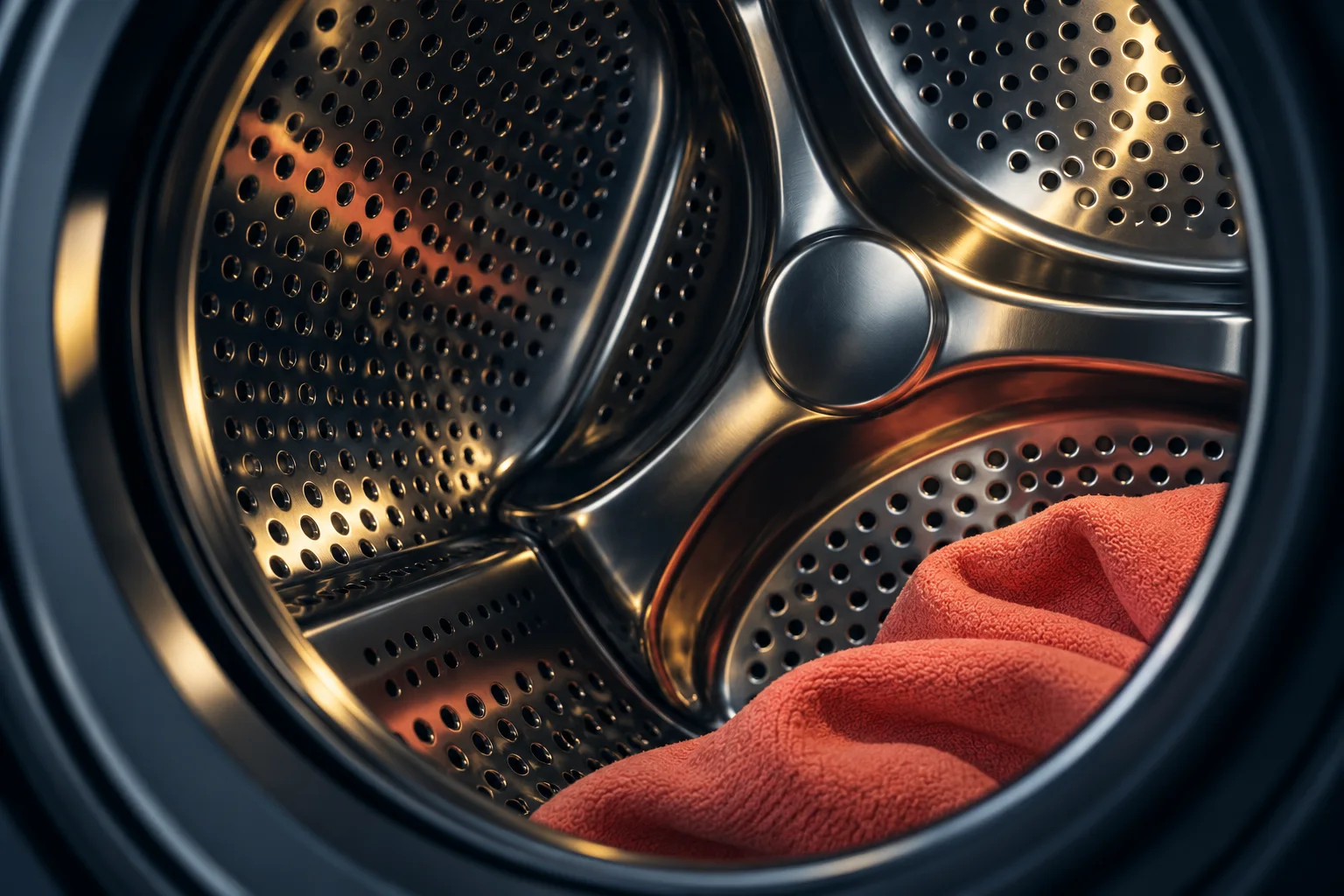
The perforated inner drum holds the laundry. Around it is a tub that can collect water leaving the load. Extraction and drainage have to work together: moving liquid out of a towel is useful only if the machine can then remove it from the collection space. Rotation alone cannot send it through the house's drain pipe.
This is an important distinction between freeing water from fabric and clearing water from the appliance. One is driven by the conditions of the rotating load; the other needs a working drainage route. The inner drum and surrounding tub have different roles: one supports fabric, while the other collects the released liquid. Drainage completes the journey rather than competing with spin.
Sources: Samsung · OpenStax, Rice University
Why a spun towel is still damp
Samsung's settings guide describes higher spin as extracting more water and lower spin as suitable for delicate items. It does not call extraction the same thing as complete drying. Some water remains associated with the fabric after the freely mobile portion has left. The result can be much less heavy without being dry enough to wear.
Compare the two tasks by following the state of the water. Spin removes it mainly as liquid. Subsequent drying removes moisture by evaporation. A dryer or a clothesline still has work to do after a successful spin. This is why drier-to-the-touch and fully dry should not be treated as interchangeable descriptions, and why a very absorbent item can remain noticeably damp at the end of an otherwise completed cycle.
Sources: Samsung
A lump of wet fabric keeps pulling the load off center
If much of the load collects on one side, the rotating mass is unevenly distributed. The resulting changing forces act on the drum and its support. A large wet item or a very small load can be difficult to distribute evenly; Samsung's guidance identifies both as possible sources of imbalance.
A washer may respond by slowing down, pausing, trying to redistribute the laundry or refusing high-speed operation. To someone watching the timer, this can look like the machine is repeatedly changing its mind. It is more useful to understand that the control is trying to meet a condition for the next stage, rather than blindly obey a fixed countdown. The exact recognition and response depend on the model.
Sources: Samsung
Maximum extraction is not the only objective
A higher setting can reduce the water left for drying, but the garment and the machine place limits on the choice. Samsung includes slow-spin and no-spin options for different fabric needs. No Spin can still drain water. That is another demonstration that drainage and drum rotation are related but distinct functions.
The reasonable question is not which number is greatest, but which process the laundry can tolerate and the selected program permits. Use the care label and the washer's instructions. An interrupted spin also has several possible causes: balance guidance describes one common mechanism, not a diagnosis of every wet load. Persistent problems call for model-specific support rather than an attempt to defeat the machine's restrictions.
Questions you might still have
Does spinning dry clothes by heating them?
The extraction phase mainly removes water as liquid, rather than evaporating it with heat. It can leave less moisture for later drying, but it is not the same process as a heated tumble-drying cycle.
Sources: Samsung
Why might the washer repeatedly slow down before spinning?
An uneven load can prevent the machine from proceeding at high speed. Samsung lists slow spinning, pauses and longer cycles among possible balance-related symptoms. Other problems can cause similar behavior, so this is not a diagnosis.
Sources: Samsung
Can the machine drain without a fast spin?
Yes. Samsung's guide includes a No Spin setting that drains without spinning. Water removal from the appliance and water extraction from the fabric are separate jobs, even when a program coordinates them.
Sources: Samsung
The thing to remember
Follow water twice: out of the rotating fabric, then out of the collection tub.
What this example leaves out
This describes extraction in ordinary domestic washers. Drum orientation, suspension, pump operation and balance detection differ. The centrifugal explanation names a rotating reference frame; it does not introduce an extra physical force. No spin speed, dryness percentage or fault diagnosis is universal.
Sources & further reading
Source access dates are listed below. Manufacturer descriptions and patents support the specific constructions described, not every product.
- 6.4 Fictitious Forces and Non-inertial Frames: The Coriolis Force ↗
OpenStax, Rice University · Retrieved 2026-10-14 · Inertial-frame motion, inward force for circular motion and centrifugal descriptions in a rotating frame.
Fundamental mechanics, not a detailed washer plumbing or sensor specification; no textbook illustration copied. - Cycles, settings, and features on your Samsung washing machine ↗
Samsung · Retrieved 2026-10-14 · Spin Only extracts water; different spin settings suit different fabrics; No Spin can drain without rotating.
A guide spanning Samsung models with explicit model variation; no universal button sequence, speed or fabric prescription. - Samsung washing machine spins poorly ↗
Samsung · Retrieved 2026-10-14 · Unbalanced loads can prevent high-speed spin, interrupt it and extend cycles.
Owner symptom guidance; balance is one possible cause, not a diagnosis. No service, bypass or disassembly directions.