Look a little closer
See the mechanism
One water batch can make several trips
Read the diagram
Water collects at the bottom and passes through a soil-handling area to the circulation pump. The pump feeds rotating spray arms. Jets reach dishes, and returning water collects below for another trip. During draining, used water follows a route out of the machine; later fresh water supplies rinsing.
Functional route, not one model's plumbing. Soil handling may use filters, a grinder or other arrangements; the drawing does not assert all phases or pumps run simultaneously.
Functional route, not one model's plumbing. Soil handling may use filters, a grinder or other arrangements; the drawing does not assert all phases or pumps run simultaneously.
Diagram basis: Whirlpool process; Kenmore ULTRA WASH manual.
Sources: Whirlpool · Sears/Kenmore; manufacturer document hosted by Whirlpool · Bosch · Bosch
The cabinet is not filled to the top
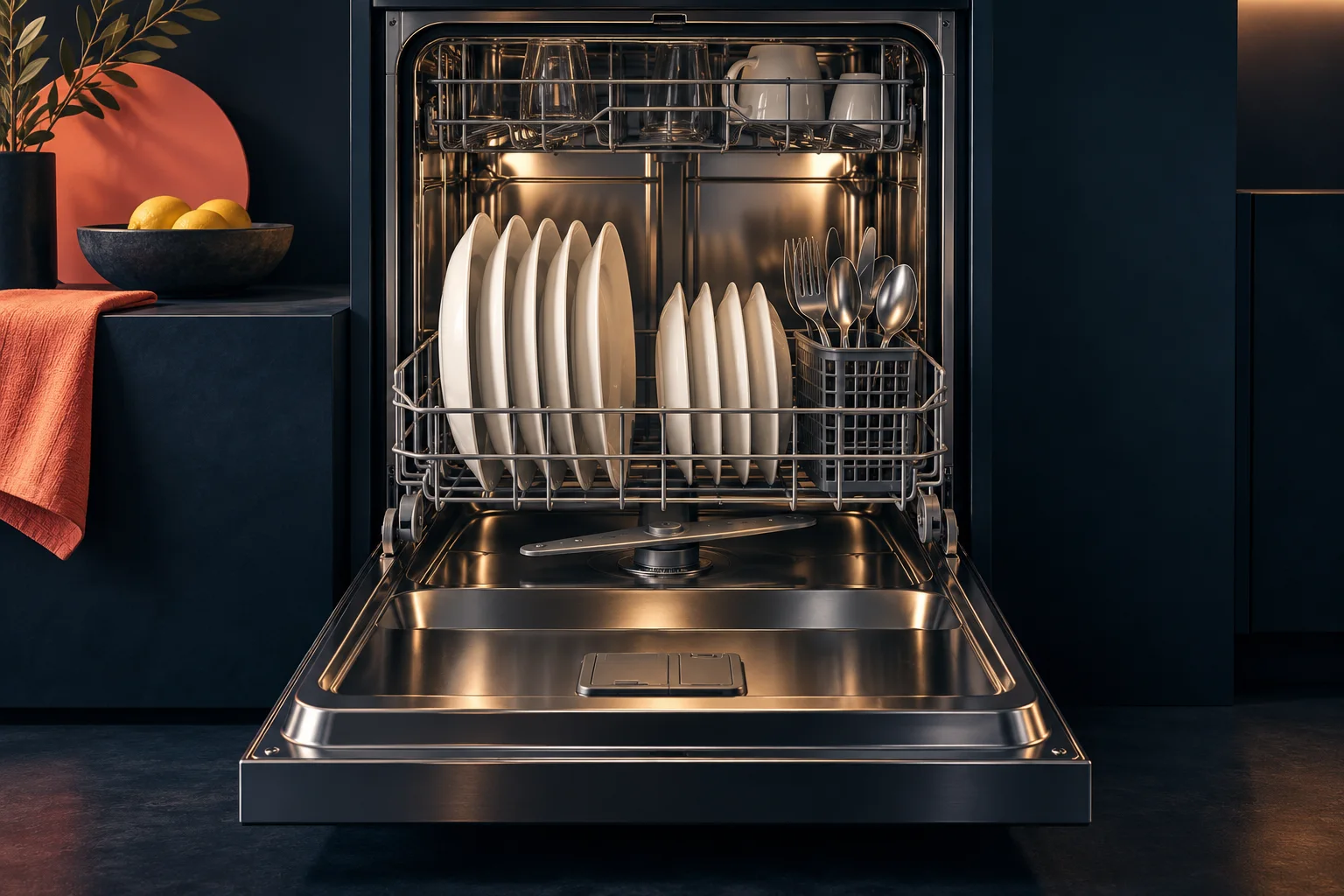
The dishwasher needs water in its lower collection area, not a bathtub around every plate. A circulation pump takes water from that supply and sends it to spray outlets. The water falls back after striking dishes and can be sent around again. The racks hold items in the paths of moving water while allowing that water to return.
This distinction explains how a large cabinet can wash a load without submerging it. The useful resource is water repeatedly reaching dirty surfaces, not the height of a standing pool beside them. It also makes the bottom area more important than it looks. A dishwasher's visible racks are only one part of its geometry; the less visible collection and pumping route makes the repeated spray possible.
Sources: Whirlpool
The jets need a route to each surface
Spray arms distribute water around the racks as they turn. Loading affects what those jets can reach and whether the arms can move. Bosch's owner guidance treats obstructed arms and unsuitable loading as possible causes of poor cleaning. A plate can block the path to another plate even though both fit neatly between the rack's tines.
Think of a bowl nested inside another bowl. The hidden surfaces have little direct access to the wash. The same basic problem occurs when a tall item obstructs an arm: the hydraulic system can operate while its intended coverage is interrupted. Rack capacity is therefore not the same as usable washing access. Enough space for a jet to enter and water to return is more relevant than a load that simply looks tidy.
Sources: Bosch
Circulating water needs a way to handle food
As water removes debris, that material joins the returning flow. Dishwashers use different soil-handling arrangements. The older Kenmore ULTRA WASH system in the cited manual has a grinder and an accumulating chamber, with collected soil discharged during draining. Other machines use accessible filters. Those alternatives change how debris is handled and which owner-care tasks apply.
The aim is to let water keep circulating without repeatedly sending large pieces back across the dishes or obstructing important passages. This creates two linked tasks: remove soil from the dish and manage it in the machine. A filter is not a magical reset that turns used wash water into fresh tap water. It removes material according to its design while the wash chemistry continues working.
Sources: Sears/Kenmore; manufacturer document hosted by Whirlpool · Bosch
The displayed time can reflect several decisions
A program coordinates water, heat, detergent, spraying and pauses. The cited ULTRA WASH manual describes a countdown pausing during heating and changing as a soil sensor adjusts the cycle. That is a specific system, but it shows why a displayed duration need not be a simple timer counting down at an unvarying pace.
The relevant question is what a machine is waiting for or choosing next. Water temperature and the selected program can change the sequence. A longer program name does not by itself explain whether the extra time is active spraying, heating or another phase. Nor does a shorter elapsed time prove a load has received the same treatment. Those details belong to the particular program chart rather than a universal dishwasher schedule.
Sources: Sears/Kenmore; manufacturer document hosted by Whirlpool · Whirlpool
Recirculation ends when the water leaves
During a wash phase, the same batch of water can make repeated trips. Draining changes that arrangement: the used water and its contents leave the machine. Fresh water then provides the next rinse stage. The Kenmore manual describes successive wash, drain and fresh-water rinsing actions, including a final heated rinse with rinse aid.
Circulation and drainage send water to different destinations. They are different destinations, even if the appliance uses related plumbing or pump components. Washing is not an endless attempt to clean every plate with one unchanged batch. The sequence combines reuse during a phase with water replacement between phases. The number and timing of those replacements vary.
Sources: Whirlpool · Sears/Kenmore; manufacturer document hosted by Whirlpool
A finished wash does not choose one universal drying method
After rinsing, remaining water must run off or become vapor. Drying systems differ: some use additional heat, some move air, and some open the door as part of the program. On selected Bosch models, a mineral-based system takes up moisture and releases heat into circulating air. That optional system is not the hidden mechanism in every dishwasher.
Rinse aid also helps water leave surfaces rather than remain as separate droplets. Shape still matters: a recessed base can retain a small pool even when most of the load is dry. This separates three issues that are often bundled into one complaint—whether soil was removed, whether rinse water drained away, and whether the remaining moisture evaporated. A good explanation of the wash loop alone cannot predict all three.
Questions you might still have
Is fresh tap water spraying throughout the whole wash?
Usually the wash stage recirculates a collected batch through the spray system. Used water is drained and replaced at later stages. The exact sequence and number of water changes depend on the program.
Sources: Whirlpool · Sears/Kenmore; manufacturer document hosted by Whirlpool
Does every dishwasher grind up food?
No. The cited older ULTRA WASH design includes a grinder, but other dishwashers use filters and different soil-removal systems. Use the actual model's instructions for loading and filter care.
Sources: Sears/Kenmore; manufacturer document hosted by Whirlpool · Bosch
The thing to remember
A dishwasher needs access, circulation and water changes. Loading is part of the first job.
What this example leaves out
This is a representative domestic process, with specific Kenmore and Bosch examples. Soil handling, heaters, pumps, sensing and drying vary. The schematic combines shared functions, not one product's plumbing. It provides no repair, sanitation-cycle or universal detergent instructions.
Sources & further reading
Source access dates are listed below. Manufacturer descriptions and patents support the specific constructions described, not every product.
- How Does a Dishwasher Work? ↗
Whirlpool · Retrieved 2026-10-14 · Shallow water collection, circulation through spray arms, draining/rinsing and different drying approaches.
Representative domestic sequence; no water-use statistics or claim that every dishwasher has the same heater. - ULTRA WASH Dishwasher Use & Care Guide 3384536 Rev A ↗
Sears/Kenmore; manufacturer document hosted by Whirlpool · Retrieved 2026-10-14 · Pump and spray circuit, soil-collection chamber, drain/refill, temperature and soil-dependent cycle changes.
Older ULTRA WASH system with a grinder. That grinder, sensor and exact program are examples, not universal dishwasher parts. - Dishwasher not cleaning dishes ↗
Bosch · Retrieved 2026-10-14 · Loading and obstructed spray arms affect access; filters and rinse aid matter to washing/drying.
Owner-level guidance; no repair instruction or literal claim that food must remain for detergent to work. - CrystalDry Dishwasher Technology ↗
Bosch · Retrieved 2026-10-14 · Selected models circulate drying air through minerals that adsorb moisture and release heat.
An optional drying architecture. Comparative percentages, temperatures and global market claims excluded.