Look a little closer
See the mechanism
Controlled wear leaves the line behind
Read the diagram
Contact with paper removes small particles from the graphite-containing core. Layered graphite offers an easier sliding direction; the paper retains the material transferred at the point.
Conceptual cross-section and layer inset, not an atomic-scale measurement. A real core contains clay and other formulation ingredients, and a real deposit is not a single perfect carbon sheet.
Diagram basis: ACS: pencils and erasers; Faber-Castell: paper and grades.
Sources: American Chemical Society · Faber-Castell USA · Faber-Castell · Royal Society of Chemistry, Analyst 2016, 141, 4055–4064; primary experimental paper
The mark is part of the point
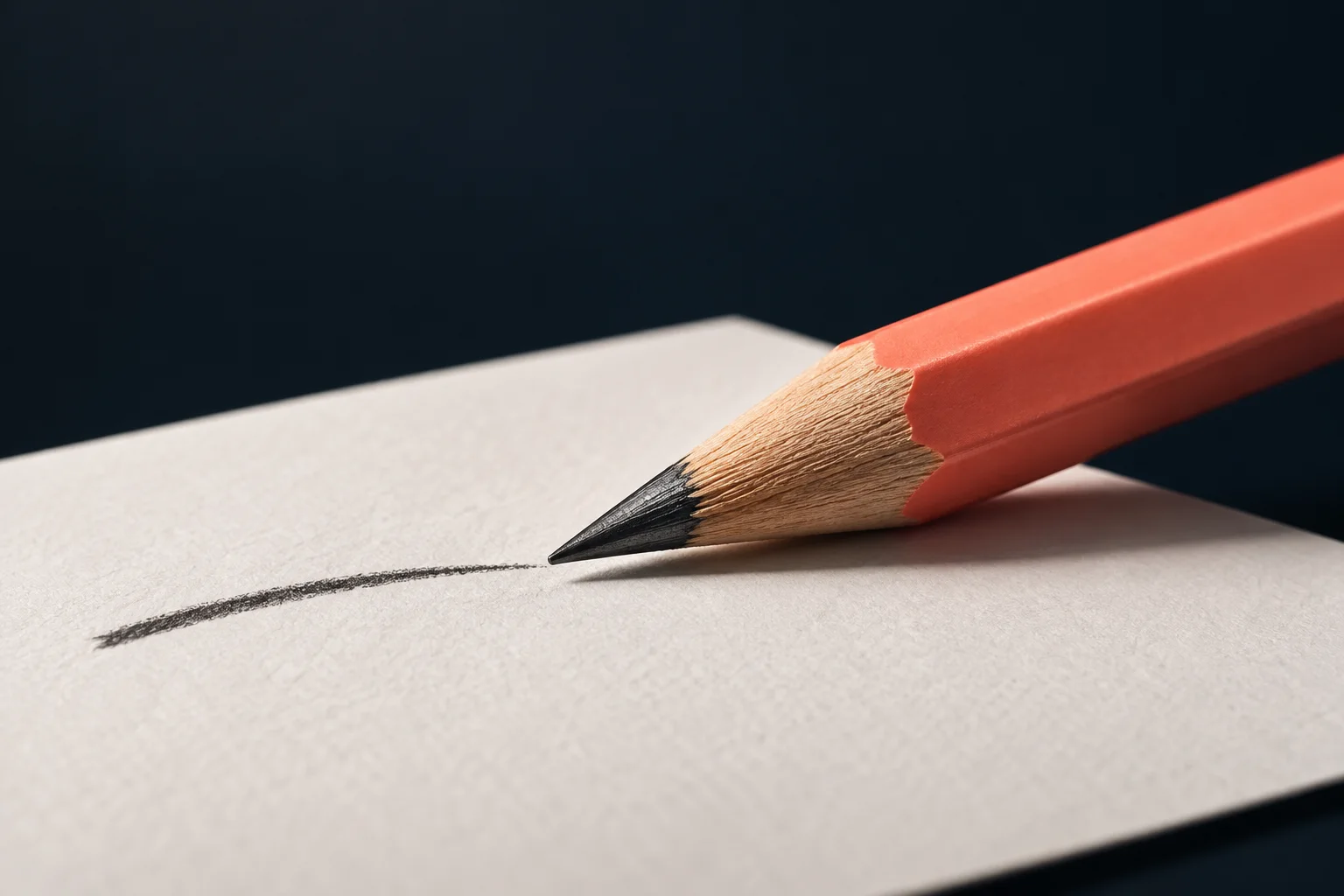
A pencil does not store a liquid that emerges through its tip. Its writing core is a solid, and making a mark uses some of that solid. Small particles transfer to the paper as the point moves. This connects two ordinary observations: a line remains behind while the sharpened point gradually changes shape.
The familiar word lead does not identify the element lead in an ordinary graphite pencil. The ACS educational account describes a core made from graphite mixed with clay. Graphite is a form of carbon. Wood provides a convenient body around that core; it is not the substance making the grey line. Separating body, point and deposited mark is a useful first step because all three are visible together, yet only one is being deliberately consumed in the act of writing.
Sources: American Chemical Society
Graphite is strong within a layer and easier to separate between layers
Graphite's carbon atoms form extended layers. Connections within those layers differ from the weaker interactions between them. That arrangement lets layers slide and separates graphite's writing behaviour from the behaviour of a material whose structure resists movement in every direction. The ACS diagram explains the transfer of graphite from point to paper through this layered structure.
Layered structure does not mean an entire pencil core becomes one perfect atomic sheet. A real mark contains transferred material at several scales, and a pencil core also contains other ingredients. The helpful idea is directional structure: a substance can have strong bonding and still offer an easier route for sliding or separation. Strong does not have to mean equally resistant in every direction.
Sources: American Chemical Society · Royal Society of Chemistry, Analyst 2016, 141, 4055–4064; primary experimental paper
Paper is a working surface, not a passive background
Paper may look smooth, but its surface has texture. Faber-Castell compares artists' paper to a rasp that removes very small particles from the core. Different papers therefore change how a pencil feels and how material is deposited. A line is an interaction between two materials, rather than a property residing entirely inside the pencil.
This gives you a better way to think about a scratchy stroke or a broad shaded area. The point contacts the paper at particular places, pressure is applied there, and material transfers where the contact does work. A wide stroke and a fine line arrange those contacts differently. The schematic shows particles settling among surface fibres to make this contact visible. It is a conceptual cross-section, not a microscopic image of the sheet on your desk.
Sources: Faber-Castell USA · American Chemical Society
Clay changes how readily the core gives up material
Pencil makers vary the mixture of graphite and clay to produce different hardness grades. More clay generally makes a harder core; a softer formulation usually leaves a darker mark. The ACS account explains that broad relationship, while Faber-Castell's manufacturer guidance describes the lettered grading system.
H denotes harder grades and B denotes softer, blacker ones. Numbers extend those families, so a 6H is harder than a 4H within the stated maker's scale. HB sits between the H and B groups. This is a useful guide to behaviour, not a promise that identically labelled pencils from every manufacturer will make indistinguishable marks. Faber-Castell notes that the classification was never definitively standardized internationally. The label narrows the choice; the pencil-and-paper combination still determines the actual stroke.
Sources: Faber-Castell · American Chemical Society
A point is a way of choosing the contact
A sharp point concentrates contact into a small region. Turning the pencil to use more of its side changes the shape of the area meeting the paper. You can recognize the distinction by looking at the line and the point rather than by imagining a different chemical reaction for shading. Both marks come from the transfer of core material.
The manufacturer's guide treats hand pressure, paper and type of drawing as factors in choosing a grade. That is more specific than claiming there is one best pencil. A writer wanting a controlled line and an artist building broad dark areas may ask the material to do different jobs. A soft grade is not a better version of a hard grade; it makes a different trade between point behaviour and the material deposited. Here the useful comparison is the task, not the price or prestige of a pencil.
Sources: Faber-Castell USA · Faber-Castell
A deposited mark can be lifted again
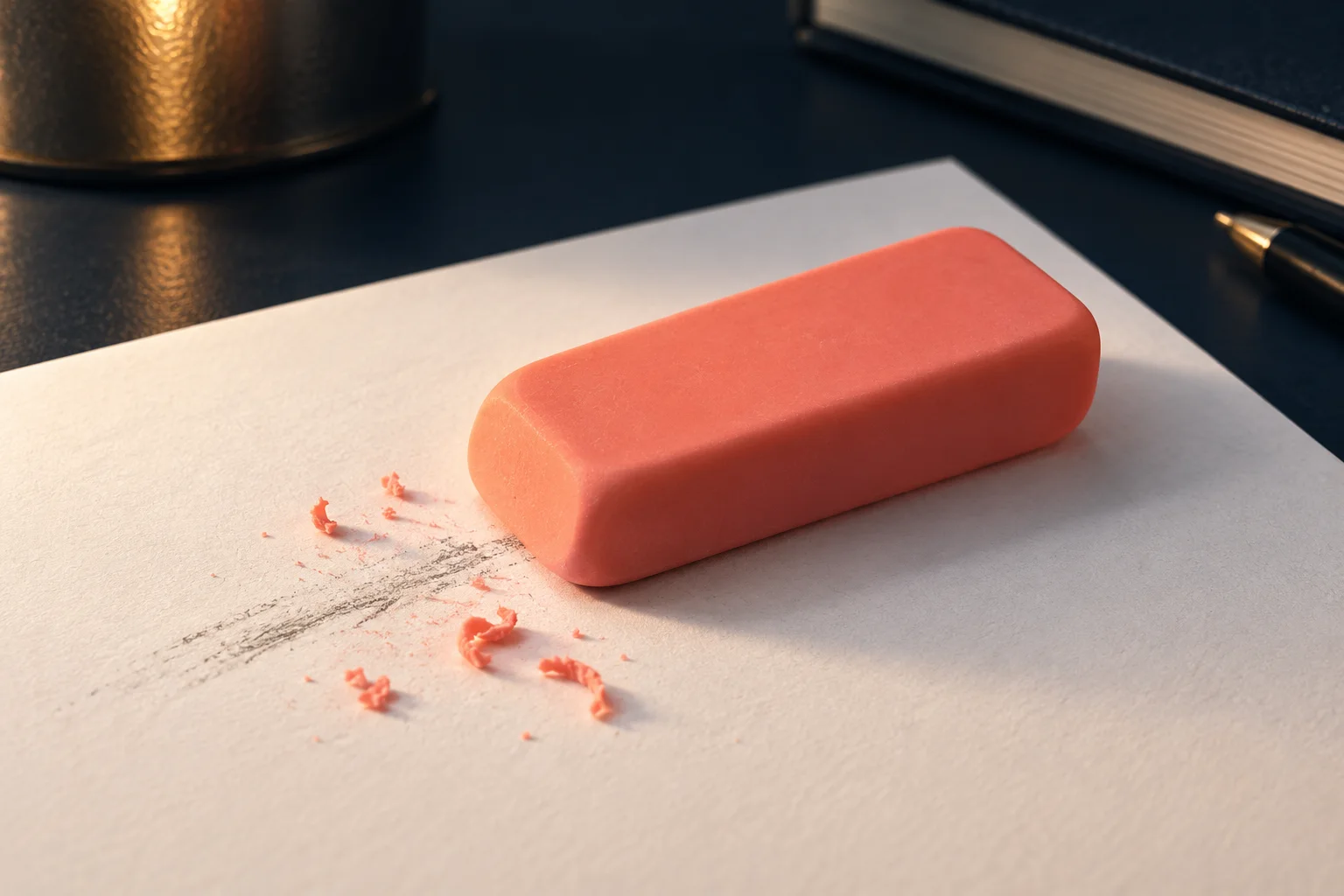
Because a pencil line consists of material left on and among the surface of the paper, an eraser has something it can pick up. The ACS account describes graphite adhering to rubber and being carried away in eraser crumbs. This is physical removal of the mark, rather than a switch that turns carbon colourless.
That connection also explains why writing and erasing are best considered together. The paper has to retain enough graphite for a useful mark, then survive contact that removes some of it. A deep impression made by pressure can remain after the visible graphite has been reduced. Looking at the paper from an angle separates those two traces: dark deposited material and a change in the sheet's shape. The pencil leaves a material trail; the trail and the surface beneath it are not the same thing.
Sources: American Chemical Society · Faber-Castell USA
Questions you might still have
Do ordinary pencils contain lead?
Their writing core is graphite mixed with clay, not the metallic element lead. Graphite is a form of carbon.
Sources: American Chemical Society
What changes between H and B pencils?
The graphite-and-clay mixture changes the hardness. H grades are harder; B grades are softer and generally leave darker marks. Exact grading can vary by manufacturer.
Sources: Faber-Castell
Why does paper texture matter?
The surface helps remove fine particles from the core. Changes in paper texture alter that contact, so the same pencil can behave differently on different sheets.
Sources: Faber-Castell USA
The thing to remember
A pencil works through controlled wear: the point releases solid material, and textured paper holds the trail.
What this example leaves out
The layer and fibre drawing is schematic. Ordinary graphite pencils, mechanical-pencil cores and coloured pencils have different formulations; identical grade labels need not match across manufacturers.
Sources & further reading
Source access dates are listed below. Manufacturer descriptions and patents support the specific constructions described, not every product.
- The Secret Science of Stuff — Pencils and Erasers ↗
American Chemical Society · Retrieved 2026-10-14 · Graphite-and-clay core; graphite layers slide; solid particles transfer to paper; rubber picks up graphite into crumbs; harder-versus-softer mark relationship.
Educational schematic supports qualitative mechanism. Graphite is described as extended layers rather than treating it as discrete ordinary molecules. Lifetime estimates and historical speculation omitted. - Graphite Pencil Degrees of Hardness Explained ↗
Faber-Castell USA · Retrieved 2026-10-14 · Paper texture removes fine particles; graphite/clay ratios influence hardness; hand pressure, paper and drawing task affect choice.
Manufacturer's qualitative guide. No best-pencil claim or brand-comparison test; point/contact and impression comparisons are editorial analysis. - Frequently Asked Questions — Pens and Pencils ↗
Faber-Castell · Retrieved 2026-10-14 · Clay increases hardness; H/B numbering; hardness classification not definitively standardized internationally.
Relevant full FAQ answer available in indexed source text; direct opening returned a minimal access shell. No inference that labels match exactly across makers. - Pencil it in: pencil drawn electrochemical sensing platforms ↗
Royal Society of Chemistry, Analyst 2016, 141, 4055–4064; primary experimental paper · Retrieved 2026-10-14 · Microscopy and spectroscopy of graphite-containing pencil cores and transferred flakes; real deposits contain sheets, defects and other core constituents.
Physicochemical characterization section read. No sensor-performance claims, numerical compositions or experiments imported into an ordinary-writing explanation.