Look a little closer
See the mechanism
The removed graphite has a destination
Read the diagram
Rubbing loosens the graphite deposit and lets the eraser pick it up. Some block erasers carry that material away in crumbs; removing the mark without damaging the paper is the constraint.
Illustrative particle and crumb sizes. This represents a block graphite eraser, not a kneaded eraser, chemical ink eraser or cleaning sponge. No material composition is inferred from colour.
Diagram basis: ACS: graphite pickup; McGill: gentle abrasion.
Sources: American Chemical Society · Joe Schwarcz, McGill University Office for Science and Society · Faber-Castell · Faber-Castell
The eraser removes material rather than cancelling a colour
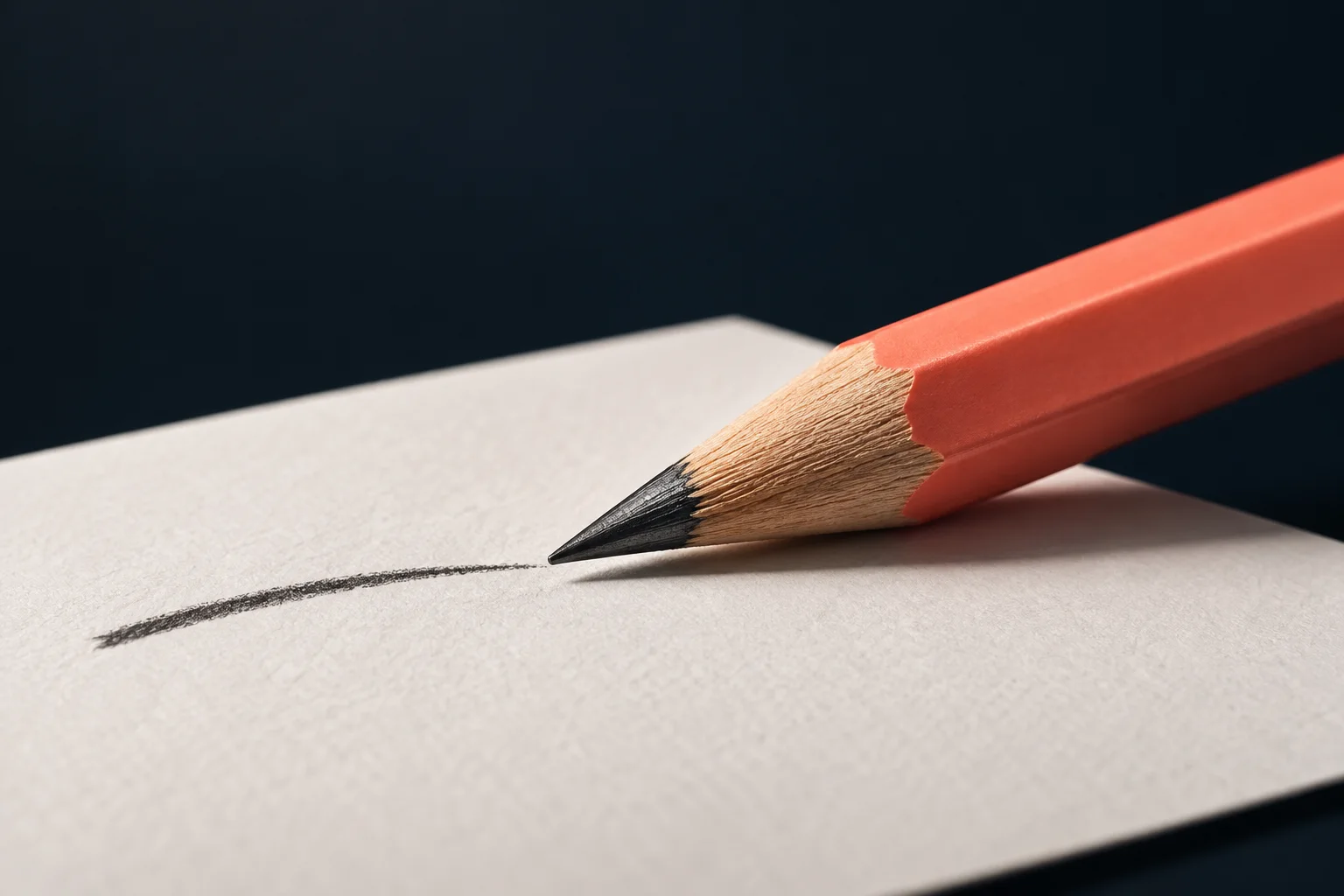
A pencil line is made of tiny pieces of its graphite-containing core left on the paper. To erase it, a tool must detach and move enough of that material for the line to become less visible. The carbon does not disappear. The ACS explanation describes graphite transferring to rubber and remaining in small eraser crumbs that can be brushed away.
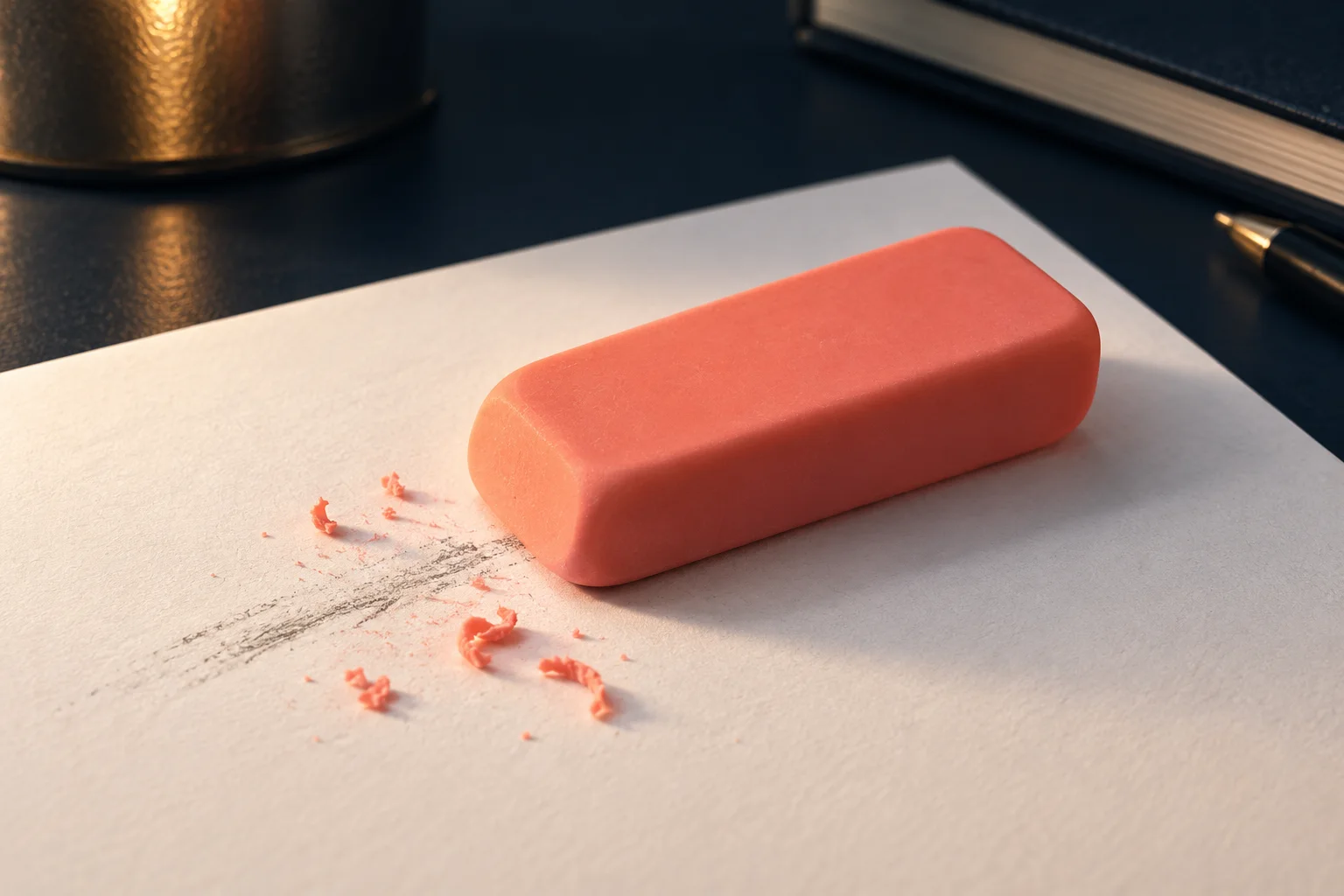
That makes the dirty edge of an eraser informative. It records contact with a mark. The grey debris around an erased area can contain both eraser material and the graphite it removed. The point is a destination: removal requires the dark material to leave the place where it formed the line.
Sources: American Chemical Society
Rubbing has to disturb the mark without destroying the sheet
McGill University's explanation emphasizes abrasion. Rubbing acts on the thin graphite deposit, and some eraser formulations include fine abrasive particles. That description complements the pickup explanation: an eraser must make contact, loosen material and carry it away. The useful action is controlled removal, not maximum scraping.
Paper creates the constraint. A very aggressive material could remove the line by removing the surface underneath it, but that would leave a damaged drawing or a hole in a notebook. An eraser has to operate between those outcomes. It must be effective enough to disturb the deposit yet gentle enough for the sheet. This balance explains why softness, formulation, pressure and the kind of mark all matter. Calling an eraser simply sticky misses part of the contact; calling it simply sandpaper misses the collection of the removed graphite.
Sources: Joe Schwarcz, McGill University Office for Science and Society · American Chemical Society
Crumbs can be part of the cleaning action
A block eraser that sheds small pieces is giving up some of its own material while it works. Graphite captured in those pieces leaves the rubbing area with them. This is why a disappearing pencil line and a growing pile of crumbs can be two sides of the same process. The crumbs are not proof that every eraser is poor quality.
They also do not mean every formulation should crumble heavily. Products differ in how they wear and gather debris. The useful question is whether the tool removes the intended mark while preserving the surface. Colour alone is an unreliable guide. A pink, white or grey block may have a different polymer mixture and abrasive content, and those details cannot be read from its colour as though it were a standardized chemistry label. The mechanism is common; the balance of properties is product-specific.
Sources: American Chemical Society · Faber-Castell
A kneaded eraser is a different way of making contact
The soft putty-like eraser in an artist's kit can be shaped into a point or a broad contact face. Faber-Castell describes its kneadable eraser as absorbent and suitable for correcting or lightening pencil, charcoal and pastel work without leaving ordinary crumbs. That makes it useful for reducing a tone as well as removing a line.
Its shape is part of the tool. A small tip can touch a limited area, while a broader face can lift material from a shaded region. This changes where removal happens without introducing a new pencil pigment. The difference from a block eraser is worth preserving: rubbing until a line vanishes and lifting a little material to create a lighter patch are distinct tasks. Neither technique proves that one eraser is universally better. It depends on whether the desired result is correction, a highlight or controlled adjustment of a drawing.
Sources: Faber-Castell
Ink is often inside the paper, not just sitting at its surface
Why can the same eraser remove a pencil line but leave a pen line? McGill's account distinguishes a graphite deposit from ink absorbed into the sheet. Surface rubbing can remove accessible graphite, while reaching absorbed ink can require removing more of the paper. More pressure does not change where the colour sits.
Manufacturer guidance accordingly distinguishes soft erasers for surface marks from harder, abrasive tools for deeper marks. These are descriptions of tools with different jobs, not a promise that a notebook pen line can be cleanly rubbed out. Erasable inks can use other mechanisms, so the comparison here concerns conventional pencil marks and absorbed ink. The useful distinction is depth and attachment: ask whether the colour is a removable deposit or part of a stained region before expecting the same physical action to reverse it.
Sources: Joe Schwarcz, McGill University Office for Science and Society · Faber-Castell
Removing graphite does not undo every trace of the pencil
A mark and an impression are different traces. An eraser can reduce the graphite while leaving a groove made by the pencil's pressure. Similarly, rubbing can disturb the paper even where the colour has become faint. A visibly clean region is therefore not necessarily a surface returned to its original condition.
Look closely at a used eraser and the area it touched. There may be graphite on the tool, grey crumbs nearby and a change in the texture of the sheet. Those observations let you follow the process without assigning an invented cleaning score or claiming to have tested a set of brands. The eraser negotiates a material trade: remove the deposit, take some of it into its own material, and spare as much of the paper as possible. That small trade is the reason an apparently simple block deserves a formulation of its own.
Sources: Faber-Castell · Joe Schwarcz, McGill University Office for Science and Society · American Chemical Society
Questions you might still have
Where does the pencil mark go?
Some of its graphite is picked up by the eraser and carried away in the eraser material or crumbs. Erasing is physical removal, not making carbon colourless.
Sources: American Chemical Society
Why does an eraser leave crumbs?
Some formulations wear as they rub. The small pieces can carry graphite away from the paper, so crumbs can be part of the working process.
Sources: American Chemical Society
Why is normal ink harder to erase?
Ink can penetrate the paper rather than remain as an accessible surface deposit. Removing it by rubbing may require damaging the sheet. Special erasable inks are a different case.
Sources: Joe Schwarcz, McGill University Office for Science and Society · Faber-Castell
The thing to remember
Erasing transfers a physical deposit; the difficult part is removing the graphite while preserving the paper.
What this example leaves out
This explains graphite erasers, including block and kneaded examples. It does not describe every ink eraser, thermochromic ink or household cleaning sponge. Product compositions vary.
Sources & further reading
Source access dates are listed below. Manufacturer descriptions and patents support the specific constructions described, not every product.
- The Secret Science of Stuff — Pencils and Erasers ↗
American Chemical Society · Retrieved 2026-10-14 · Graphite-and-clay core; graphite layers slide; solid particles transfer to paper; rubber picks up graphite into crumbs; harder-versus-softer mark relationship.
Educational schematic supports qualitative mechanism. Graphite is described as extended layers rather than treating it as discrete ordinary molecules. Lifetime estimates and historical speculation omitted. - How do erasers work? ↗
Joe Schwarcz, McGill University Office for Science and Society · Retrieved 2026-10-14 · Gentle abrasion removes thin graphite deposits; fine abrasive additives in rubber examples; absorbed ink requires deeper removal and can damage paper.
Rubber eraser account is not generalized to identical composition in every eraser. Historical assertions and formulation percentages omitted. - Erasers — General information and correct use ↗
Faber-Castell · Retrieved 2026-10-14 · Soft erasers for surface marks; hard abrasive tools remove deeper surface material; graphite less strongly bound to fibres than many coloured marks; product mixtures vary.
Full relevant manufacturer prose read in indexed source result; direct opening returned minimal shell. No claim that colour determines composition or all products share one formula. - Kneadable eraser grey — Product 127020 ↗
Faber-Castell · Retrieved 2026-10-14 · Absorbent, shapeable kneaded eraser for correcting/lightening pencil, charcoal and pastel; does not leave ordinary crumbs.
Relevant complete product description read in indexed text; direct opening returned minimal shell. No product-ranking or unlimited-life claim.