Look a little closer
See the mechanism
The cap rises; the ring is held down
Read the diagram
Before first opening, thin bridges connect the cap skirt to a ring. As the cap unscrews upward, the ring’s inward projections meet the underside of a ridge on the neck. The restrained ring and rising cap load the bridges until they break. In this detachable-ring example the ring remains below the ridge.
Original local cross-section, not to scale. The two panels share a fixed neck/ridge position. Thread marks are schematic; only two bridges and catches are visible in section. The figure selects a detachable ring, not every tethered closure or the patent’s optional retained section. It gives opening evidence, not a tamper-proof guarantee.
Diagram basis: EP0573138A1: neck ridge, ring projections and frangible bridges.
Sources: European patent publication via Google Patents · Berry Global, now hosted by Amcor Packaging Solutions
The neck holds more than a screw thread
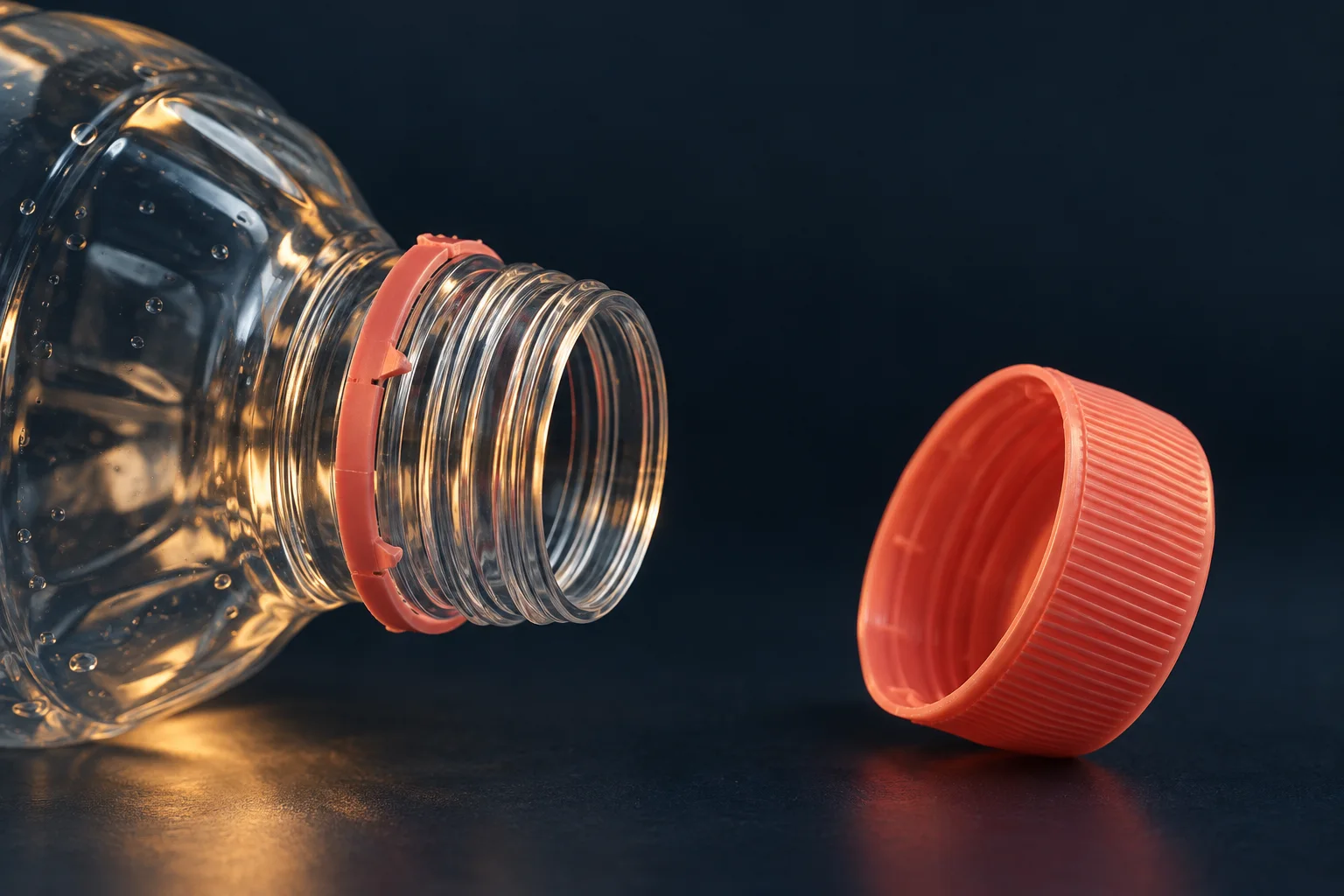
The cap's thread and the ring's catches meet different parts of the neck. The thread guides the cap upward as it turns. Lower down, inward projections on the ring bear beneath a retaining ridge. Those contacts stop the ring following the cap's rise.
EP0573138A1 describes a plastic closure with these projections and breakable bridges. Its particular bridge shapes control how separation progresses. The underlying conflict is simple: the cap rises along its thread while the catches keep the ring below the neck ridge.
The connections give way
As the cap moves and the ring is restrained, tension and shear load the bridges. Their reduced sections are designed to fracture. The bridges are distributed around the closure and needn't all break at the same instant.
The broken band provides opening evidence. It isn't the bottle's sealing surface. A cap liner addresses leakage at a different contact, while the band makes a change visible after the closure has moved. A retained ring alone cannot certify everything that has happened to the contents.
Some caps are meant to stay attached
A cap that stays tethered after opening isn't necessarily failing to separate. A manufacturer can preserve a deliberate connection while other bridges provide the opening indication. Berry's documented tethered closure keeps the cap attached after its tamper-evident band breaks.
So look at the intended connection before treating every remaining strip as a broken part. The detachable-ring version and the tethered version can both reveal first opening, but they leave the cap in different places. A permanent tether preserves a path from the cap to the band even after the weak connections have separated.
Sources: Berry Global, now hosted by Amcor Packaging Solutions
The thing to remember
The cap rises while the neck holds the band down. Thin bridges break between them; a separate tether can be designed to remain.
What this example leaves out
This explains a threaded plastic closure with a retained breakaway band, using a patent as a design example. Bridge shapes, opening sequences and tethers vary. Opening evidence is distinct from sealing and does not make a container tamper-proof.
Sources & further reading
Source access dates are listed below. Manufacturer descriptions and patents support the specific constructions described, not every product.
- Container closure with frangible bridges — EP0573138A1 ↗
European patent publication via Google Patents · Retrieved 2026-10-16 · Threaded skirt rises, ring protrusions retained under neck band, weakened bridges fracture under tension/shear; bridge shapes can control separation order.
Description paragraphs148–159 and bridge-sequence explanation read. Selected design example, not all current bottle caps. The original drawing simplifies contacts and does not reproduce exact proprietary bridge profiles. - Berry and Coca-Cola Collaborate to Implement Tethered Closure ↗
Berry Global, now hosted by Amcor Packaging Solutions · Retrieved 2026-10-16 · A deliberate tether can keep a cap attached after the tamper-evident band breaks.
Actual redirected article paragraph127 read. Used only for construction exception; no regulatory, recycling, sales, sustainability or adoption claims adopted.