Look a little closer
See the mechanism
Porosity supplies more than the outside surface
Read the diagram
Water vapor can reach the porous silica inside a permeable sachet. The beads provide internal surfaces that bind water; pore condensation can also contribute as conditions change. Uptake is finite and depends on humidity, temperature and exposure history, rather than making an unlimited water sink.
Original nested-scale pore sketch, not molecular imaging or a pore-size measurement. Blue circles indicate retained water without imposing a monolayer-only mechanism. Bead, pore and water-symbol scales differ. No regeneration instruction, uptake rate, capacity number or toxicity conclusion is shown.
Diagram basis: Clariant: porous amorphous silica and water uptake; Silica research: adsorption and pore condensation.
Sources: Clariant · Materials15(17),6031 (2022); primary article via Europe PMC
The bead has more surface than its outside suggests
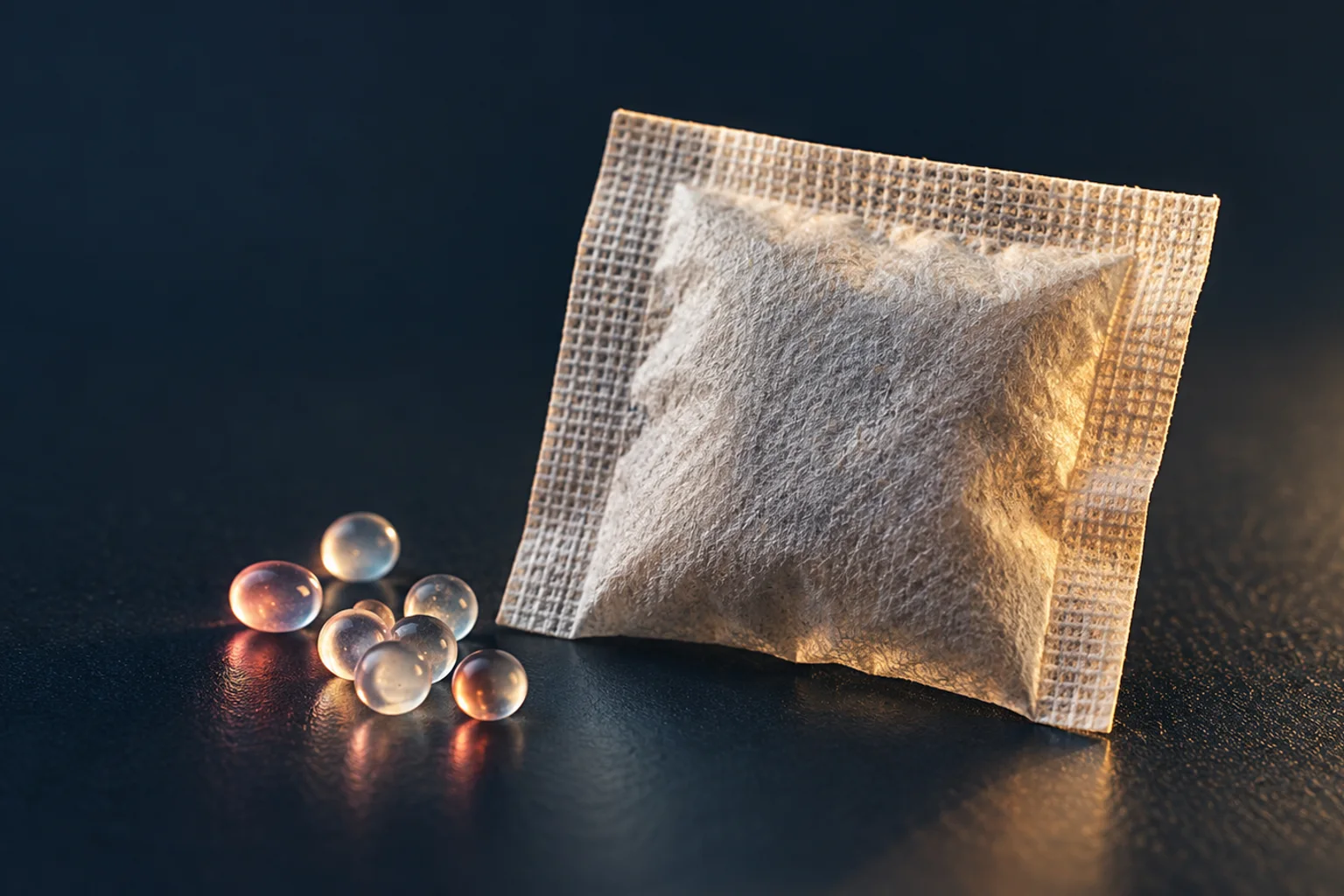
Silica gel is a highly porous form of amorphous silicon oxide. A bead's visible outline encloses a much finer network of channels and pores. Water molecules reaching those spaces encounter internal surfaces, not just the outside of a smooth glass marble.
Clariant describes its Sorb-It silica gel binding water within intersecting channels while remaining free-flowing. The word gel doesn't mean the packet contains a squishy puddle. The familiar desiccant can be supplied as solid particles with a porous structure.
Sources: Clariant · Materials15(17),6031 (2022); primary article via Europe PMC
Water attaches within that pore network
Adsorption describes water associating with a material's surfaces. The spelling is close to absorption, but the surface is the important feature here. A small packet can offer internal pore surfaces that its external size doesn't reveal.
Water uptake isn't always only a single molecular layer. Research on silica gel also describes condensation within pores under suitable humidity conditions. Water can collect inside that fine network while the bead retains its overall shape and remains a solid particle.
Sources: Materials15(17),6031 (2022); primary article via Europe PMC · Clariant
A packet works with a limited moisture load
The amount silica gel holds changes with humidity and temperature. Its condition also reflects how much moisture it has already encountered. That is why a packet protecting a package is not an unlimited sink for water entering from its surroundings.
The outside can still look dry after substantial vapor uptake, so appearance alone isn't a moisture gauge. Nor does a sachet's presence identify its contents: other desiccant packets use clay or molecular sieves. They may look similar while taking up moisture differently.
Sources: Clariant · Materials15(17),6031 (2022); primary article via Europe PMC
The thing to remember
Silica gel's pore network supplies internal surfaces for water uptake. The process can leave the particles dry-looking, but it doesn't give them infinite capacity.
What this example leaves out
This explains silica-gel moisture adsorbents, not every packet found in packaging. The pore drawing is conceptual, with no claimed pore size or capacity. It isn't guidance for ingestion, home heating, packet reuse or drying damaged electronics.
Sources & further reading
Source access dates are listed below. Manufacturer descriptions and patents support the specific constructions described, not every product.
- Desiccant Types and Performance — Sorb-It Silica Gel ↗
Clariant · Retrieved 2026-10-16 · Highly porous amorphous silicon oxide; water uptake within intersecting channels; dry/free-flowing particles; humidity/temperature-dependent capacity; other adsorbent families differ.
Sorb-It sections read, web lines55–58,82–89. Gated technical documents not read. Numeric capacity/rate claims, home regeneration and toxicity conclusions not adopted. - Investigation of the Kinetics of Hysteresis Effects in Silica Gel ↗
Materials15(17),6031 (2022); primary article via Europe PMC · Retrieved 2026-10-16 · High internal surface area; surface adsorption and pore condensation contribute under different conditions; uptake/desorption depends on humidity and exposure history.
MDPI direct429/403 and PMC CAPTCHA; full-text XML actually fetched from https://www.ebi.ac.uk/europepmc/webservices/rest/PMC9457172/fullTextXML. Relevant sections2.1,2.3,2.5 and4.1–4.2 read. No numeric pore size/capacity/RH thresholds generalized to every sachet. This source prevents a monolayer-only story.