
Look a little closer
See the mechanism
Wetting and squeezing change the network
Read every step
- Wet open network. Water occupies connected voids in the wettable cellulose structure. Wetting can also swell the cellulose walls. The network is open and deformable, rather than a collection of rigid sealed water bags.
- Squeezed network. Compression reduces the available pore volume and pushes some interstitial water out. The walls and gaps change shape. This selected squeeze is qualitative; it does not assign a universal pore shape or amount of water released.
Original open-network model, not microscopy. Scale, wall arrangement and compression are qualitative. The squeeze comparison concerns an already wet sponge; it is not a measured wicking or swelling sequence. Cellulose wall wetting and swelling are distinct from simply filling fixed holes.
Diagram basis: Ha et al. 2018: wetting and swelling cellulose sponge; MacMinn et al.: compressing porous material expels interstitial fluid.
Sources: Jonghyun Ha et al.; Science Advances2018 · 3M / Scotch-Brite · Christopher W. MacMinn, Eric R. Dufresne and John S. Wettlaufer; research manuscript
The holes are part of a connected material
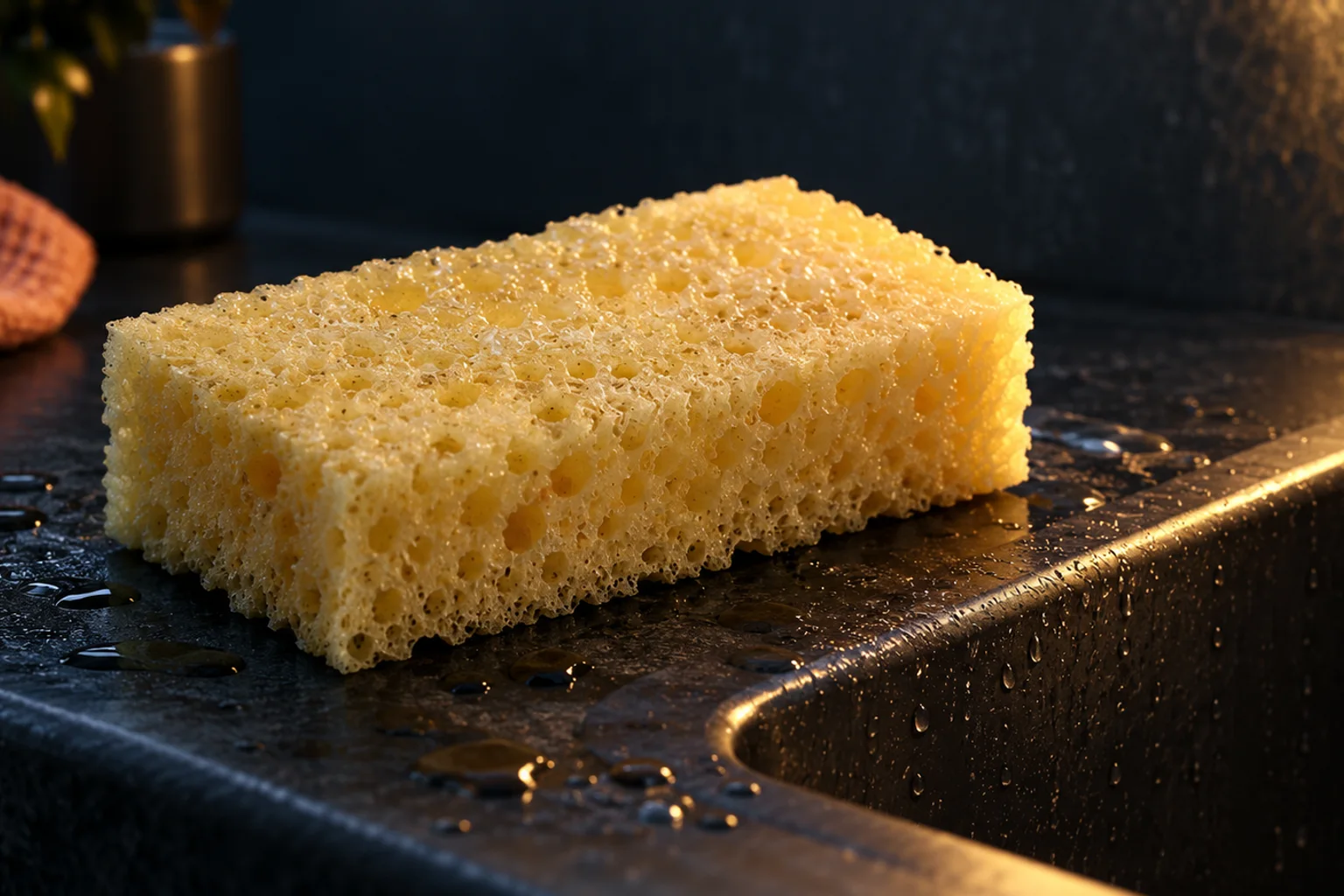
The large holes you can see are only one scale of the structure. Research on commercial cellulose sponge describes porous cellulose walls surrounding larger voids. Water can advance through the wettable network rather than waiting for every visible cavity to be dipped below the surface.
That helps explain why a sponge can draw liquid from a wet surface. The material contains paths into its interior, and wetting can continue beyond the first contact.
The walls change while they get wet
In the studied cellulose sponge, water uptake and expansion occur together. The authors attribute this swelling to wetting of the cellulose walls, not simply rising pressure inflating the large holes. The network itself changes as the wet front advances.
Scotch-Brite's description of cellulose scrub sponges likewise identifies water filling their holes. That everyday picture is useful, but the detailed research shows why holes alone aren't the whole explanation: their surrounding material also interacts with the water.
Sources: Jonghyun Ha et al.; Science Advances2018 · 3M / Scotch-Brite
A squeeze makes less room for the liquid
Compress a water-filled porous material and liquid can be driven out as its solid framework deforms. MacMinn and colleagues use squeezing a kitchen sponge as an example of this general interaction between a material and the fluid in its pores.
Compression reduces the open space, so water can flow toward and out of the sponge's exposed surfaces. Some moisture can remain in the porous walls and spaces after the visible flow stops.
Sources: Christopher W. MacMinn, Eric R. Dufresne and John S. Wettlaufer; research manuscript · Jonghyun Ha et al.; Science Advances2018
The thing to remember
A cellulose sponge takes in water through a wettable, changing pore network. Compression deforms that network and pushes some of its liquid out.
What this example leaves out
This selects a cellulose kitchen sponge. Polyurethane, natural luffa and other sponges differ. The figure is not a measured compression model, capacity test or hygiene recommendation.
Sources & further reading
Source access dates are listed below. Manufacturer descriptions and patents support the specific constructions described, not every product.
- Poro-elasto-capillary wicking of cellulose sponges ↗
Jonghyun Ha et al.; Science Advances2018 · Retrieved 2026-10-16 · Studied cellulose sponge has multiscale pores and wetting-driven wall swelling while liquid wicks.
Direct PDF fetched in memory; page index0 abstract, Introduction and Characteristics of cellulose sponges extracted/read with existing pypdf. Font encoding warnings occurred for symbols, so no exponents, sizes or equations adopted. No image pixels inspected. CC BY-NC source figures not copied. - Float Test — Regular Cellulose ↗
3M / Scotch-Brite · Retrieved 2026-10-16 · Cellulose scrub sponge has holes that take in water.
Regular Cellulose passage read. Manufacturer float/sink absorbency ranking not adopted or generalized; not a universal capacity test. - Fluid-driven deformation of a soft granular material ↗
Christopher W. MacMinn, Eric R. Dufresne and John S. Wettlaufer; research manuscript · Retrieved 2026-10-16 · Compressing fluid-filled porous material drives interstitial fluid out; authors explicitly use kitchen sponge example.
Abstract opening read. Compression shown only qualitatively; this paper experiments on granular monolayers, not a measurement of the depicted cellulose sponge or a precise pore collapse geometry.