Look a little closer
See the mechanism
Pressure acts behind opposed pistons
Read the diagram steps
Released circuit. The reservoir port communicates with the working chamber when released. Caliper seal recovery leaves small gaps between pads and rotor.
Braking pressure. The master seal passes the reservoir port, isolating the working volume. Pressure in the connected fluid acts behind both caliper pistons, pressing their pads toward the rotor.
Functional circuit assembled from source-bounded master-port and opposed-caliper principles, not a production assembly. Port location and gaps exaggerated; input linkage omitted and square-seal recovery simplified. No bleeding or service procedure.
Diagram basis: US20210331765; US7559414 port; EP4124523 rollback.
Sources: USPTO / Google Patents · SRAM · USPTO / Google Patents · EPO / Google Patents
The master piston starts the pressure rise
The hand lever pivots against a small piston in the master cylinder. Once the working chamber is closed from the reservoir during the braking stroke, advancing that piston displaces fluid toward the caliper and raises pressure as pad movement is resisted.
The hose contains this connected fluid volume. It transmits hydraulic pressure around bends without a sliding inner cable. The fluid moves enough to advance the pistons; it doesn't have to travel continuously around a loop to keep the pads pressed.
Sources: USPTO / Google Patents · USPTO / Google Patents
The caliper gives pressure a pushing surface
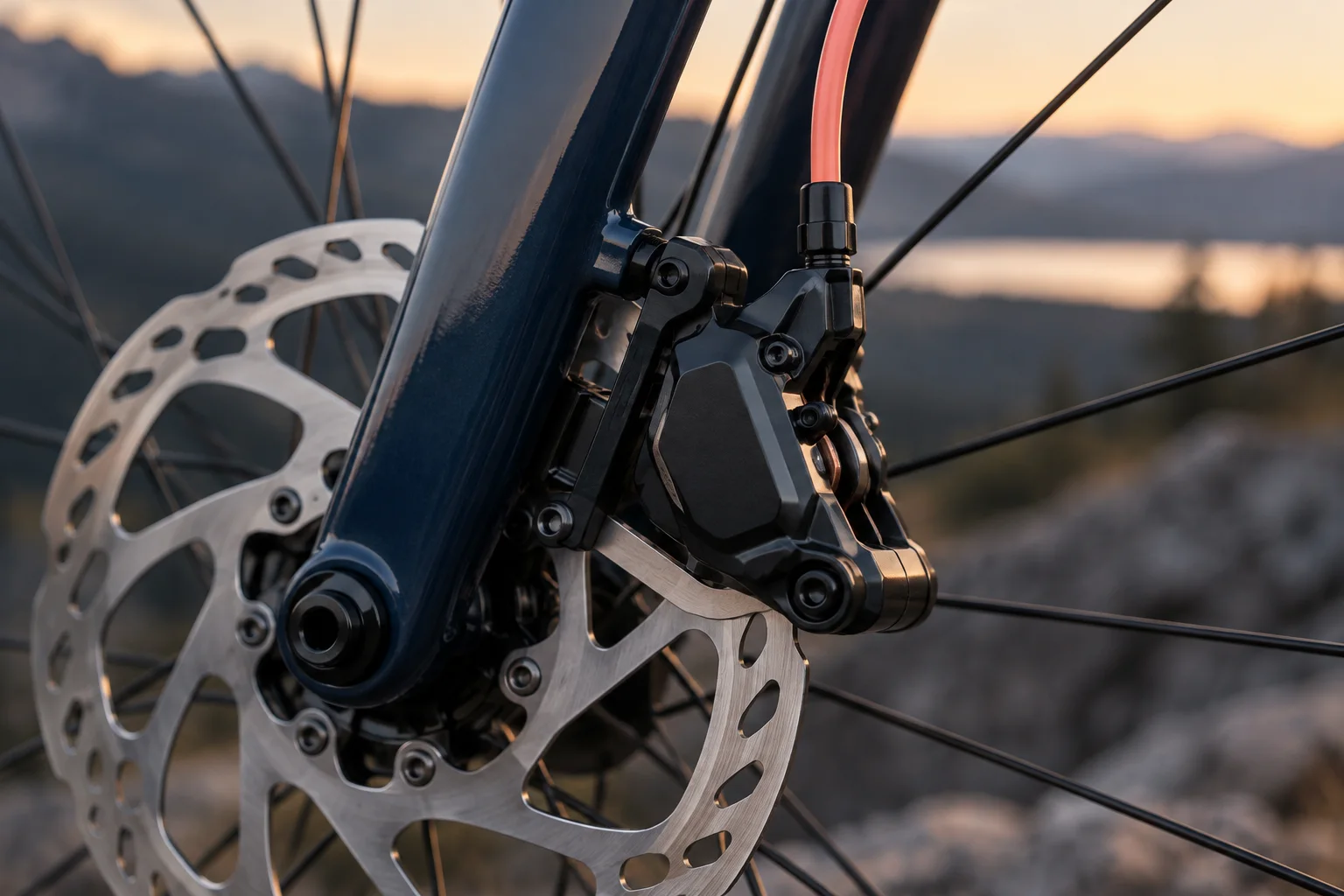
Fluid reaches chambers behind the caliper pistons. Pressure acting over a piston face produces force. Opposed pistons face a central rotor slot, so their pads approach the rotor from opposite sides.
The caliper body supports those chambers and is fixed to the fork or frame. The rotor turns with the wheel. Pad friction resists its rotation and transfers the reaction through the caliper mounting, while much of the lost mechanical energy becomes heat.
Sources: USPTO / Google Patents
Release needs only a small retreat
When master pressure falls, the caliper's elastic piston seals can recover from their deformation and retract the pistons slightly. SRAM's service documentation calls the resulting retreat pad rollback. The released gap is small compared with the full travel available as pads wear.
The reservoir accommodates changes in the system's fluid requirement when its port is open. It isn't an air chamber that the lever intentionally compresses. Gas in the working fluid can absorb piston travel by compressing, which is different from transmitting pressure through a largely incompressible liquid.
Sources: USPTO / Google Patents · SRAM · USPTO / Google Patents · EPO / Google Patents
The thing to remember
The master piston displaces fluid, pressure pushes the caliper pistons, and the pads apply friction to the wheel-mounted rotor.
What this example leaves out
The graphic simplifies an opposed-piston hydraulic circuit. Reservoir timing, piston counts, seals and fluid specifications vary. It provides no bleeding, repair, fluid-selection or braking-performance instructions.
Sources & further reading
Source access dates are listed below. Manufacturer descriptions and patents support the specific constructions described, not every product.
- US20210331765A1 — Brake system ↗
USPTO / Google Patents · Retrieved 2026-10-18 · Master Cylinder Assembly Figs3A–6C: piston110/spring130/pushrod135/reservoir port105b; Caliper Assembly Figs14A–14C: bodies305/310, opposed325pistons, square320seals,350pads/hose380.
Actual HTML and direct-fetched Caliper Assembly read. Simplified opposed-piston circuit, no universal linkage/piston count. Pressure-force and heat explanations elementary mechanics, no repair instructions. - G2 Ultimate and RSC Service Manual ↗
SRAM · Retrieved 2026-10-18 · Caliper piston/seal discussion: pad rollback and resulting pad/rotor clearance; service illustrations establish seal/piston arrangement.
Actual PDF text read. No service procedures, fluid choice or maintenance advice reproduced. - US7559414B2 — Symmetric master cylinder lever for a hydraulic disc brake ↗
USPTO / Google Patents · Retrieved 2026-10-18 · Summary first aspect: piston seal passes reservoir port, preventing reservoir communication during working stroke.
Actual HTML summary read. Specific port/seal circuit supports simplified master-cylinder phase, not universal port geometry or maintenance instructions. - EP4124523B1 — Bicycle hydraulic braking system of the disc type and related components and methods ↗
EPO / Google Patents · Retrieved 2026-10-18 · Description release sequence after Figs2–5: gasket34 recovers elastic deformation called roll back, returning piston33; reservoir return after main passage21 reopens.
Actual HTML release passage read. Supports elastic seal rollback and port reopening only; not exact depiction of entire selected caliper or recommended procedure.