Look a little closer
See the mechanism
The cable and housing draw the arm tops together
Read the diagram steps
Released pad gaps. The noodle supports the housing on one arm, while the inner cable crosses to a clamp on the other. Return springs hold the pads clear of the rim.
Pads against rim. Cable tension and housing reaction draw the tops together. Both arms rotate about pivots below the rim, bringing the pad faces against its metal sidewalls.
Selected V-brake. Motion and pad gaps enlarged; no pad placement, adjustment or riding instruction. Cable housing carries a reaction force rather than merely protecting the inner cable.
Diagram basis: Park Tool: linear-pull arms, noodle and cable.
Both ends of the pull act on the brake
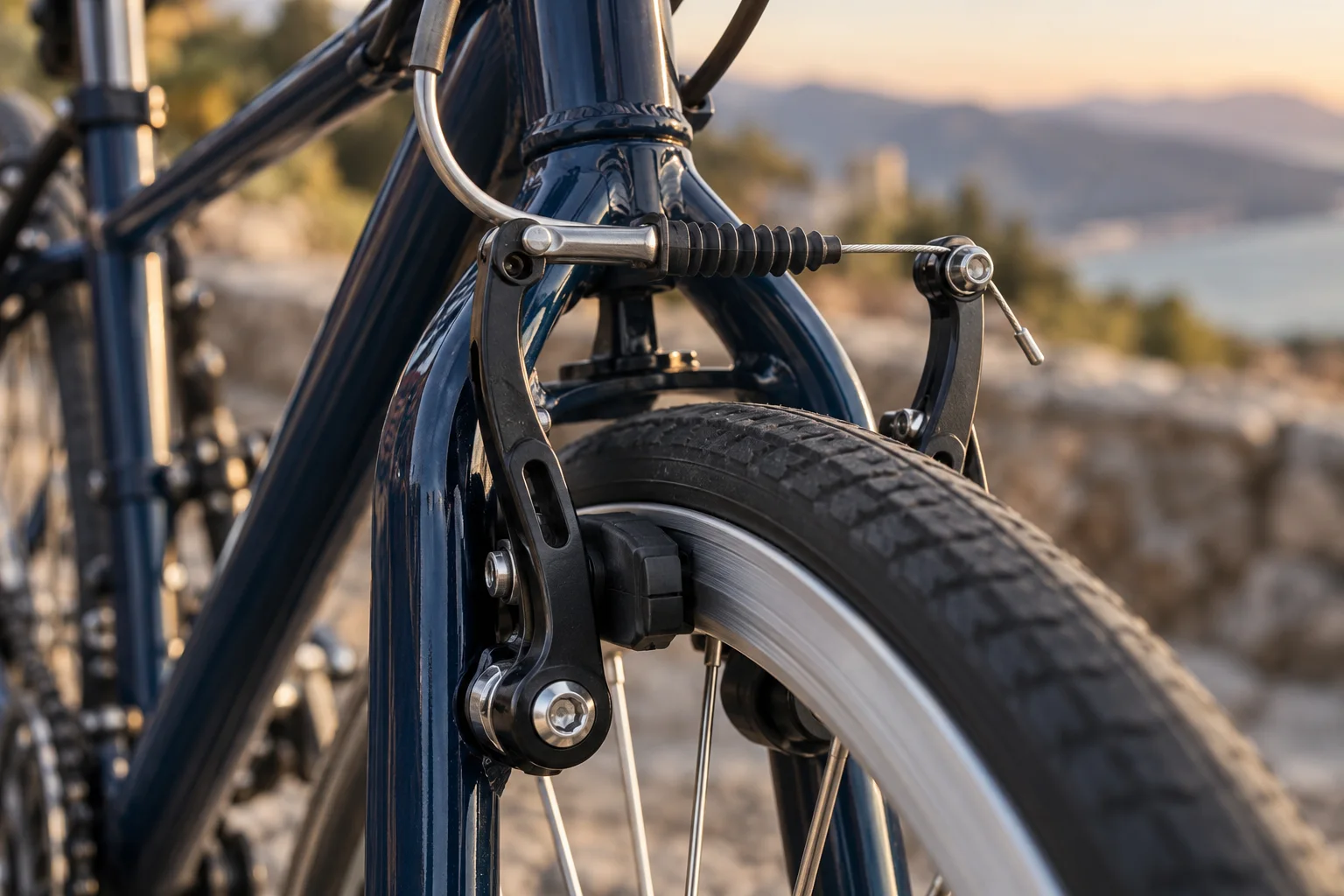
The curved metal tube often called the noodle supports the cable housing at one arm. The inner cable continues across the gap and is clamped to the other arm. Pulling the cable relative to its housing draws these two sides of the brake together.
The housing is part of the force path, not just a protective sleeve. Its supported end reacts against one arm while cable tension acts on the other. That arrangement lets a cable arriving from one side operate both arms.
Sources: Park Tool
The pads follow arcs toward the rim
Each brake arm rotates on a frame or fork fitting beneath the rim. The cable acts above the rim and the pad sits between the pivot and the cable connection. Arm rotation moves each pad inward along an arc.
The pad faces meet the rim's sidewalls. They don't squeeze the tire, and the rim isn't clamped at the hub. A disc brake puts its friction surfaces at a rotor near the hub instead; the V-brake uses the wheel rim itself as the rotating braking surface.
Squeezing creates friction; springs create clearance
Pad pressure produces a friction force opposing the rim's motion past the pads. Because that force acts at a distance from the wheel axis, it produces a braking torque. Mechanical energy is converted largely into heat at the contact.
When the hand lever stops maintaining cable tension, springs rotate the arms outward. Their job is to restore clearance. A spring that opens an arm and the friction force that slows the rim act at different points and do different work.
The thing to remember
The cable and housing draw the arm tops together; the pivots carry that motion to pads on the rim sidewalls.
What this example leaves out
This is a linear-pull/V-brake layout. Side-pull and center-pull rim brakes route forces differently. Pad condition, rim condition and setup affect braking; the schematic supplies no setup, repair or riding advice.
Sources & further reading
Source access dates are listed below. Manufacturer descriptions and patents support the specific constructions described, not every product.
- Linear Pull Brake Service ↗
Park Tool · Retrieved 2026-10-18 · Preliminary Info/Cable Attachment/Centering: pivots below rim, housing/noodle on one arm, clamp opposite, pad arcs and return springs.
Actual HTML read. Only mechanism facts; all installation, toe-in and torque instructions omitted. Friction/heat explanation is elementary analysis. - Rim Brake Identification ↗
Park Tool · Retrieved 2026-10-18 · Linear Pull/V-Brake section identifies pivots below rim and side cable force.
Actual search-retrieved page sections read; identification only, no performance or compatibility inference. - EV-BR-R353-3357 — SHIMANO V-BRAKE Brake ↗
Shimano · Retrieved 2026-10-18 · Parts record names brake arms, inner cable lead units and spring tension components.
Search-rendered exploded-view description and parts table read, not full PDF geometry; component corroboration only.