Look a little closer
See the mechanism
Sideways guide motion and cage rotation
Read the diagram steps
Outer sprocket position. The linkage positions the upper guide pulley beneath a selected sprocket plane. The lower pulley and cage take up the return chain path.
Inward sprocket position. Cable pull shifts the linkage inward in this conventional arrangement. The guide pulley changes the chain approach while the spring-loaded cage rotates to accommodate the changed path.
Rear-view sprocket planes and simplified chain-route inset combined; not a full drivetrain perspective. Both cage pulleys remain linked. Chain circulation is required for transfer.
Diagram basis: Park Tool: guide pulley, linkage and indexing.
Sources: Park Tool
The cable positions the guide pulley
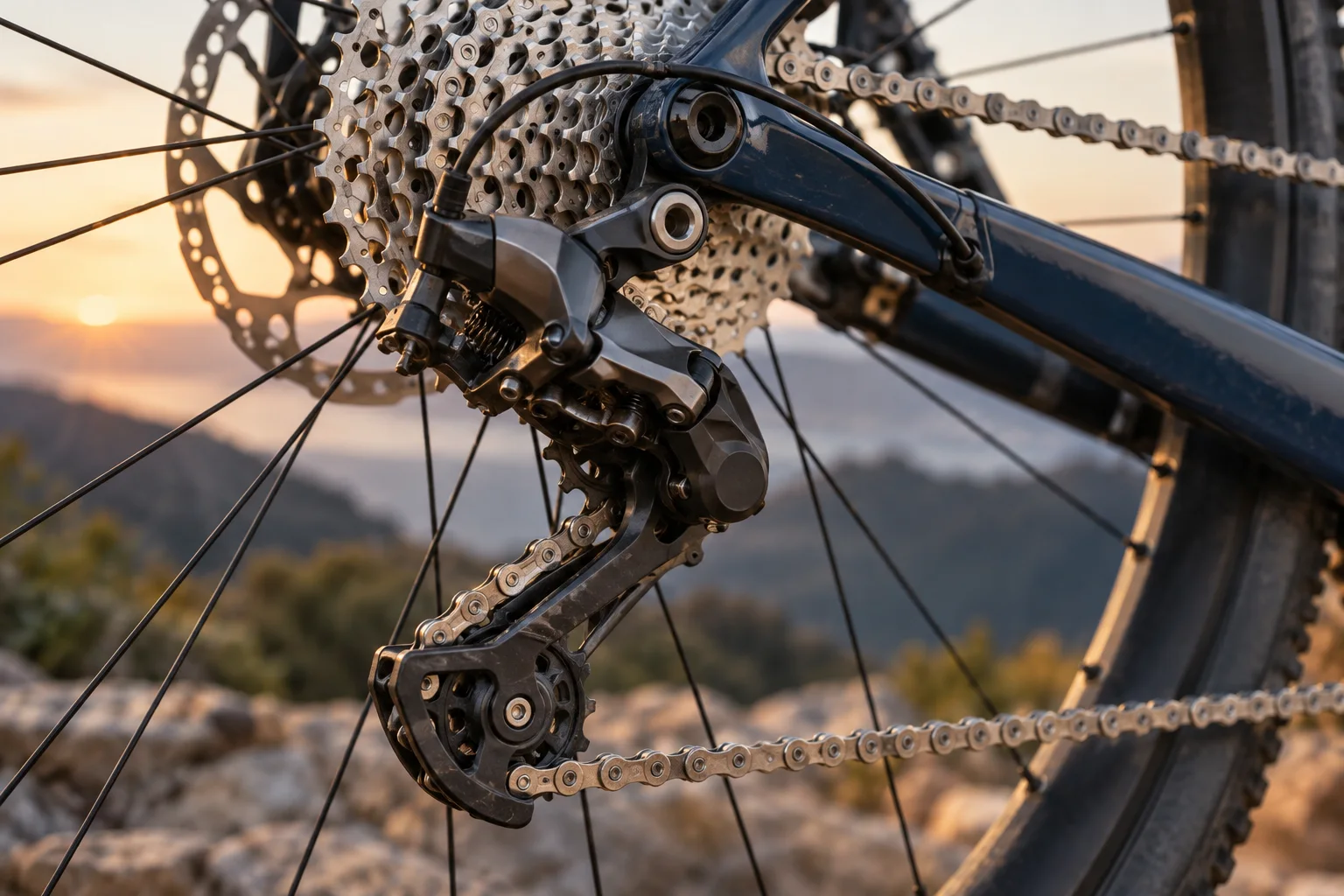
The derailleur's linked arms form a parallelogram that moves the pulley assembly across the sprockets. The upper pulley, called the guide pulley, determines the chain's approach to the cassette. Pulling or releasing a small length of cable changes that position.
On the conventional arrangement described by Park Tool, pulling cable moves the cage inward toward larger rear sprockets. Releasing cable lets the linkage spring move it the other way. Electronic derailleurs replace this cable actuation with a motor; the chain still needs a guiding path.
Sources: Park Tool
The chain has to follow the new approach
The guide pulley changes where the lower chain run approaches the cassette. As the chain circulates, its links arrive at the sprockets along that shifted path and can transfer to the neighboring set of teeth. Sideways positioning and chain circulation are different parts of the change.
An indexed shifter holds predetermined cable positions. Each click changes cable length by a set amount so the derailleur can align with a sprocket. The click doesn't grab and transport an entire stationary chain sideways.
Sources: Park Tool
A second movement keeps the chain path taut
A larger sprocket uses more chain around its circumference than a smaller one. The two-pulley cage can rotate to accommodate the resulting change in the available lower chain run. Its spring pulls the lower tension pulley backward to take up slack.
So there are two spring functions: returning the shifting linkage and rotating the cage to manage chain length. The guide pulley steers the chain, while the tension pulley helps keep its return path controlled. Those jobs remain distinct even though the pulleys share a cage.
Sources: Park Tool
The thing to remember
The linkage moves the chain guide sideways; the cage rotates to accommodate the changed chain path.
What this example leaves out
This follows a conventional cable-operated rear derailleur, not every spring direction, shifter or electronic system. It explains motion rather than adjustment, compatibility or safe riding condition.
Sources & further reading
Source access dates are listed below. Manufacturer descriptions and patents support the specific constructions described, not every product.
- How A Rear Derailleur Works ↗
Park Tool · Retrieved 2026-10-18 · Main body and Indexing: parallelogram, guide/tension pulley, cable inward/linkage return spring, cage chain slack and indexed cable positions.
Actual HTML read. Conventional mechanical derailleur; no adjustment, compatibility or universal spring-direction claim.