Look a little closer
See the mechanism
Heads face water; tails face grease
Read the diagram steps
An interface ready to separate. Surfactants gather at the grease-water boundary. Water-friendly heads face the water and oil-friendly tails extend into the grease.
Coated droplet and smaller micelle. Motion can detach grease as a coated droplet. A separate, much smaller micelle has oil-friendly regions inside. Wash water carries dispersed material away.
Droplet and micelle sizes are schematic and intentionally shown at different scales. Detergency alone does not establish disinfection.
Diagram basis: OpenStax: Soaps and Detergents; micelle basis: arXiv cond-mat/0402107.
Sources: OpenStax / Rice University · Author research manuscript / arXiv · Author research manuscript / arXiv · Thomas M. Schutzius and coauthors / author manuscript via arXiv
One molecule connects unlike surroundings
A surfactant has a water-friendly region and an oil-friendly region. At an oil-water boundary, the oil-friendly part points into the grease while the water-friendly part remains exposed to water.
That arrangement changes the interface. Water can spread more readily, and greasy material becomes easier to separate from a surface under the right washing conditions.
Sources: OpenStax / Rice University · Author research manuscript / arXiv
Grease can travel in more than one form
Detached grease may be dispersed as droplets coated with surfactant. Surfactant molecules can also assemble into small aggregates called micelles, with water-friendly regions outside and oil-friendly regions inside.
These are related but different pictures. A large grease droplet coated at its surface is not simply a giant drawing of one small micelle. Both help explain how oily material can remain dispersed long enough to leave with the wash water.
Sources: OpenStax / Rice University · Author research manuscript / arXiv · Thomas M. Schutzius and coauthors / author manuscript via arXiv
The wash still has work to do
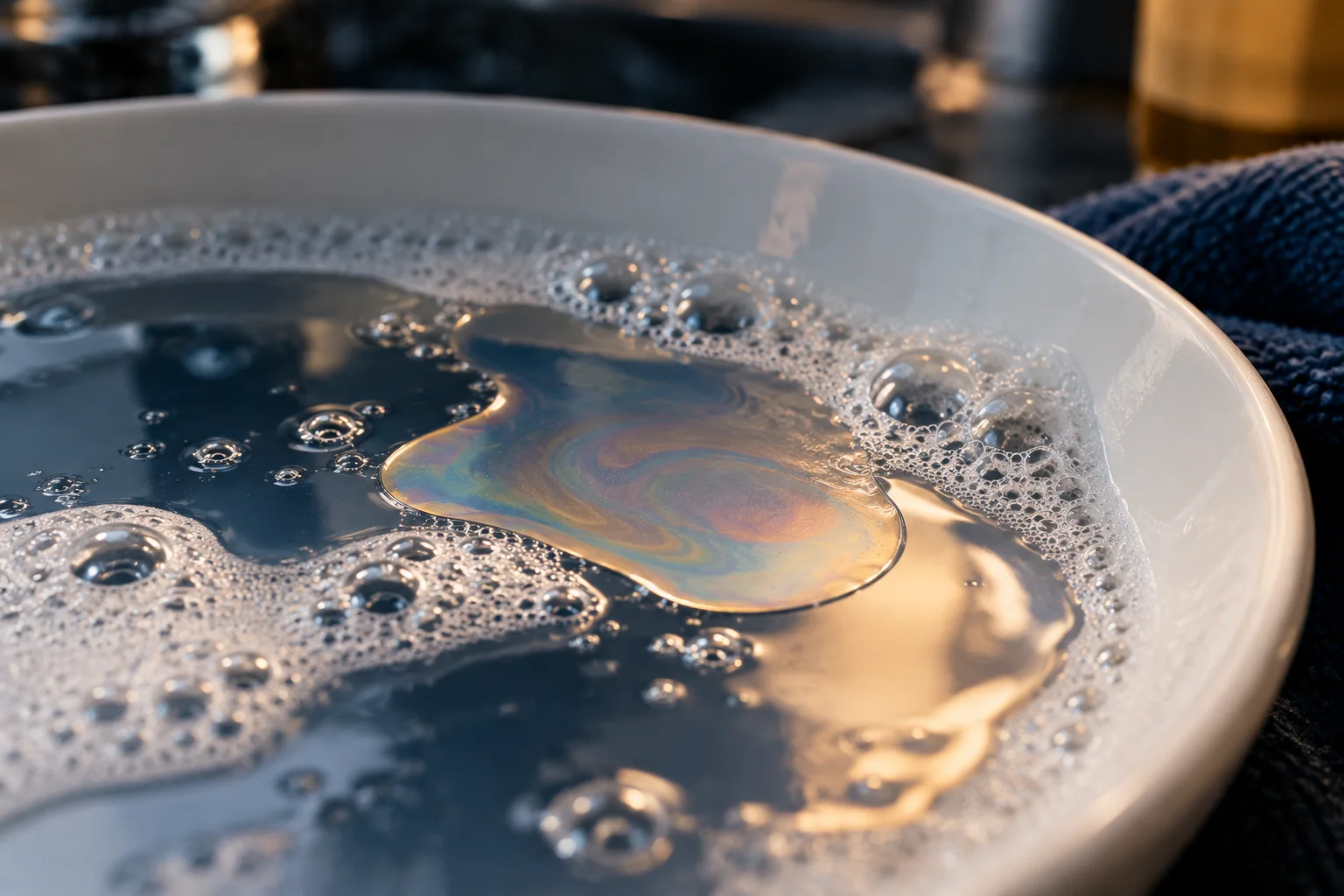
Rubbing, stirring or machine motion helps detach and break up soil. The result also depends on the surface, soil and detergent formulation. Foam alone does not show how much grease has been removed.
Sources: OpenStax / Rice University
The thing to remember
Detergent changes how grease meets water; washing motion and rinsing complete the removal path.
What this example leaves out
This is a surfactant explanation, not a complete account of enzymes, builders or every stain. Removing grease does not by itself establish disinfection or sterilization.
Sources & further reading
Source access dates are listed below. Manufacturer descriptions and patents support the specific constructions described, not every product.
- 11.5 Colloids — Chemistry 2e ↗
OpenStax / Rice University · Retrieved 2026-10-18 · Soaps and Detergents, lines69–79: oil-friendly/water-friendly regions, interface orientation and suspended oil; Preparation section lines55–60: mechanical dispersion/emulsions.
Actual complete relevant live HTML sections read; no copied images/text. General physical account, not cleaning performance. - Micelle Formation and the Hydrophobic Effect ↗
Author research manuscript / arXiv · Retrieved 2026-10-18 · Abstract/Introduction: amphiphilic molecules aggregate into micelles with polar exterior/nonpolar interior as a hydrophobic effect.
Actual full HTML abstract/introduction read; no numerical micelle size or idealized research prediction generalized. - Tuning contact angles of aqueous droplets on hydrophilic and hydrophobic surfaces by surfactants ↗
Author research manuscript / arXiv · Retrieved 2026-10-18 · Abstract: surfactants modify wetting/contact angle on surfaces.
Actual abstract read only, supporting qualified wetting statement; not all substrates made perfectly wettable. - Detergency and its implications for oil emulsion sieving and separation ↗
Thomas M. Schutzius and coauthors / author manuscript via arXiv · Retrieved 2026-10-18 · Water-soluble surfactants stabilize oil droplets in emulsion.
Read abstract; scope limited to surfactant-stabilized droplets and interfacial behavior, not all cleaning mechanisms or performance.