Look a little closer
See the mechanism
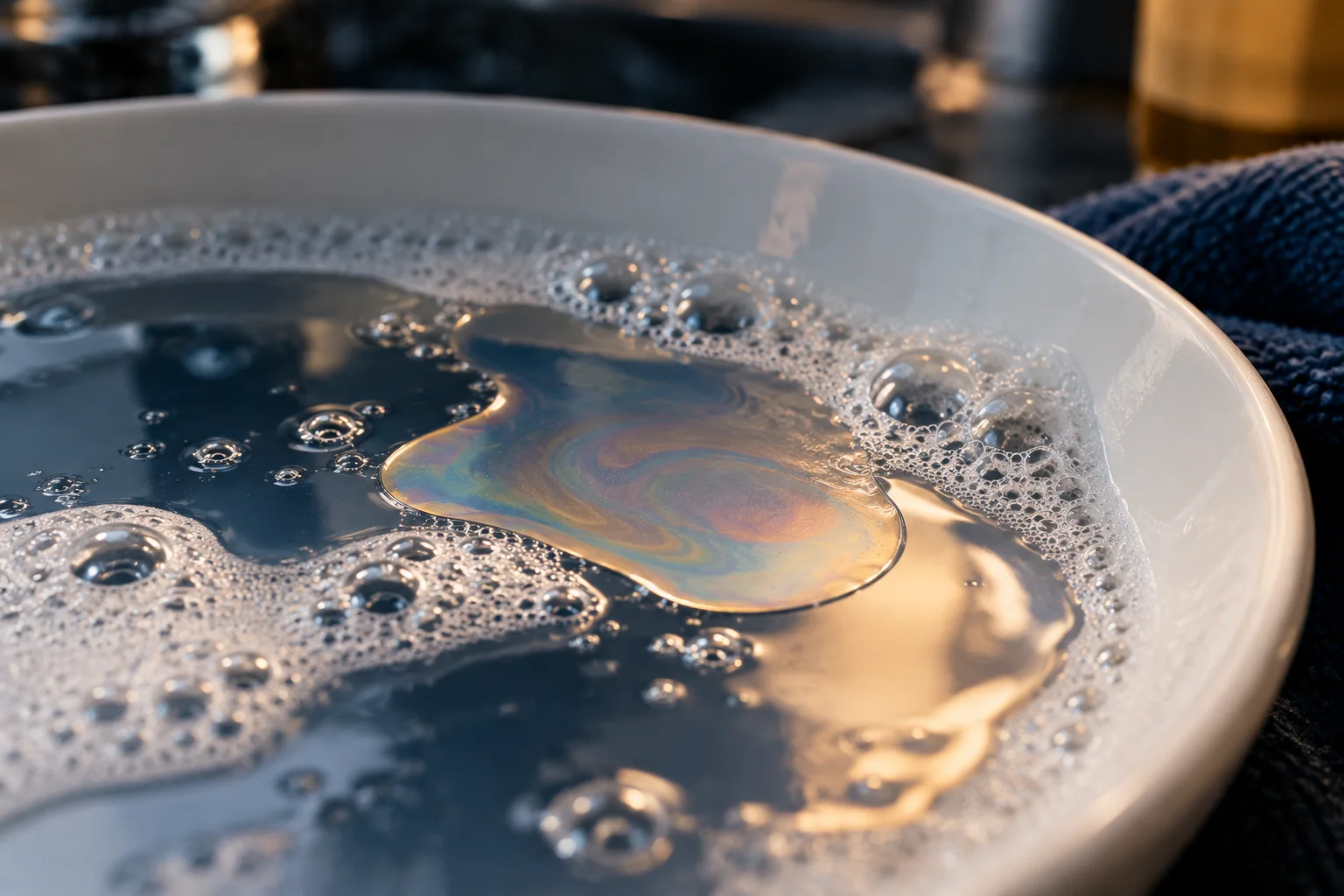
The film disperses into solution
Read the diagram steps
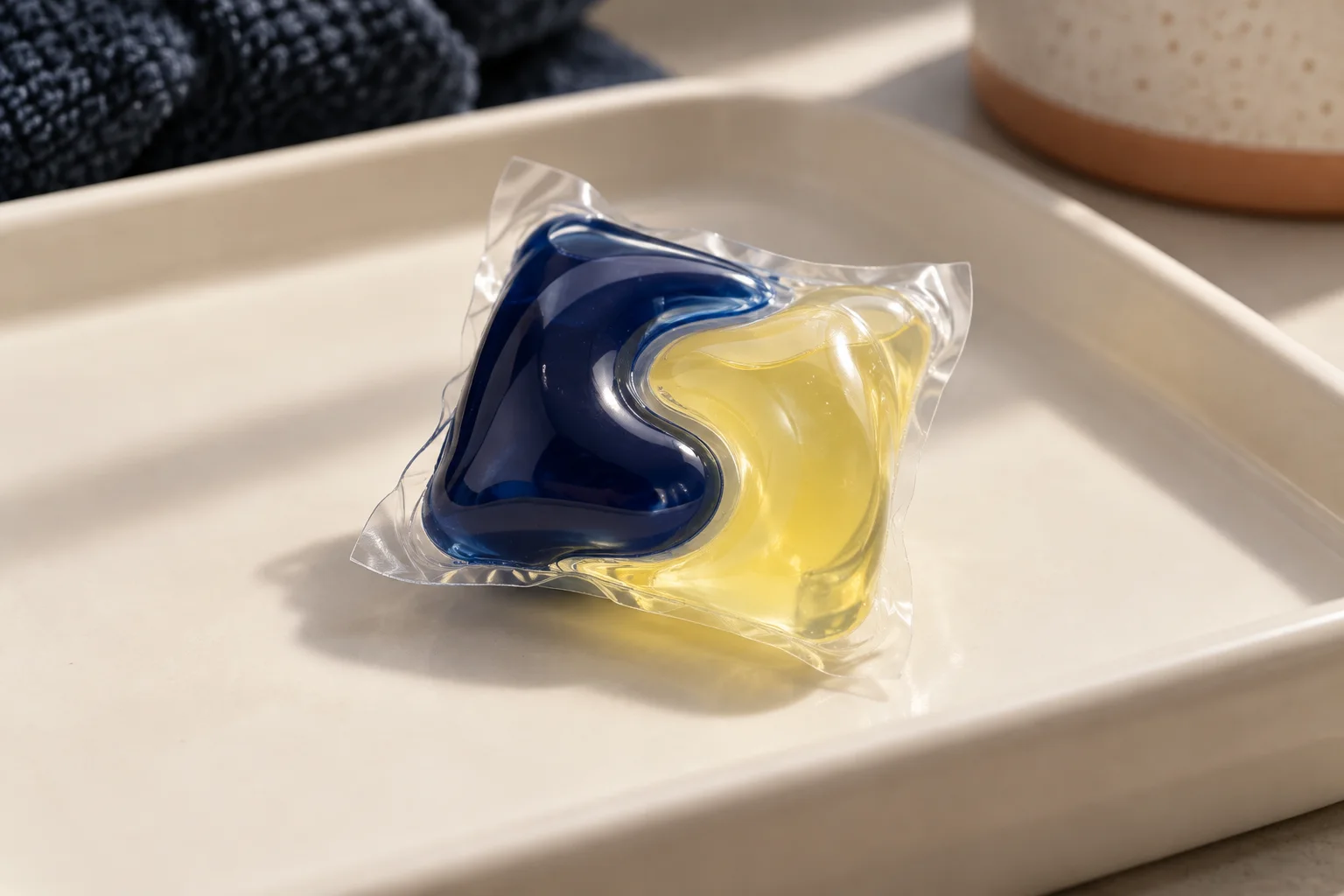
Coherent film. Long PVOH chains form a continuous wrapper around the detergent.
Water enters the film. Water interacts with the film and allows its polymer chains to separate and disperse.
Polymer remains in solution. The wrapper no longer holds a continuous shape. Dissolved chains remain material in the water; dissolution is not complete biodegradation.
Conceptual chain view; film grades and wash conditions change dissolution. No environmental degradation endpoint is shown.
Diagram basis: Kuraray PVOH grade properties; MonoSol film context.
Sources: Kuraray · Kuraray POVAL · MonoSol
A strong dry film can still be water-soluble
PVOH is a polymer: its molecules are long chains. Those chains form a coherent thin film around the detergent. Chemical groups along the chains interact with water, allowing suitable grades to dissolve.
Film makers adjust polymer properties for the application. Chain length, chemical modification and the degree of hydrolysis affect film strength and dissolution. PVOH is a family of grades, not one material with one fixed dissolving time.
Sources: Kuraray · Kuraray POVAL · MonoSol
The wrapper dissolves rather than simply melting
Dissolution spreads polymer through water. Melting would instead turn the material itself into a liquid through heating. A water-soluble wrapper can lose its form by dissolving without reaching a conventional melting temperature.
Water temperature and the formulation influence the rate. That makes both the film design and the conditions in the wash important to whether a wrapper disappears as intended.
Sources: Kuraray · Kuraray POVAL · MonoSol
Disappearing from sight is one stage
Dissolved polymer is still material in the water. Biodegradation requires further processes that break down the polymer; it is not another word for dissolution. Its extent depends on conditions beyond the wrapper opening.
Sources: Kuraray · Kuraray POVAL · MonoSol
The thing to remember
Water removes the film's continuous structure by dissolving its polymer; what happens to that polymer afterward is a separate question.
What this example leaves out
This describes PVOH-based detergent film. It does not establish complete degradation in every wastewater system or environment, and it is not advice for handling concentrated detergent pods.
Sources & further reading
Source access dates are listed below. Manufacturer descriptions and patents support the specific constructions described, not every product.
- Water-soluble PVOH film ↗
Kuraray · Retrieved 2026-10-18 · PVOH film used for detergent unit doses and dissolving upon water contact.
Read Overview. Broad environmental marketing statements are not treated as proof of complete degradation in every setting. - What Are the Degree of Polymerization and Degree of Hydrolysis of PVOH? ↗
Kuraray POVAL · Retrieved 2026-10-18 · Chain-length/chemical-group design affects film strength, water solubility and dissolution conditions.
Read definitions, property effects and high-water-soluble grades. No grade-specific temperature generalized to laundry pods. - Validated by Science — water-soluble materials ↗
MonoSol · Retrieved 2026-10-18 · Dissolution and biodegradation under appropriate conditions are distinct.
Read Validated by Science lines 118–121. Conditional manufacturer statement; no wastewater fate measurement or regulatory conclusion inferred.