Look a little closer
See the mechanism
A split filament changes the contact network
Read the diagram
In the documented polyester/polyamide parent-filament example, water jets split one composite filament into finer filaments. Those finer pieces form a nonwoven network with spaces and more surface contact for picking up particles. Physical pickup is different from killing microorganisms.
Original nested-scale schematic, not microscopy. The parent has 32 sectors to identify the documented Pie32 example; only selected separated filaments are enlarged at right. The lower contact inset uses a different scale. No universal fiber count, diameter, bacterial-removal rate, electrostatic mechanism or disinfection claim is represented.
Diagram basis: Vileda Professional: Pie32 splitting and mechanical particle pickup.
Sources: US Environmental Protection Agency archive · Vileda Professional / Freudenberg · Vileda
The useful scale is smaller than the visible thread
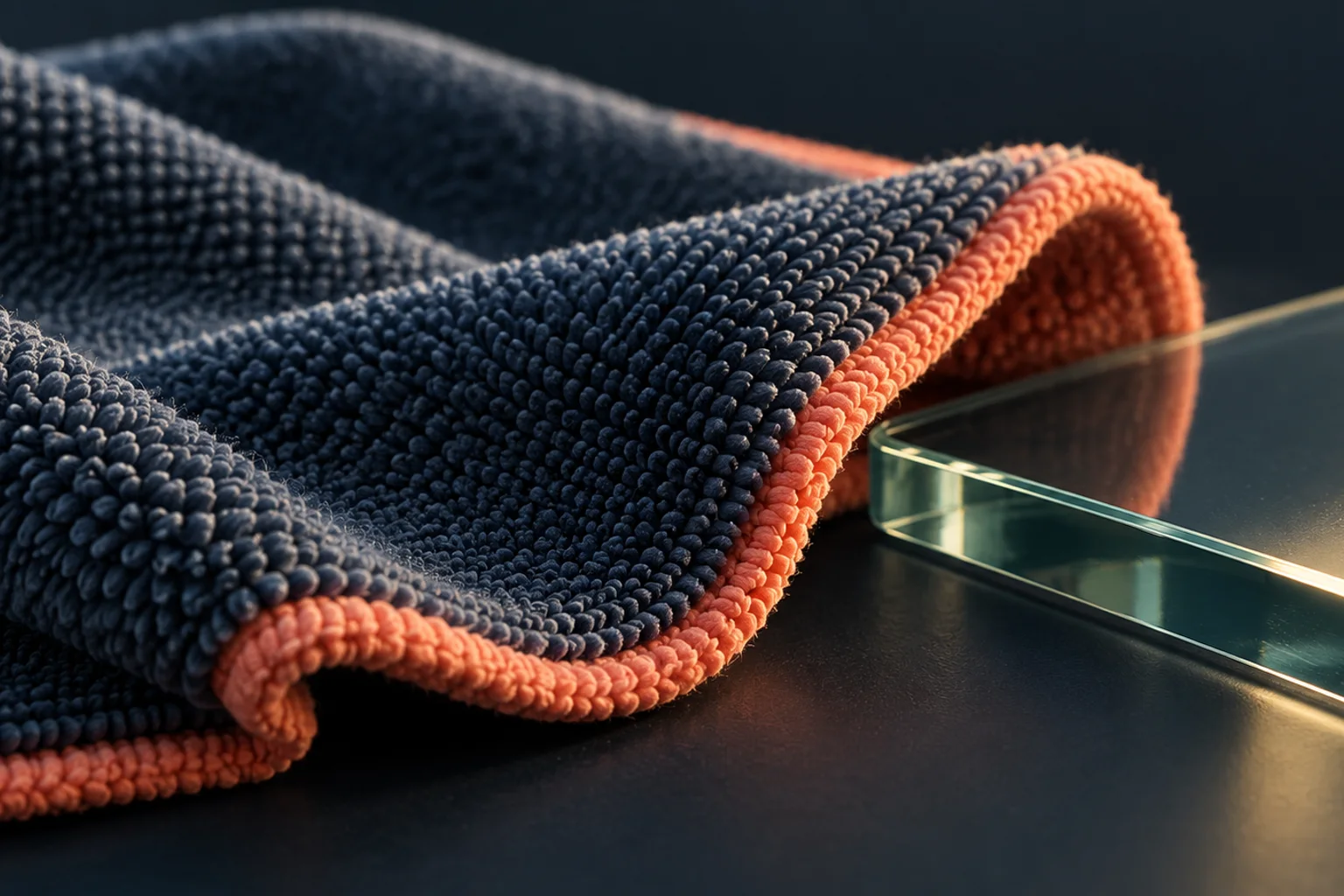
A cloth's visible texture can hide many much finer filaments. The EPA's archived microfiber-mop case study describes split polyester and polyamide fibers that scrape up and hold dust and dirt. Its language of tiny hooks is an analogy for pickup, not a drawing of literal claws on every filament.
Wiping needs both contact and retention. Moving particles across a surface is only part of cleaning; they must also leave with the cloth rather than simply settle elsewhere on that surface. The fine fiber network provides many places for that contact.
One documented process starts with a divided parent fiber
Freudenberg's Evolon Pie32 example starts with a polyester-and-polyamide parent fiber. High-pressure water jets split it into fine filaments and form a nonwoven structure. Vileda Professional describes particles being scraped and held in the small spaces between those filaments.
The fine filaments form a network with small spaces around them. As that network crosses a surface, particles can lodge among the filaments and leave with the cloth. The splitting process creates the finer elements; wiping brings them into contact with the dirt.
Sources: Vileda Professional / Freudenberg
Carrying something away doesn't mean killing it
A captured particle remains matter somewhere in the cloth or cleaning liquid. The same distinction matters when a product discusses microorganism removal. Vileda explicitly says its microfiber mops physically remove bacteria and viruses rather than kill them by the fibers alone.
The captured material has changed location rather than disappeared. Filaments touch, loosen and retain it as the wipe passes, leaving the cloth carrying what it removed.
Sources: Vileda
The thing to remember
Fine filaments create many small contacts and retaining spaces. Their mechanical pickup can remove material without destroying it.
What this example leaves out
The cross-section selects a documented split polyester/polyamide nonwoven example. Microfiber construction varies. It is not a microscope image, universal disinfection claim, scratch-free guarantee or product-performance comparison.
Sources & further reading
Source access dates are listed below. Manufacturer descriptions and patents support the specific constructions described, not every product.
- Using Microfiber Mops in Hospitals — Environmental Best Practices for Health Care Facilities ↗
US Environmental Protection Agency archive · Retrieved 2026-10-16 · Split polyester/polyamide cleaning fibers contact, scrape and retain dirt.
Actual PDF page index3 sidebar The secret of microfiber read through web extraction. Hooks/claws wording treated as analogy; historical institutional case study, not universal microbiological-performance evidence. - Not all microfibers are equal — here is what the science says ↗
Vileda Professional / Freudenberg · Retrieved 2026-10-16 · Specific EvolonPie32 polyester/polyamide parent fiber split by water jets; nonwoven filaments mechanically contact and retain particles.
How Pie32 Evolon process works paragraph read. No comparative superiority, complete soil release, numerical disinfection, service-life or green claims adopted. Selected construction not every microfiber. - Bacteria Removal ↗
Vileda · Retrieved 2026-10-16 · Maker explicitly distinguishes physical microorganism pickup from killing/disinfection.
FAQ Does microfiber kill all bacteria and viruses? and Will microfiber mop pads disinfect? read. Product test percentages excluded; no hygiene protocol or rinsing/temperature guarantee.