Look a little closer
See the mechanism
The fan moves air past a resistance heater
Read the diagram steps
Heater supplied. The fan draws air through the inlet. Current heats the resistance wire, and the stream carries heat toward the outlet.
Heater circuit open. The thermal switch interrupts heater current. Stored heat remains; the element does not become cold instantly. Airflow is shown separately.
Original functional schematic; dimensions and motion are exaggerated, not measured. Selected resistance-wire dryer. The fan circuit and reset behavior are not specified.
Diagram basis: US3943329A: parts 21, 23, 24, 29, 33.
Sources: Clairol Inc / Andrew E. Hlavac
The fan carries air past a hot wire
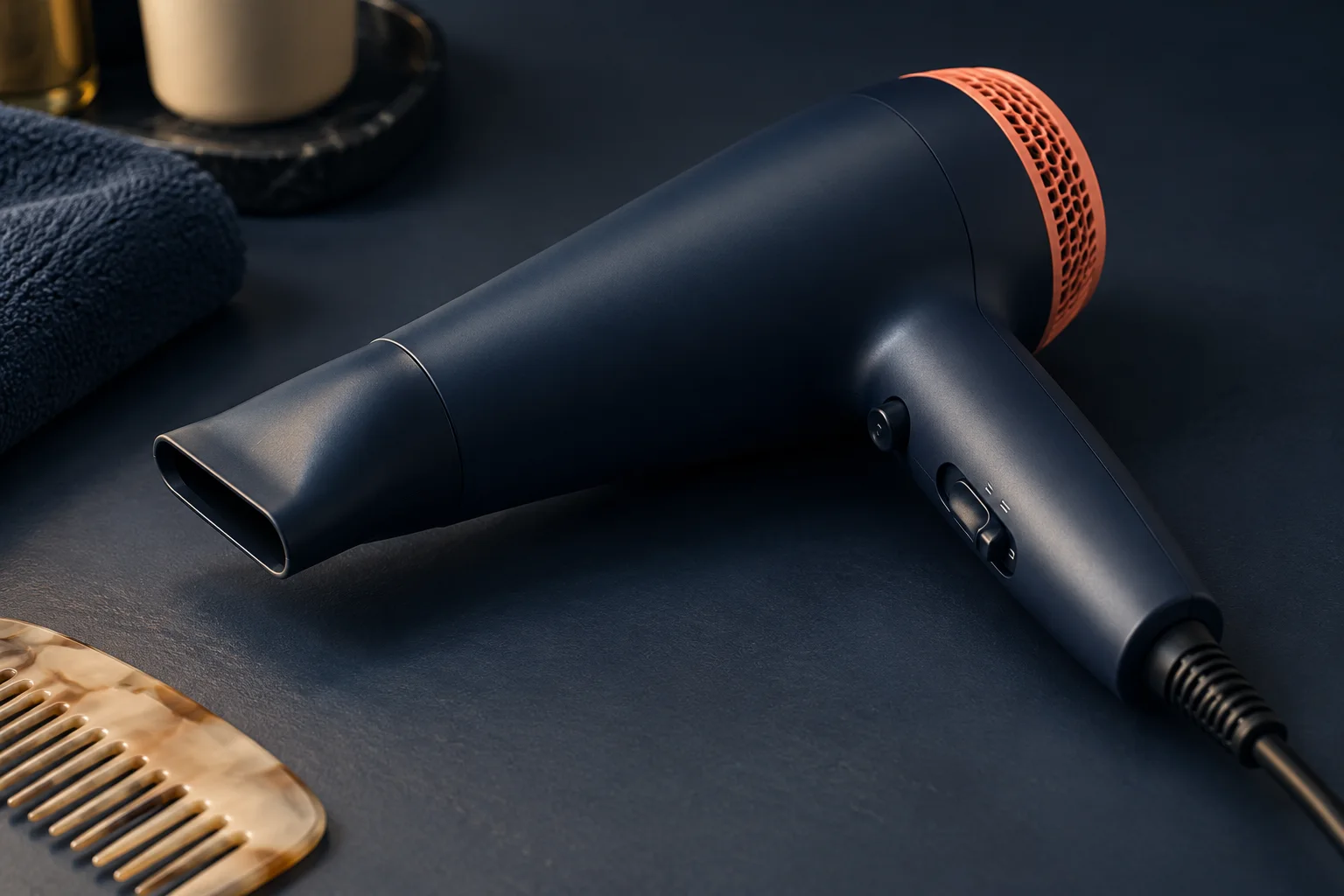
The blower draws air through an inlet and sends it toward the outlet. In the patent example, the heater runs along the nozzle, where the moving air passes it before leaving. The outlet points the stream rather than producing the heat.
The heater is resistance wire wound around an insulating support. Electrical energy becomes heat in the wire, and the passing air carries some of that heat away. The fan and heater therefore perform separate jobs along the same path.
Sources: Clairol Inc / Andrew E. Hlavac
A cutoff interrupts the heat supply
The documented design includes a thermal switch that opens the heater circuit during overheating. That interrupts current through the heater. The element can remain hot while its stored heat dissipates; opening a switch does not instantly cool the wire or the air around it.
Sources: Clairol Inc / Andrew E. Hlavac
The thing to remember
The warm stream needs both airflow and heat transfer from the element.
What this example leaves out
This describes a resistance-wire dryer and one documented cutoff arrangement. Heater layouts and temperature controls vary by model.
Sources & further reading
Source access dates are listed below. Manufacturer descriptions and patents support the specific constructions described, not every product.
- Hair dryer with safety guard air outlet nozzle (US3943329A) ↗
Clairol Inc / Andrew E. Hlavac · Retrieved 2026-10-18 · Motor-driven blower, inlet and outlet, resistance wire heater and overheat switch opening heater circuit.
Read description of parts 21, 23, 24, 29 and 33; HTML definitions and preferred embodiment. Selected resistance-wire dryer example, not a specification for every dryer.