Look a little closer
See the mechanism
Heat the bread, then end its exposure
Read the diagram
Bread is held between hot elements. Radiation transfers energy toward its faces, while heat-driven browning develops at the surface. A control stops heating. In the pop-up example a carriage rises; manual-eject toasters separate that movement from the end of heating.
Functional slot section. No particular retaining latch, thermostat, electrical wiring or browning time is represented. The upward arrow belongs to the carriage, not the heating wires.
Functional slot section. No particular retaining latch, thermostat, electrical wiring or browning time is represented. The upward arrow belongs to the carriage, not the heating wires.
Diagram basis: Dualit element guide; Breville BTA735 manual; Dualit manual ejector.
Sources: Dualit · Breville · Dualit · Exploratorium
A glowing element is a heat source you can see
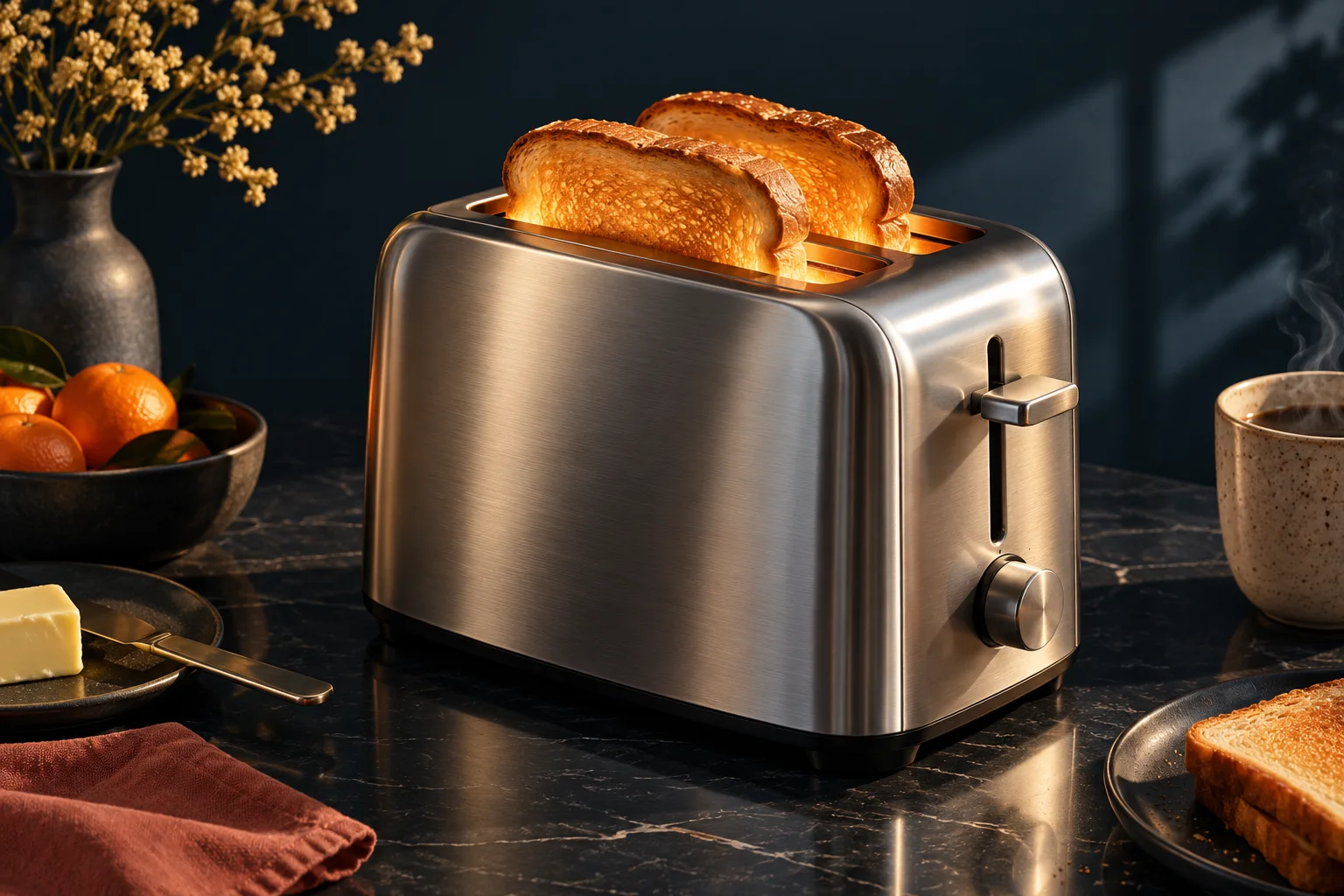
The wire element resists electric current, converting electrical energy into heat. As it becomes hot, it radiates energy toward the bread. Dualit's guide describes wire arranged across a supporting surface; there are other element constructions too. The bread faces these hot surfaces inside the slots, so it can receive heat without touching the wire.
The visible glow is only one part of the element's radiation. It is a useful sign of a hot source, not a map of the bread's eventual brown patches. Distance and exposure matter. A slice tilted toward one side, a thick edge and a surface hidden beside another object do not have the same view of the surrounding heaters. The slot is both a holder and a geometry for heat transfer.
Sources: Dualit
Warm bread and brown toast are different stages
Browning is more than a thermometer reading. As bread heats, its surface conditions change and reactions between sugars and amino compounds contribute new colors, flavors and aromas. The Exploratorium uses toast as an example of the Maillard reaction. That family of reactions helps explain why toast smells and tastes different from bread that has simply become warm.
Moisture also matters to the journey toward a dry, browned surface. Two slices can receive similar heating yet begin with different thicknesses, water content and ingredients. It follows that the control setting alone cannot specify the result. Sweet bread, a dense loaf and a thin slice should not be expected to acquire the same color merely because they occupied the slot for the same period.
Sources: Exploratorium
What the numbers actually promise
On the Breville BTA735, the dial is described as a browning control, with lighter and darker endpoints. The manual does not make its numbered settings a universal unit of minutes. Other toasters can have an actual timer. The name and operation of the control must be checked on the particular machine before interpreting a printed number.
Even a time-based control measures a process duration rather than a color. A timed exposure is not the same as a measurement of the bread's surface chemistry. This distinction is why a number that produces a good slice of one loaf may need adjustment for another. Treat the dial as a reproducible input for that toaster and bread combination, not a transferable temperature scale across appliances.
Sources: Breville
The toast is carried down and returned up
A pop-up toaster holds bread on a moving carriage during the heating cycle. At the end, the control stops heating and the carriage rises. Its exact retaining and release mechanism varies. A product's ordinary operating manual shows what the carriage does; it does not necessarily establish which latch or sensor lies behind that behavior.
Automatic ejection is not essential to the definition of a toaster. Dualit's NewGen design uses a mechanical timer and a manual ejector. Heating can finish while the bread remains down in the slots. Heating, deciding when to stop and moving the bread are separate jobs. Different products can combine them in different ways.
Frozen, bagel and Lift & Look change different things
Breville's frozen setting adds toasting time to accommodate the frozen starting condition. Its Lift & Look feature lets the carriage rise temporarily while the selected cycle continues. Dualit's guide also describes bagel arrangements that alter which side receives direct heating. These functions act on time, access or the pattern of heating; they are not interchangeable labels for more power.
This helps make sense of a toaster's controls without memorizing every button. Ask what changed: the slice's starting temperature, the length of exposure, the active elements or the carriage position. A mode that changes one of these cannot automatically compensate for all the others. A thick bagel's cut face and outer crust still present different surfaces even when the machine is designed to treat them differently.
The bottom tray is part of ordinary use
Crumbs fall away from bread and collect below the slots. A removable crumb tray provides access to that material without reaching into the heating area. The cited manuals and guide treat crumb handling and bread removal as user tasks with their own precautions. They do not make the exposed slots an invitation to inspect the mechanism.
The practical boundary is straightforward: use the supplied carriage, lift or ejector to retrieve bread, and follow the manual for cooling and cleaning. Breville warns against inserting metal utensils. A stuck slice does not justify improvising around energized elements. Understanding the machine should make its visible controls more intelligible; it does not require taking the safety-critical heating compartment apart.
Questions you might still have
Are toaster numbers minutes?
Sometimes a control is an actual timer, but many numbered dials request lighter or darker toast. The Breville example uses a browning scale. Check the particular toaster's manual before assigning time units to its numbers.
Why does frozen mode take longer?
The bread begins colder, so it has farther to go before toasting develops. On the cited Breville model, frozen mode adds time to the cycle; that does not establish how every toaster implements its frozen function.
Sources: Breville
Does every toaster pop up automatically?
No. Some toasters separate heating control from ejection. Dualit's NewGen uses a mechanical timer and a manual ejector, so the end of heating and the act of raising the bread are distinct events.
Sources: Dualit
The thing to remember
Toasting has three separate jobs: deliver heat, allow browning to develop, and end the exposure.
What this example leaves out
This explains ordinary slotted electric toasters. Control systems, heating elements and ejection differ, and the cited models are examples. The diagram shows heat and carriage functions without claiming an exact internal latch. Browning time is not a universal measure of food temperature.
Sources & further reading
Source access dates are listed below. Manufacturer descriptions and patents support the specific constructions described, not every product.
- How to buy the right toaster ↗
Dualit · Retrieved 2026-10-14 · Wire heating elements, slot and bagel options, bread-dependent results and crumb trays.
Manufacturer guide used for components and mode distinctions; durability and comparative claims omitted. - BTA735 Instruction Book ↗
Breville · Retrieved 2026-10-14 · Browning dial, carriage operation, frozen and Lift & Look functions, high lift and metal-utensil cautions.
Operation of one pop-up family; not evidence for every latch, timer or thermostat. - 2 Slice NewGen Toaster ↗
Dualit · Retrieved 2026-10-14 · This toaster uses a mechanical timer and manual ejector.
Specific counterexample to universal automatic pop-up claims; product marketing and life-expectancy statements excluded. - The Maillard Reaction ↗
Exploratorium · Retrieved 2026-10-14 · Heat-driven reactions between amino compounds and sugars contribute brown color, flavor and aroma, including toast.
Food chemistry facts only; no reproduction of the museum activity, temperature threshold or experiment.