Look a little closer
See the mechanism
Magnetic transfer, then ordinary heat transfer
Read the diagram
Alternating current in a coil creates a changing magnetic field through the glass. The field induces currents in a suitable metal pan base, where resistance generates heat. Heat travels from the pan into food and also back into the glass. The surface can stay hot after induction input stops.
Conceptual field loops and current symbols, not measured field lines, exposure levels or a heating-uniformity map. The pan base is exaggerated to separate the processes.
Conceptual field loops and current symbols, not measured field lines, exposure levels or a heating-uniformity map. The pan base is exaggerated to separate the processes.
Diagram basis: OpenStax eddy currents; DOE induction explanation; Bosch hob manual.
Sources: OpenStax, Rice University · U.S. Department of Energy · Bosch · Bosch
Energy crosses the glass without a glowing ring
An ordinary electric cooking ring becomes hot and transfers heat to a pan. Induction takes a different first step. Current in the coil creates a changing magnetic field. That field reaches through the cooking surface and induces currents within a suitable metal pan base. Electrical resistance in the base converts their energy into heat.
The coil and the pan do not need an exposed electrical connection. The current circulating in the pan is induced there, rather than delivered by a wire clipped to its handle. There are three linked parts to the transfer: current in the coil, the magnetic field and currents in the cookware. They are physically distinct, even though one process connects them.
Sources: OpenStax, Rice University
Why metal is not enough
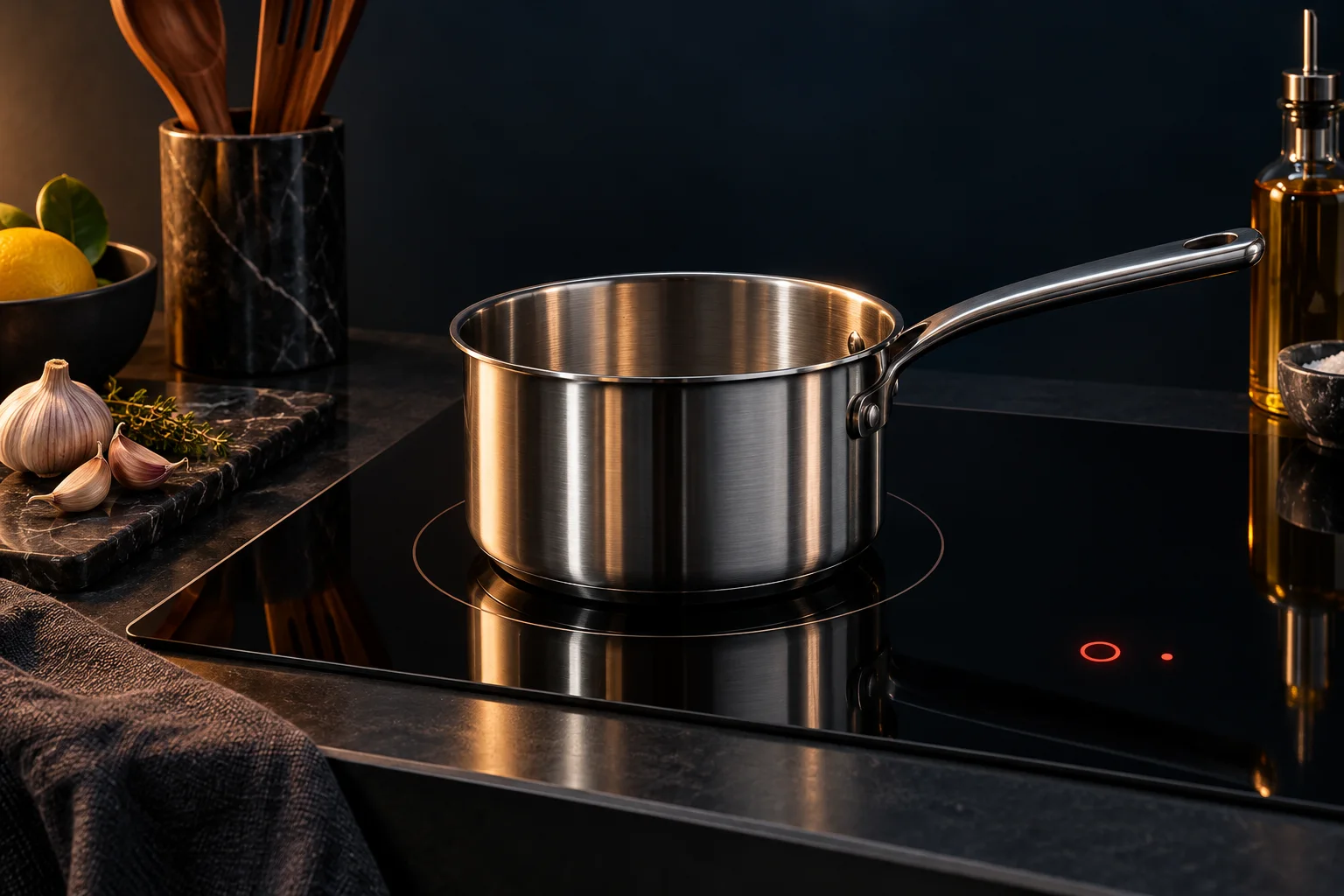
The usual domestic induction hob expects suitable magnetic cookware. Cast iron, steel and magnetic stainless-steel bases are common examples in Bosch's guidance. Plain aluminum, glass and ordinary copper cookware do not satisfy that requirement. A pan made partly from an otherwise unsuitable material can work if its base includes an appropriate magnetic layer.
That makes the base more informative than the material named on the packaging or visible on the sides. A copper-colored exterior does not establish what lies beneath it; neither does a stainless-steel label establish that its base is magnetic. A magnet sticking to the bottom is a useful first clue. It does not tell you whether the hob will recognize the pan at the chosen zone or how evenly the pan will cook.
Sources: Bosch
The magnetic footprint can be smaller than the pan
Bosch's PXX...D6..2 manual distinguishes the total cookware base from the ferromagnetic area that actually couples to the field. If only part of the base is magnetic, heat initially develops in that part and then has to spread through the rest. The manual also describes recognition problems when the base material or size is unsuitable.
A large-looking frying pan can therefore have a much smaller effective heating footprint. The upper rim diameter is especially unhelpful for judging the base. This is a concrete reason to consider shape, base construction and position together. Compatibility means the machine can supply energy to the pan; it does not guarantee that every place across a wide cooking surface instantly receives the same heat.
Sources: Bosch
Induction heats cookware, not a meal through a force field
The Department of Energy describes induction as transferring energy to the cookware. From that hot metal, heat travels into food in familiar ways. The pan surface contacts its contents, and liquids can circulate as they warm. The cooking method changes where heat is generated first; it does not make the pan-to-food part of cooking disappear.
This distinction prevents a tempting but incorrect extension of the idea. An induction hob is not a microwave oven for a saucepan. The food is not being heated by the same mechanism as the metal base. A thick piece of food still needs time for heat to travel inward. The pan's construction, the amount of food and contact with the cooking surface remain consequential.
Sources: U.S. Department of Energy
The surface can burn you after induction stops
The glass-ceramic surface is in contact with a hot pan, so heat travels back into it. Removing the cookware can stop new induction heating while leaving both the pan and the surface hot. Bosch's cited manual includes a residual-heat indicator that can remain illuminated after the cooking zone is switched off.
Advertisements often compress this into the claim that only the pan heats. As a description of the main energy-generation location, that helps distinguish induction from a radiant heater. As a claim that the surface stays safe to touch, it fails. The direction of the initial electromagnetic transfer does not prevent later thermal transfer in the opposite direction. Absence of a visible glow is particularly poor evidence of a cool surface.
Sources: U.S. Department of Energy · Bosch
Changing the setting changes input, not stored heat
Induction can change the energy supplied to a compatible pan promptly when its control setting changes. But the pan and the food already contain thermal energy. Reducing input cannot remove that stored energy instantly. A heavy pan may continue warming its contents after the supply is lowered or switched off.
Keep those two responses separate when judging cooking behavior. The electrical system responds to the command; the meal responds to the changing thermal balance. A responsive hob can still be paired with cookware that changes temperature slowly. It is more useful to ask how much heat is entering and where existing heat can go than to assume the entire cooking system has the same response time as its electronics.
Sources: Bosch · OpenStax, Rice University
Questions you might still have
Can an aluminum pan work on induction?
A plain aluminum base generally will not work on a conventional domestic hob. A pan with aluminum in its construction may work if it has an appropriate magnetic base layer. Check the cookware and hob requirements.
Sources: Bosch
Why does a compatible pan sometimes fail to register?
Recognition can depend on the magnetic base area, diameter and placement, not only whether a magnet sticks. Bosch's cited manual describes unsuitable size or material as reasons a selected cooking zone may not detect cookware.
Sources: Bosch
Is the glass cool as soon as I remove the pan?
No. Heat from the pan can remain in the cooking surface after new energy input has stopped. Follow the residual-heat indication and the appliance's instructions; do not use a touch test.
Sources: U.S. Department of Energy · Bosch
The thing to remember
Induction changes the location where heat starts. It does not eliminate heat storage or heat transfer.
What this example leaves out
This covers conventional domestic induction hobs and ferromagnetic cookware. Other induction technologies and specialized all-metal systems differ. Coil geometry, recognition thresholds and control methods are model-specific. The magnetic-field sketch is conceptual; it is not a map of exposure or heating uniformity.
Sources & further reading
Source access dates are listed below. Manufacturer descriptions and patents support the specific constructions described, not every product.
- 13.5 Eddy Currents ↗
OpenStax, Rice University · Retrieved 2026-10-14 · A changing magnetic field induces currents in conducting metal; induction cooktops heat the pan base.
Basic physics facts only; no textbook artwork, exercises or numeric efficiency claims. - Making the Switch to Induction Stoves or Cooktops ↗
U.S. Department of Energy · Retrieved 2026-10-14 · Energy is transferred electromagnetically to suitable cookware; a hot pan transfers heat back to the surface.
Cooking mechanism and residual warmth only; incentives, comparative savings and medical guidance omitted. - What is induction cookware? ↗
Bosch · Retrieved 2026-10-14 · Magnetic iron/steel bases and layered cookware; a magnet is a useful compatibility clue.
Conventional domestic induction cookware. Magnet test is a clue, not a guarantee of detection, heating uniformity or safety. - PXX...D6..2 Induction Hob Instruction Manual 9001469461 B ↗
Bosch · Retrieved 2026-10-14 · Ferromagnetic area, base size and placement affect recognition and heating; residual-heat indication persists after switch-off.
One hob family including a ventilation system; no universal minimum diameter, timeout, sensor or control implementation inferred.