Look a little closer
See the mechanism
One ramp, one stop
Read every step
- Pull through. The strap moves right through the head. A sloping tooth face pushes the flexible tongue upward so the next tooth can pass. The head stays in place while the strap advances.
- Pull back. The tongue has sprung down into the next gap. A pull to the left brings the steep tooth face against the tongue. That contact blocks backward travel; it does not provide the ramp that lifted the tongue during tightening.
Enlarged local contact schematic, not to scale or a manufactured tooth profile. The tongue flexes between states and the strap shifts right to the next engagement. Arrows show strap motion or attempted motion, not force magnitude. This depicts a one-piece plastic-pawl tie, not a smooth metal ball-lock tie.
Diagram basis: HellermannTyton: flexible tongue and strap serrations; HellermannTyton technical information, p. 22: plastic-pawl locking.
Sources: HellermannTyton · Bowthorpe Hellerman Ltd; United States patent publication via Google Patents · Avery Dennison Corporation; United States patent publication via Google Patents · Panduit
The buckle hides a springy catch
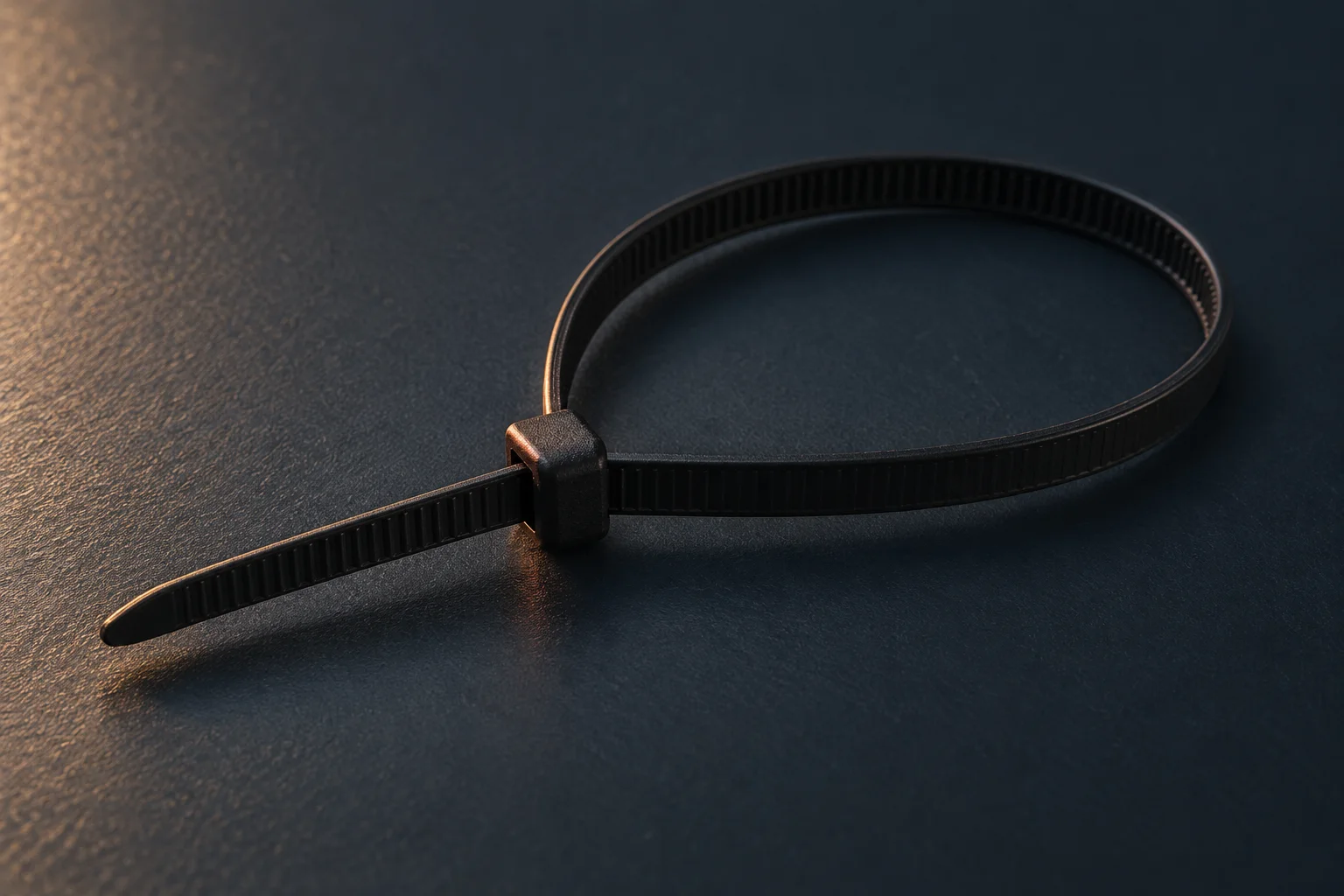
A zip tie makes a loop by feeding its free end through its own head. Inside a one-piece plastic-pawl design, the tongue is molded with the head. It can flex locally while the surrounding frame guides the strap. HellermannTyton describes this tongue engaging the strap's molded serrations.
That engagement gives the loop a series of holding positions. It doesn't need two long rows of fasteners to join. A zipper uses its slider to bring separate rows together; a zip tie feeds one strap through a catch at a single head.
Sources: HellermannTyton
Reverse the force, and the contact changes
While the tail advances, each passing tooth moves the pawl aside. Once the tooth has passed, the pawl can return toward the strap and engage again. That repeated flexing lets the loop tighten one holding position at a time.
Backward tension doesn't repeat that clearing movement. The locking faces meet, and the head takes the load. Patent US4009509A describes one version in which reverse tension turns the pawl toward the strap and presses the strap against the opposite wall. Its exact tooth arrangement is a design example, not the shape of every cable tie.
Sources: Bowthorpe Hellerman Ltd; United States patent publication via Google Patents · Avery Dennison Corporation; United States patent publication via Google Patents
A smooth strap can use another lock
Teeth and a plastic tongue explain the selected tie, but the product name covers other mechanisms. HellermannTyton also makes smooth stainless-steel ties that trap a small ball in the head. Panduit lists ties with metal barbs, two-wedge locks and two-piece construction. You can't identify all of those internal contacts from the familiar loop alone.
Releasable ties add a designed way to disengage their lock. That feature belongs to the particular closure; it doesn't follow from the presence of a plastic strap.
Sources: HellermannTyton · Panduit
The thing to remember
Tightening moves a flexible catch out of the teeth's path. Reverse tension brings the locking faces together, so the loop stays closed.
What this example leaves out
The cutaway explains a conventional serrated plastic tie with a flexible pawl. Tooth counts, hinge geometry, release controls and load limits differ. It is not an installation guide or a strength test.
Sources & further reading
Source access dates are listed below. Manufacturer descriptions and patents support the specific constructions described, not every product.
- Cable ties and zip ties for industry — How does a cable tie fastener work? ↗
HellermannTyton · Retrieved 2026-10-16 · Molded flexible tongue engages strap serrations; one-piece plastic-pawl family; different smooth-strap ball-lock and releasable mechanisms.
Sections How does a cable tie fastener work?, Cable ties with plastic pawls, Cable ties without serration, MBT metal ball-locking and releasable ties read. No universal strength or application guidance inferred. - Cable ties — US4009509A ↗
Bowthorpe Hellerman Ltd; United States patent publication via Google Patents · Retrieved 2026-10-16 · Selected ratchet-pawl design permits insertion and turns pawl to grip the strap against an abutment under reverse tension.
Abstract and description beginning As seen from one aspect read. A particular patented design supports the contact explanation, not prevalence, exact modern dimensions or performance. - Cable tie — US5956813A ↗
Avery Dennison Corporation; United States patent publication via Google Patents · Retrieved 2026-10-16 · Background description of insertion deflecting a hinged pawl and its return to engage a strap when insertion force is released.
Background paragraphs describing typical cable tie operation read. Not a claim that every mechanism or the original article drawing reproduces this patent's proposed improvement. - Cable Ties Product Selection Guide — CTSG05-SA-ENG ↗
Panduit · Retrieved 2026-10-16 · Documented diversity: metal locking barb, two-wedge locking, two-piece and releasable tie families.
PDF first page product-family list read. No certifications, material tables, service-life numbers or load ratings adopted.