Look a little closer
See the mechanism
Sloping teeth lift the crown
Read the diagram steps
Thin tips enter. Opposed thin tooth tips enter beneath the crown. The staple legs are still bent beneath the paper.
Thicker slopes lift. As the jaws close, thicker sloping tooth surfaces lift the crown. Contact near the legs helps straighten them during withdrawal; real legs may emerge unevenly.
Tooth-contact inset of conventional claws; hinge and handles omitted. Opposed tooth pairs interleave in depth. Tooth overlaps and staple bends are enlarged; variable-width patent teeth and damage-free removal are not asserted.
Diagram basis: US8083211 background; US2624545 leg support.
Sources: United States Patent and Trademark Office / Google Patents · United States Patent Office / Google Patents
A wedge changes the direction of movement
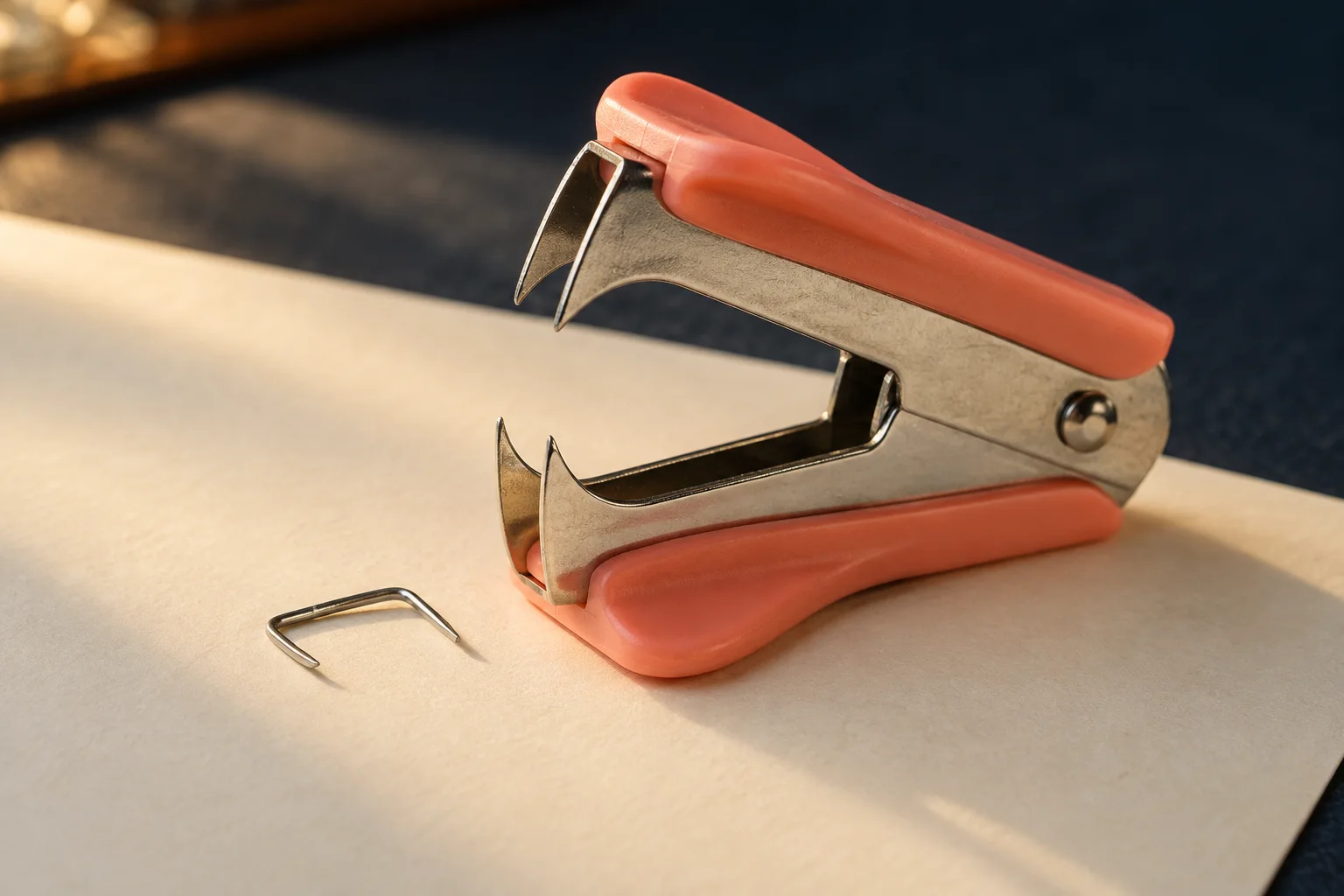
The crown is the short bridge of wire visible above the paper. Thin tooth tips can approach beneath it from opposite sides. Behind each tip, the tooth becomes thicker: its sloping upper surface pushes upward on the crown as the jaw moves inward.
The hinge guides the jaws through their closing arcs. It doesn't pull the staple out by itself. The useful contact is at the sloping teeth, where sideways movement becomes lift.
Sources: United States Patent and Trademark Office / Google Patents
The staple is still hooked through the paper
A stapler has already bent the two legs beneath the stack. Lifting only the crown asks those bent ends to follow it. They cannot pass through the original punctures unchanged; the wire must bend again as it is withdrawn.
Solid surfaces near the inside of the legs help straighten them during withdrawal. The teeth therefore do more than raise the crown: their position also controls where the legs bend. Lifting the bridge and freeing the hooked ends must happen together.
The two legs don't always come out together
Sliding metal against wire creates friction while the staple changes shape. One leg can emerge before the other, leaving the crown tilted and one end still caught. The neat symmetry of the two jaws doesn't guarantee symmetrical movement of the staple.
The opening spring resets the jaws when finger pressure is removed. It prepares the teeth for another closure; it is not the force that lifts the staple during the squeeze.
Sources: United States Patent and Trademark Office / Google Patents · United States Patent Office / Google Patents
The thing to remember
Opposing wedges lift the crown, while contact near the staple's legs helps reverse the bends that held the sheets together.
What this example leaves out
This is the hinged claw type. Sliding blade removers and other lever arrangements use different contacts. Paper condition, staple shape and unequal withdrawal affect the result; no damage-free removal is guaranteed.
Sources & further reading
Source access dates are listed below. Manufacturer descriptions and patents support the specific constructions described, not every product.
- US8083211B2 — Staple remover ↗
United States Patent and Trademark Office / Google Patents · Retrieved 2026-10-18 · Background describes opposed pivoted claws wedging under crown, sliding/lifting friction and unequal leg withdrawal; description at lines 263–284 in web read.
Article uses conventional claw discussion, not the patent's later optimized staged embodiment. Comparative inefficiency/force numbers omitted. - US2624545A — Staple remover ↗
United States Patent Office / Google Patents · Retrieved 2026-10-18 · Description opening: surfaces near inner legs straighten them during withdrawal. Opposed jaws pivot under handle force and reopen under spring; upper/lower camming tooth surfaces.
Actual HTML description read, including paragraphs on variable crown width. Flexible/spreading teeth are a particular invention, not ascribed to all claw removers.