Look a little closer
See the mechanism
Inclined guides move three jaws inward
Read the diagram steps
Jaws retracted. The common nut positions three jaws in inclined guides. Retracted jaws leave a wider opening around the central axis.
Jaws advanced. Advancing the jaws along the guides also brings their gripping edges inward. Three coordinated contacts grip the round shank.
Conventional threaded-jaw layout. Front and side views use different scales; only two jaws appear in the side section. No gripping-torque or runout guarantee.
Diagram basis: US5918887: threaded jaws and inclined passages.
Sources: USPTO / Google Patents · Jacobs Chuck
Forward is also inward
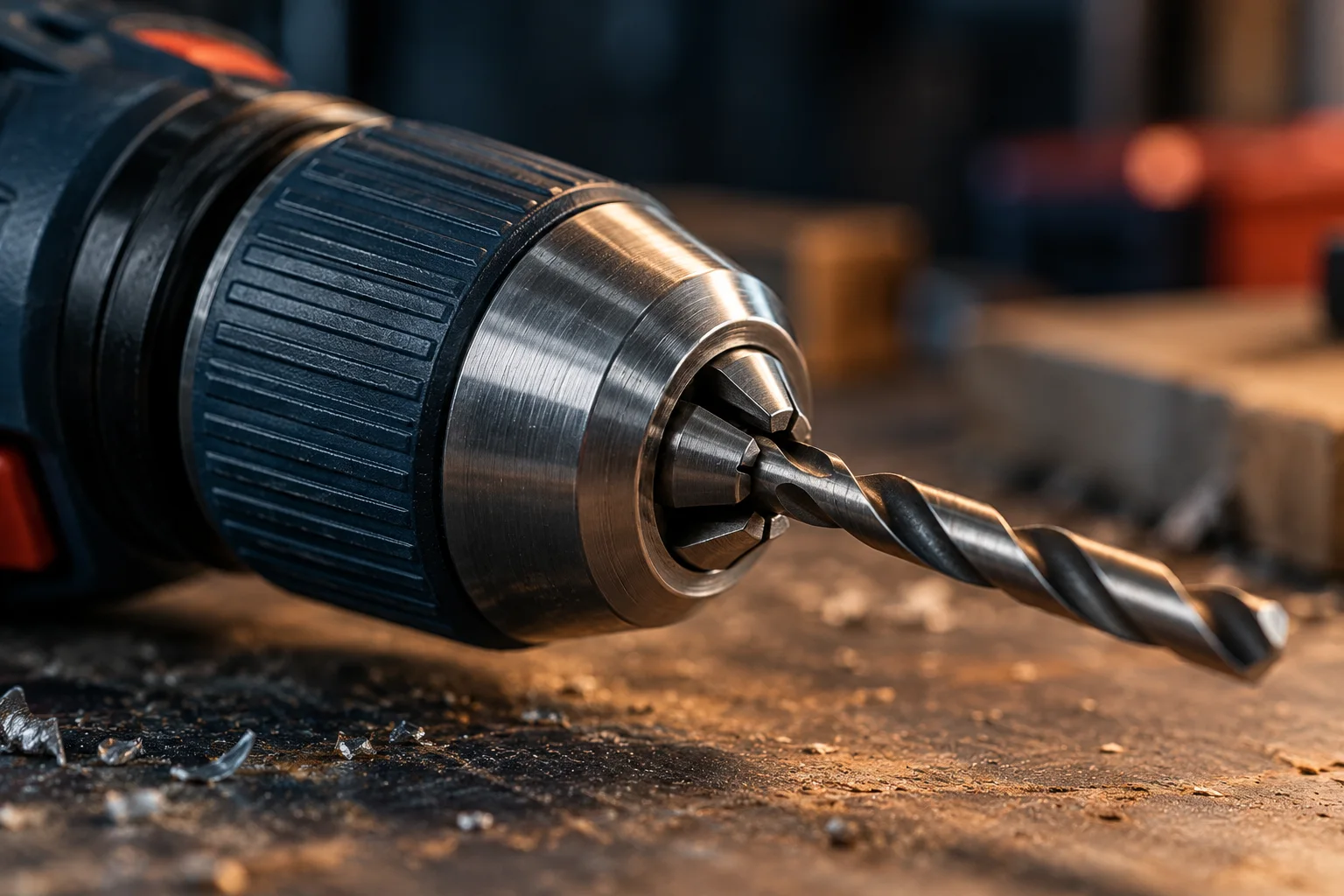
Look into the chuck nose and the three jaw tips surround the central opening. Inside the body, each jaw follows its own inclined passage. A jaw cannot simply move sideways at will: the guide determines its path.
As a jaw advances toward the nose, that path brings its gripping edge closer to the chuck axis. Retraction takes the edge outward, increasing the opening. The taper of the guides converts longitudinal movement into a change in gripping diameter.
Sources: USPTO / Google Patents
One threaded part coordinates the opening
A nut around the jaw assembly engages the threads on all three jaws. Turning the sleeve relative to the chuck body turns that adjustment mechanism. The jaws travel by corresponding amounts rather than being positioned separately with three controls.
In the conventional design discussed in U.S. Patent 5,918,887, the jaws have equal thread pitch, with their thread positions arranged to account for their different locations around the nut. That coordination lets the gripping edges approach the same central axis.
Sources: USPTO / Google Patents
The closed jaws carry the turning load
Once the three edges contact a round shank, further tightening produces clamping force instead of simply closing an empty gap. Contact between jaws and shank must then resist the bit turning relative to the chuck.
Keyless describes how the adjustment is driven: the hand turns the sleeve rather than applying a toothed chuck key. It doesn't specify one internal locking system. Some models add mechanisms to resist loosening; the basic jaw movement alone doesn't establish a torque rating or perfectly concentric rotation.
Sources: USPTO / Google Patents · Jacobs Chuck
The thing to remember
Equal threaded travel along three inclined guides closes the jaws around a shared axis.
What this example leaves out
This is the conventional threaded-jaw form. The source patent proposes a jaw/passage improvement; other keyless chucks use different internal drives and locks. The schematic is not a tightening, maintenance or accuracy guide.
Sources & further reading
Source access dates are listed below. Manufacturer descriptions and patents support the specific constructions described, not every product.
- US5918887A — Drill chuck with matching jaw and jaw passageways ↗
USPTO / Google Patents · Retrieved 2026-10-18 · BACKGROUND web215–217: three inclined passages, jaws120degrees apart, equal thread pitch/common nut and phase offsets; hand/keyless actuation.
Actual HTML background read. Conventional threaded-jaw mechanism, not all patented passage improvements or all keyless designs; no accuracy/torque rating. - Professional Keyless Chuck ↗
Jacobs Chuck · Retrieved 2026-10-18 · Product category identifies anti-loosening features among professional keyless chucks.
Search tool returned full short category text read; explicit open Internal Error. Supports added anti-loosening feature existence only, no magnitude or geometry.