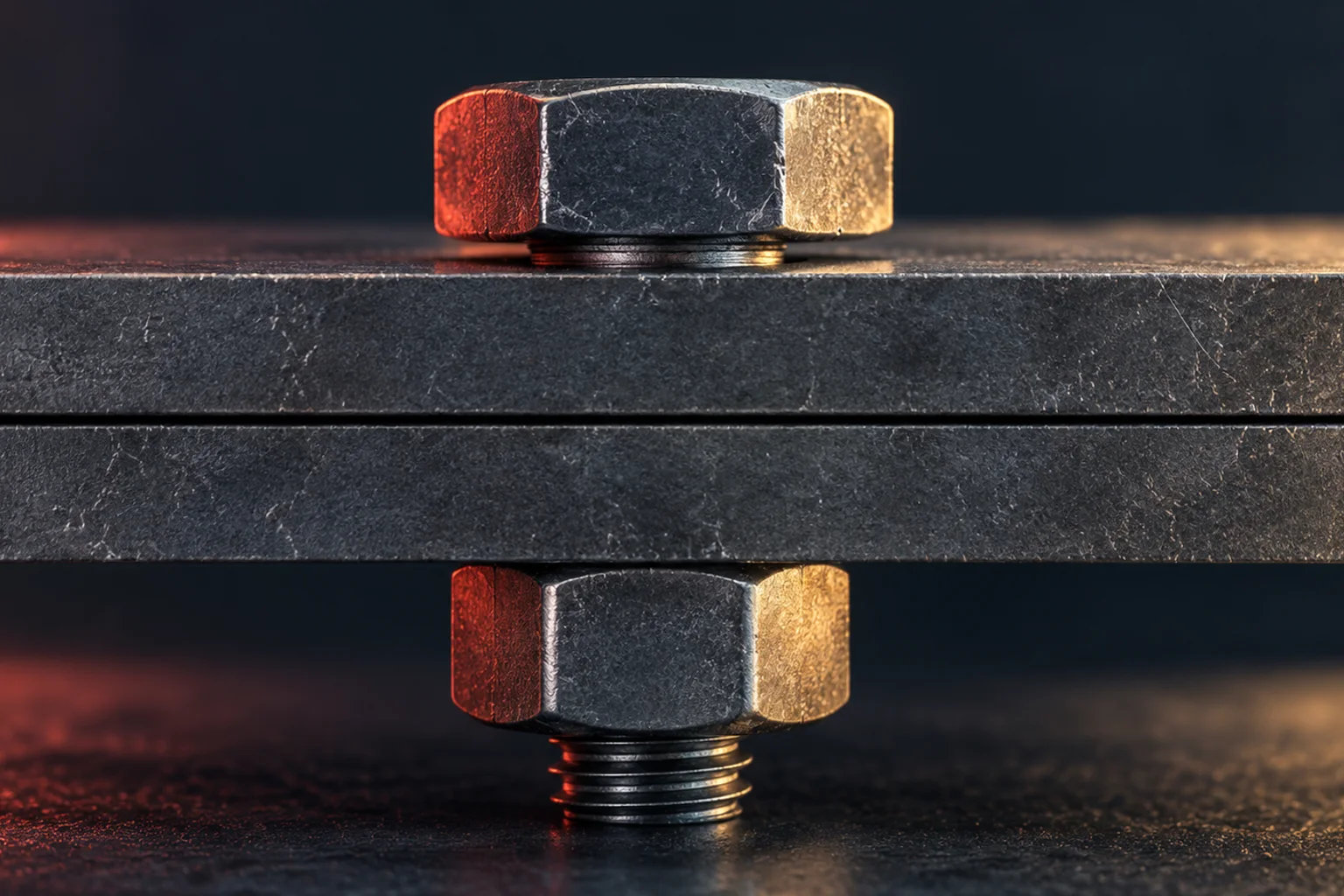
Look a little closer
See the mechanism
The bolt and the joint store elastic load
Read the diagram
After the head and nut bear against the joint, further tightening stretches the bolt elastically and compresses the clamped parts. The bolt’s tension and the joint’s compression form a preload. These drawings greatly enlarge both changes so they can be seen.
Original qualitative axial sections, not to scale. The head is the datum; the bolt tip extends while nut thread engagement advances and the joint compresses. Dashed line is the initial tip position, not a dimension. No torque, thread pitch, stress map or response to an arbitrary external load is specified.
Diagram basis: Bolt Science: bolt extension and joint compression.
Sources: Bolt Science · Bolt Science · Nord-Lock Group
Running the nut down isn't yet the whole clamp
Before the nut bears on the parts, it can travel along the thread without compressing the joint. Once the bearing surfaces meet, further movement has to deform the assembly. The bolt lengthens slightly while the material trapped between its head and nut shortens slightly.
Bolt Science's joint diagram puts those two changes on the same picture: bolt extension and joint compression. The opposing forces are linked. Tension in the bolt corresponds to compression in the material it holds.
Sources: Bolt Science
The tiny stretch keeps working after the wrench stops
The deformed bolt tries to shorten again. The clamped material prevents it returning freely, so the assembly remains loaded even when the wrench is removed. The deformation is small, but its restoring force keeps the parts pressed together.
That initial tension is the preload. An outside force that tries to separate the joint changes the balance between bolt tension and remaining compression. It doesn't necessarily add its full value directly to the bolt's existing tension. Joint and bolt stiffness affect how that load is shared.
Sources: Bolt Science · Bolt Science
Turning effort and clamp force aren't the same measurement
A wrench applies torque, but friction in the threads and beneath the turning bearing surface affects how that effort becomes preload. Nord-Lock identifies this as a source of variation in torque tightening. Equal turning effort doesn't by itself establish equal bolt tension under different surface conditions.
Nor does more always mean better. Too little preload can leave a joint vulnerable to movement or separation; too much can damage the bolt or the clamped material. The required value belongs to a particular engineered joint. Its geometry, materials and loading matter alongside the fastener.
Sources: Nord-Lock Group
The thing to remember
Tightening stores a small elastic deformation in the assembly: the bolt is in tension and the parts are in compression.
What this example leaves out
This is a preloaded bolt-and-nut joint, with greatly exaggerated deformation. Other joints carry loads differently. No universal tightening torque, friction coefficient or safe structural load follows from the illustration.
Sources & further reading
Source access dates are listed below. Manufacturer descriptions and patents support the specific constructions described, not every product.
- What is a Joint Diagram? ↗
Bolt Science · Retrieved 2026-10-16 · Nut tightening extends bolt, generates tension/preload and compresses clamped joint; stiffness relates force and deformation.
Full short page read, especially paragraph below Joint Diagram1. Deformation qualitative/exaggerated; no engineering torque or universal load model. - A Tutorial on the Basics of Bolted Joints ↗
Bolt Science · Retrieved 2026-10-16 · A preloaded joint carries external load differently from a loose bolt; applied force is not simply added whole to bolt tension.
Introduction and tutorial map read. Numerical life comparisons not adopted; no claim every structural joint must be preloaded. - Advanced Tensioning — Why the Correct Preload Is Important ↗
Nord-Lock Group · Retrieved 2026-10-16 · Preload creates clamp force; friction affects torque-to-preload accuracy; too little or too much preload can harm a joint.
Search service returned actual PDF paragraphs on correct preload and traditional torque tightening; those passages read. No whole-PDF/image inspection or product superiority adopted.