Look a little closer
See the mechanism
The same network changes shape
Read the diagram steps
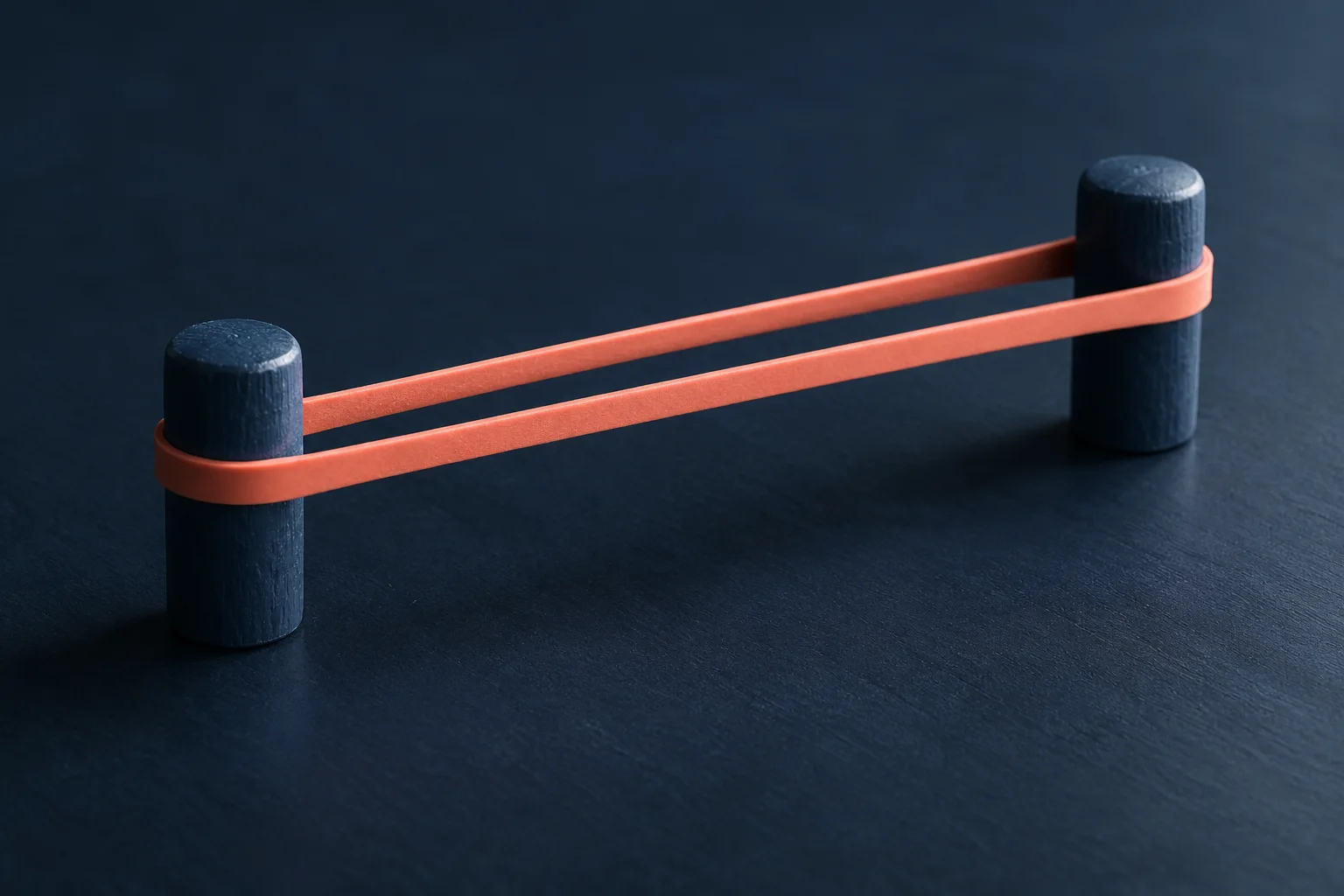
Relaxed network. Flexible chains have many coiled arrangements. Cross-links connect them into a deformable network.
Pull extends chain segments. Junctions move farther apart along the pull. Chains running along that direction become more extended while cross-links remain connected.
Connectivity and chain contour length are preserved in this symbolic network. Entropy supplies much of ordinary rubber elasticity; excessive strain can damage it.
Diagram basis: Yoshikawa et al.: rubber network and entropy elasticity.
Sources: Yuki Yoshikawa, Naoyuki Sakumichi, Ung-il Chung, Takamasa Sakai / University of Tokyo · Paul M. Goldbart, Horacio E. Castillo, Annette Zippelius / author manuscript via arXiv
A long chain can span a short distance
An unstretched polymer chain bends and changes direction many times. Its ends can be close together even though the chain between them is long. Stretching the rubber increases the distance between network junctions and makes the connecting chains more extended.
At ordinary elastic stretches, this rearrangement matters much more than stretching every chemical bond by the same large amount.
Sources: Yuki Yoshikawa, Naoyuki Sakumichi, Ung-il Chung, Takamasa Sakai / University of Tokyo · Paul M. Goldbart, Horacio E. Castillo, Annette Zippelius / author manuscript via arXiv
Cross-links keep the chains connected
Cross-links join chains into a network. They prevent the material from simply behaving like independent long molecules slipping apart. The network can deform while retaining connections that couple one region to another.
Sources: Yuki Yoshikawa, Naoyuki Sakumichi, Ung-il Chung, Takamasa Sakai / University of Tokyo · Paul M. Goldbart, Horacio E. Castillo, Annette Zippelius / author manuscript via arXiv
More chain shapes are available on release
There are many more coiled arrangements than highly extended ones. This difference in the number of available molecular shapes is an entropy effect. It supplies much of rubber's characteristic restoring force.
Recovery depends on the network remaining intact. Pulling beyond its useful range can damage that network, so a band that stretches elastically under a modest pull need not recover after every possible deformation.
Sources: Yuki Yoshikawa, Naoyuki Sakumichi, Ung-il Chung, Takamasa Sakai / University of Tokyo · Paul M. Goldbart, Horacio E. Castillo, Annette Zippelius / author manuscript via arXiv
The thing to remember
The band becomes longer as connected chains become more extended; release allows the network to explore coiled shapes again.
What this example leaves out
This is a qualitative account of cross-linked rubber in its elastic range. Composition, temperature, aging and large strains change its response; entropy is the main contribution here, not the only possible contribution.
Sources & further reading
Source access dates are listed below. Manufacturer descriptions and patents support the specific constructions described, not every product.
- Negative Energy Elasticity in a Rubberlike gel ↗
Yuki Yoshikawa, Naoyuki Sakumichi, Ung-il Chung, Takamasa Sakai / University of Tokyo · Retrieved 2026-10-18 · Natural/synthetic rubber elasticity primarily entropic; cross-linked network and conformational rather than bond-length changes.
Read Abstract/Introduction lines 42–76. Paper distinguishes solvent-rich gels from dry rubber; gel-specific negative energy elasticity is not assigned to a rubber band. - Randomly Crosslinked Macromolecular Systems: Vulcanisation Transition to and Properties of the Amorphous Solid State ↗
Paul M. Goldbart, Horacio E. Castillo, Annette Zippelius / author manuscript via arXiv · Retrieved 2026-10-18 · Permanent cross-links turn a macromolecular liquid into a solid network.
Read abstract only; not represented as reading the full review. Qualitative junction/network support, no numerical stretch or failure claims.