Look a little closer
See the mechanism
Closed cells change volume
Read the diagram steps
Unloaded cell patch. Natural cork contains many gas-filled closed cells. The flexible walls have space to deform under pressure.
Compressed cell patch. Cell walls deform and the enclosed gas occupies smaller spaces. Recovering walls can press outward when a bottle neck prevents full expansion.
The neck holds the cork compressed. A compressed natural-cork stopper tends to expand. The bottle neck prevents full recovery, so the stopper presses outward against the glass.
Cell outlines are symbolic; no exact anatomy, complete recovery or airtight seal is implied. Natural cork, not every composite closure.
Diagram basis: Amorim Cork Properties: compressibility and resilience.
Sources: Corticeira Amorim · Amorim Cork Composites
The solid-looking material contains gas-filled cells
Cork is bark from the cork oak. Its fine structure contains many tiny closed cells rather than one solid block of cell-wall material. Those enclosed spaces give the walls room to change shape under a squeeze.
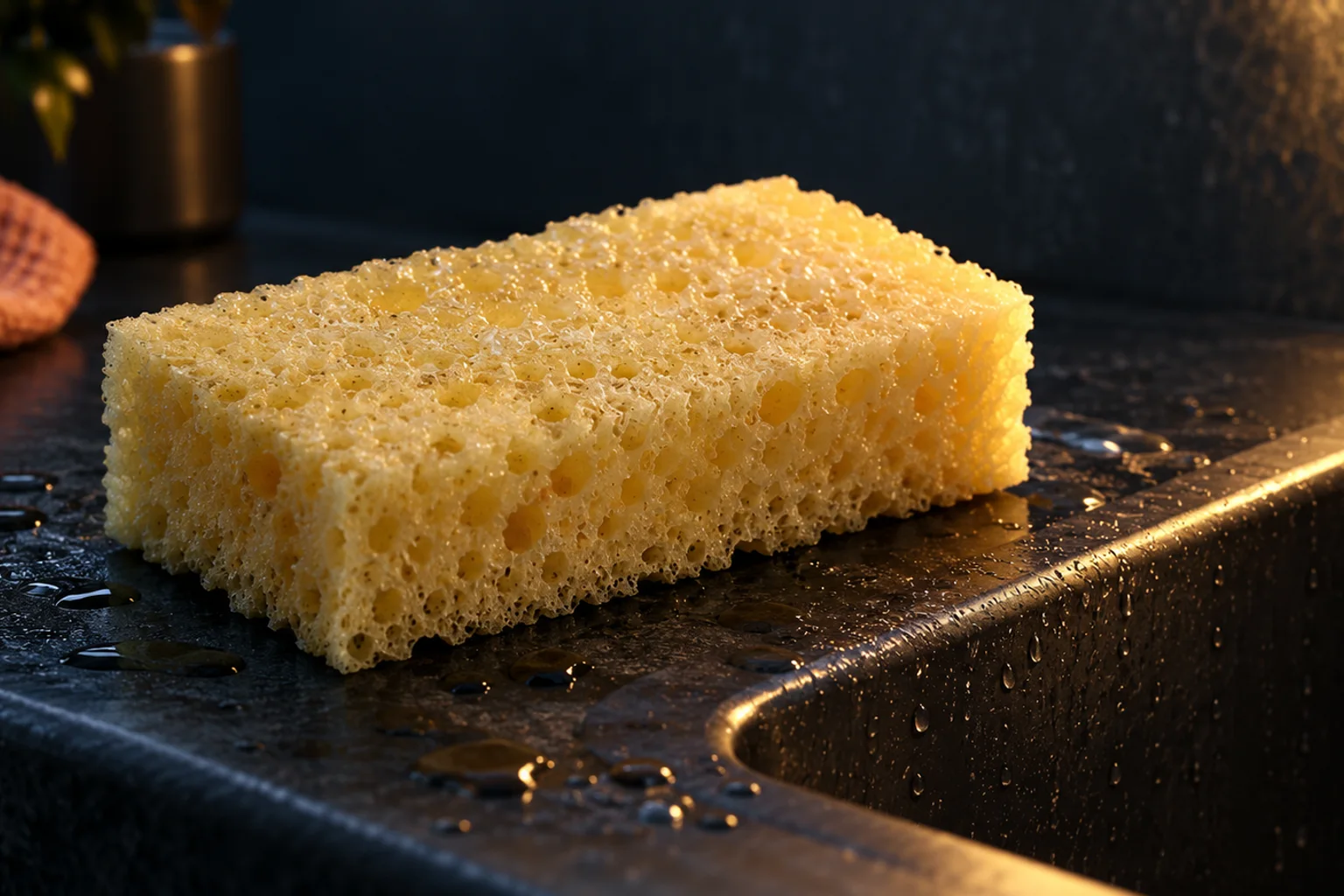
The closed-cell structure differs from an open kitchen sponge, whose connected spaces readily hold and release water.
Sources: Corticeira Amorim · Amorim Cork Composites
The bottle holds the stopper in a compressed state
A stopper is compressed to fit into the neck. Within the cork, flexible walls deform and the cell spaces become smaller. The material can therefore shrink without needing to bulge outward as much as a nearly incompressible solid.
Once inside, the bottle prevents full expansion. Recovery of the compressed cork creates outward contact against the glass. Pulling the stopper free removes that constraint, allowing it to expand farther.
Sources: Corticeira Amorim · Amorim Cork Composites
The thing to remember
Cork fits by deforming a cellular structure, then presses outward because that compressed structure tends to recover.
What this example leaves out
This describes natural cork's cellular response. Stopper construction, dimensions and condition affect sealing; the mechanism does not guarantee airtightness, indefinite recovery or the behavior of synthetic and agglomerated closures.
Sources & further reading
Source access dates are listed below. Manufacturer descriptions and patents support the specific constructions described, not every product.
- Sustainability Report 2006 — 2.2 Characteristics of cork ↗
Corticeira Amorim · Retrieved 2026-10-18 · Gas-filled cellular structure, compressibility, recovery and limited lateral expansion.
Read PDF physical page 12 (zero-based page 11), characteristics of cork, web lines 208–239. Historical primary material description; company ecological/market figures omitted. - Cork Solutions & Manufacturing Processes — Cork Properties ↗
Amorim Cork Composites · Retrieved 2026-10-18 · Closed cells, smaller gas spaces under compression, flexible wall deformation and recovery.
Read PDF pages 20–24 (zero-based19–23), especially Compressible/Resilient. Does not guarantee closure seal or all compression recoverable.