Look a little closer
See the mechanism
Water moves through a connected network
Read the diagram
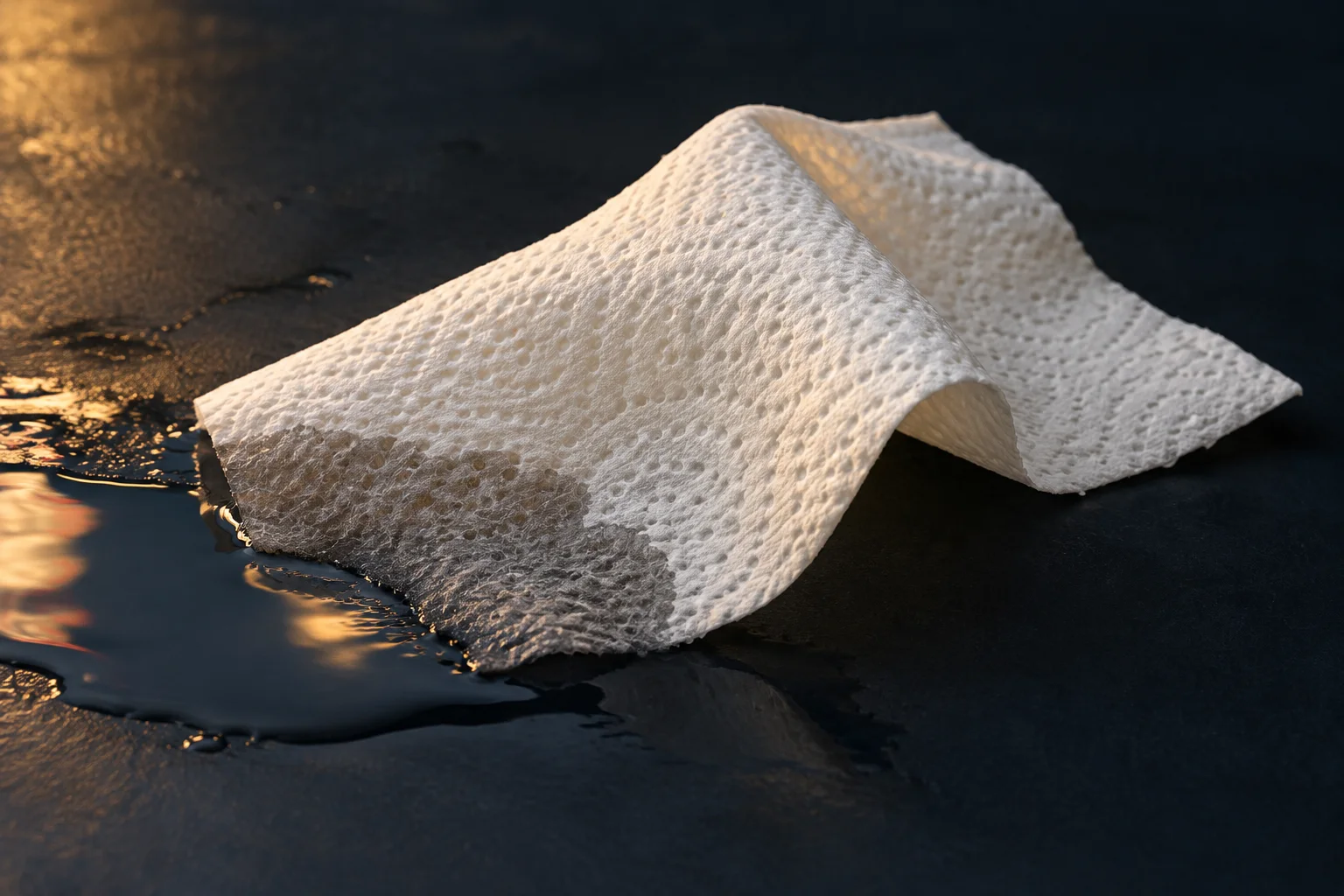
The towel edge touches a reservoir of water. Wetting spreads through connected gaps between the cellulose fibers, including upward above the reservoir. The two enlarged views show a lower wet front and a later, higher wet front; the fibers stay in the same arrangement.
Original enlarged network model, not a microscope image. Colored water makes wet and dry regions distinguishable; the curved front is illustrative, not a measured rise or timed comparison. Arrows show advance, not a pump. The gaps are not identical tubes, and the fibers are not drawn as hollow drinking straws. This figure does not quantify fiber swelling or total towel capacity.
Diagram basis: USGS: capillary action and the paper-towel example.
Sources: American Chemical Society, inChemistry; Steven Keller · American Chemical Society · OpenStax, Rice University
A sheet contains room for water
Paper looks continuous from a distance, but its fibers cross and leave spaces. The American Chemical Society describes paper towels as a relatively low-density structure with internal room for liquid. Its images show flattened, ribbon-like fibers and an irregular network, rather than neatly aligned tubes.
Cellulose attracts water because of chemical groups along its molecules. Water can enter the fiber wall as well as the gaps around it. Those are related processes, but filling a space between fibers and swelling a fiber are not the same movement.
Sources: American Chemical Society, inChemistry; Steven Keller
The wet edge advances through narrow gaps
Attraction between water and another material is adhesion. Attraction among water molecules is cohesion. Together with surface tension, these interactions allow water to move into a narrow wettable path. In the paper network, that means a dry patch next to the wetted region can begin to fill without being pushed under the puddle.
The paths branch around neighboring fibers. As water fills one gap, it can wet connected gaps farther into the sheet. Their irregular shapes and widths make a towel more complicated than a row of identical tubes.
Sources: American Chemical Society · OpenStax, Rice University
Upward movement has limits
A vertical wet front can climb above the surface of the water. Gravity still acts on it. OpenStax explains that capillary rise in a tube is limited by the weight of the raised liquid; wetting and gap size affect the result. A towel's branching pores make its behavior more complicated than one uniform tube.
Capillary movement also doesn't give the sheet unlimited storage. The towel has a finite structure to fill. Its fibers, bonding and pore network all matter to the finished product. ACS describes added cross-linking chemistry that helps paper towels admit water while retaining their structure. That combination explains why a useful towel must take in liquid and remain intact enough to lift.
Sources: OpenStax, Rice University · American Chemical Society, inChemistry; Steven Keller
The thing to remember
Water wets cellulose and moves through connected narrow spaces. Capillarity spreads the wet region; the towel's structure determines where that water can go.
What this example leaves out
The enlarged network is schematic, not a microscope image. Capillary movement, fiber swelling and total capacity are distinct. Pore structure and treatments vary between paper products, so this drawing cannot predict a towel's absorption rate or capacity.
Sources & further reading
Source access dates are listed below. Manufacturer descriptions and patents support the specific constructions described, not every product.
- Paper Chemistry in the Digital Age ↗
American Chemical Society, inChemistry; Steven Keller · Retrieved 2026-10-16 · Hydrophilic cellulose takes water into fiber walls; paper towels retain low-density internal spaces; cross-linking supports wet integrity; collapsed ribbon-like fibers rather than parallel open straws.
Paragraphs on cellulose hydroxyl groups, paper formation and final paper-towel discussion read, including textual microscopy descriptions. Embedded microscopy videos not watched and no experimental observations claimed. - ChemMatters Teacher's Guide — Don't Sweat It: How Moisture-Wicking Fabrics Keep You Cool and Dry ↗
American Chemical Society · Retrieved 2026-10-16 · Adhesion to a surface and cohesion between water molecules support flow through narrow spaces between fibers.
PDF page index9 / printed9, answer11 on capillary action read. General physical mechanism, not a test of a paper-towel product; no textile-performance or medical guidance adopted. - 11.8 Cohesion and Adhesion in Liquids: Surface Tension and Capillary Action — College Physics 2e ↗
OpenStax, Rice University · Retrieved 2026-10-16 · Cohesion/adhesion definitions, surface tension, wetting-dependent capillary rise and gravitational limit in a uniform tube.
Definitions, Capillary Action section and paragraph preceding height equation read. Uniform-tube model explicitly not treated as quantitative prediction for a heterogeneous paper network.