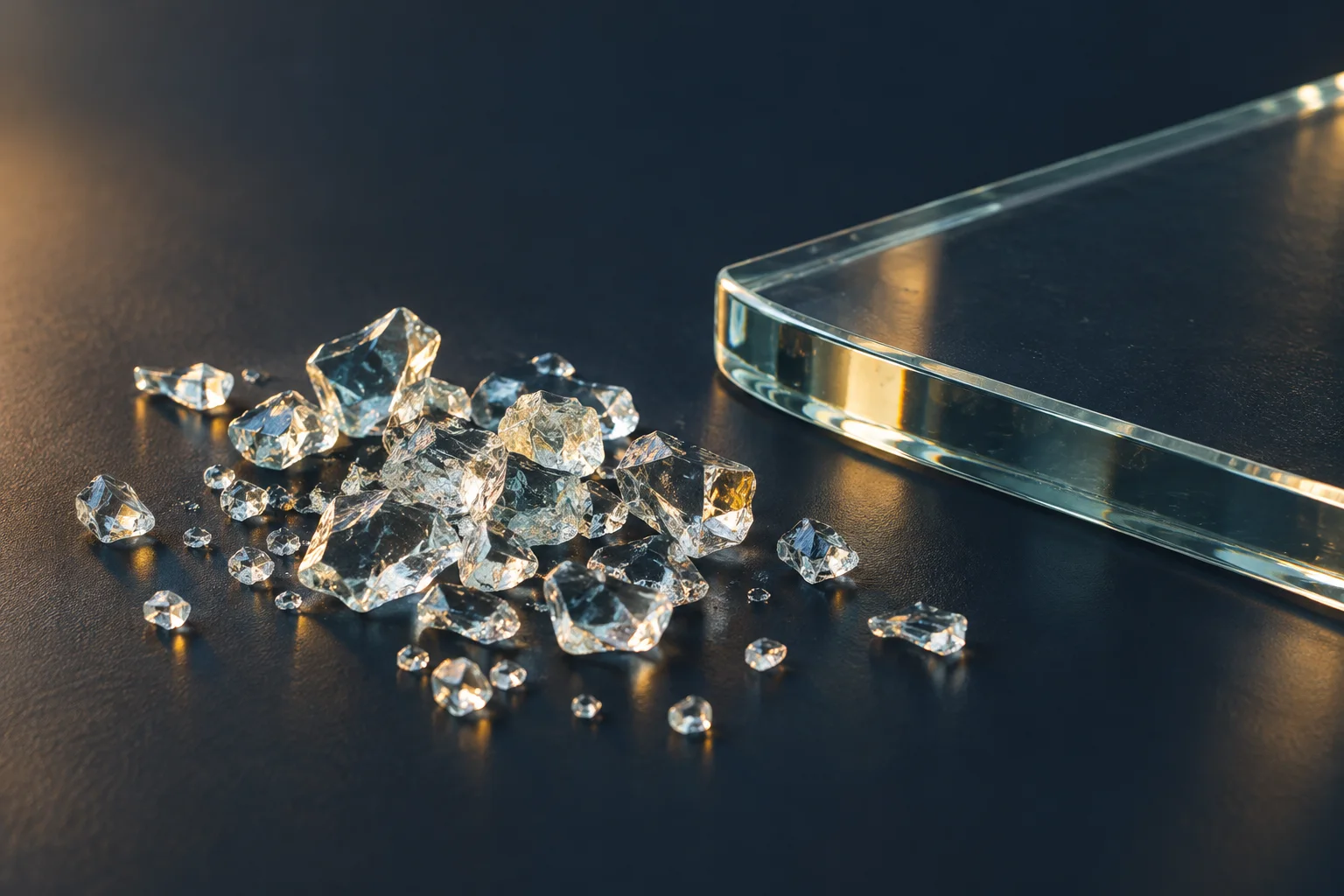
Look a little closer
See the mechanism
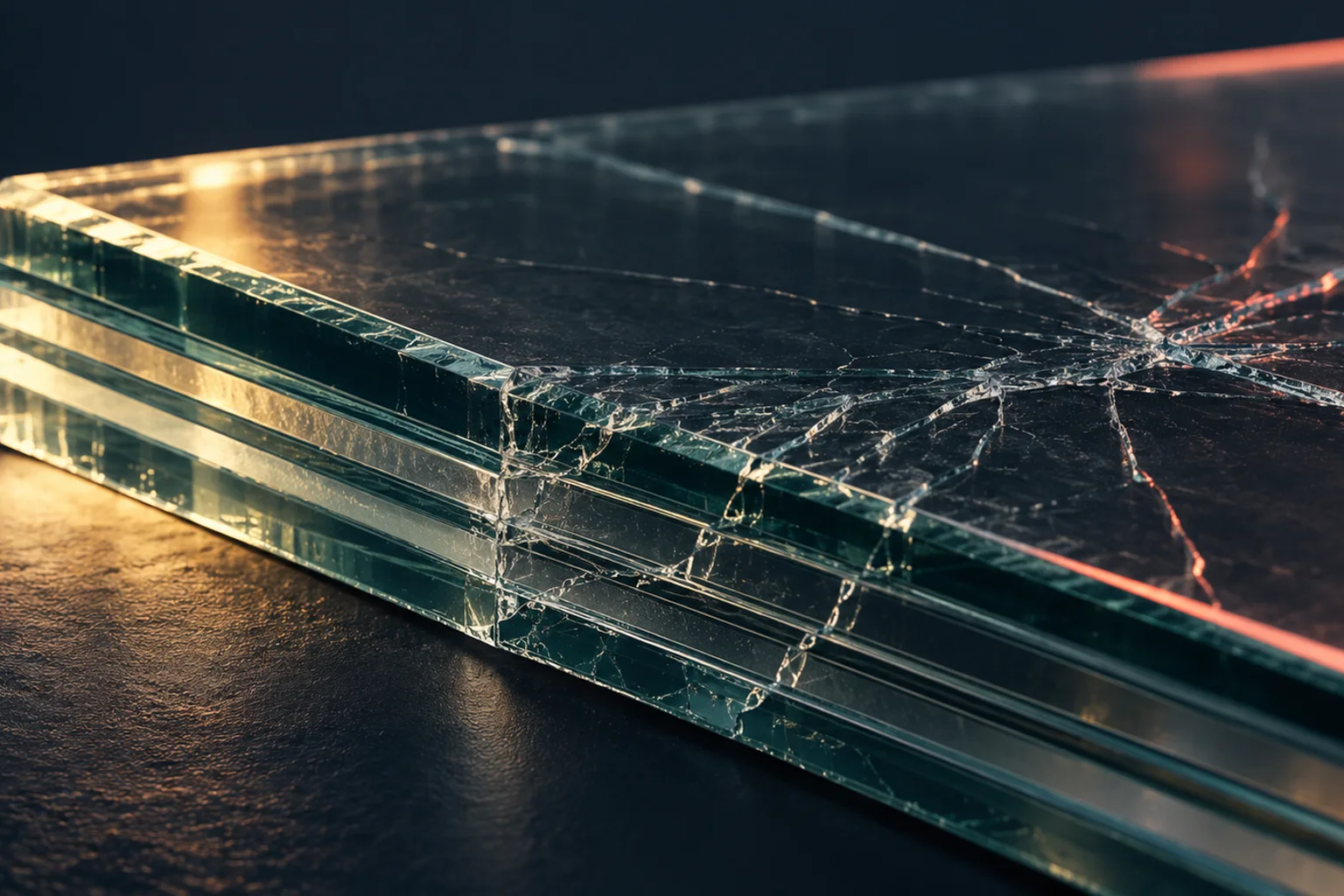
The glass breaks; the bond retains fragments
Read every step
- Bonded assembly. Two glass plies are bonded to a continuous PVB interlayer. The enlarged section distinguishes the bonded polymer from the glass; it is not a loose sheet inside an air gap.
- After fracture. Glass can crack while many fragments remain attached to the bonded interlayer. Lamination helps retain the fractured assembly; it does not make the glass unbreakable or guarantee that a damaged pane remains usable.
Original enlarged section with one selected PVB construction, not a fracture simulation, safety certification or impact rating. Crack paths and layer ratios are illustrative. Other interlayers and glass treatments exist; lamination and tempering describe different aspects of an assembly.
Diagram basis: Pilkington Optilam: bonded plies and retained fragments.
Sources: Pilkington / NSG · Pilkington / NSG
The middle layer is bonded to the glass
Two sheets with a loose film placed between them would not explain the effect. The interlayer is bonded to the glass faces. Pilkington describes its Optilam construction as two or more panes permanently joined through a transparent interlayer, typically PVB.
That connection remains important after cracks form. The interlayer can bridge neighboring fragments while they remain adhered to it. A crack through the glass isn't automatically a separation through every layer of the assembly.
Sources: Pilkington / NSG
Cracking and falling apart are separate events
The interlayer can remain continuous across a crack, keeping fragments attached after the glass has fractured. Breaking the glass and separating the laminate are different failures.
Pilkington's automotive description identifies the same bonded-ply principle in laminated vehicle glazing, including windshields. Its manufacturing sequence combines shaped glass layers and the interlayer under heat and pressure. The visible transparency of the finished middle layer doesn't make it mechanically irrelevant.
Glass thicknesses, interlayer choice and the complete build-up affect the result. Pilkington ties impact behavior to the configuration rather than the word laminated alone. Lamination describes the bonded assembly; it doesn't specify every treatment applied to its individual glass plies.
Sources: Pilkington / NSG · Pilkington / NSG
The thing to remember
The bonded interlayer can keep fractured glass attached. It changes fragment retention without preventing every crack or failure.
What this example leaves out
The layers are exaggerated and PVB is an example, not the only interlayer. No impact rating, protective certification or judgment about a damaged windshield follows from this schematic.
Sources & further reading
Source access dates are listed below. Manufacturer descriptions and patents support the specific constructions described, not every product.
- Pilkington Optilam ↗
Pilkington / NSG · Retrieved 2026-10-16 · Bonded panes with typically PVB interlayer retain adhered fragments; impact behavior depends on glass/interlayer build-up.
Actual product introduction and features fetched/read directly. No application certification or damaged-glazing suitability inferred; source numbers and exact thicknesses excluded. - Lamination — Safety and Comfort in Every Layer ↗
Pilkington / NSG · Retrieved 2026-10-16 · Automotive glass plies/PVB bond, fragment retention, windshield context and heat/pressure bonding.
Actual relevant full product body fetched/read directly. No visibility-after-damage guarantee, quantified noise/security performance or present-day vehicle certification adopted.