Look a little closer
See the mechanism
Glucose joins growing crystals
Read the diagram steps
Concentrated liquid. Sugars are dissolved in a small amount of water. Supersaturated liquid can persist before crystal growth starts.
Crystals within the liquid. Glucose joins ordered crystals around starting points. Water, fructose and some glucose remain in the surrounding liquid.
Symbols are not an exact crystal lattice or composition. Crystallization rate depends on composition, particles and temperature; it does not prove purity.
Diagram basis: Southern Cross University: Crystallisation in Honey.
Sources: Southern Cross University · European Commission CORDIS
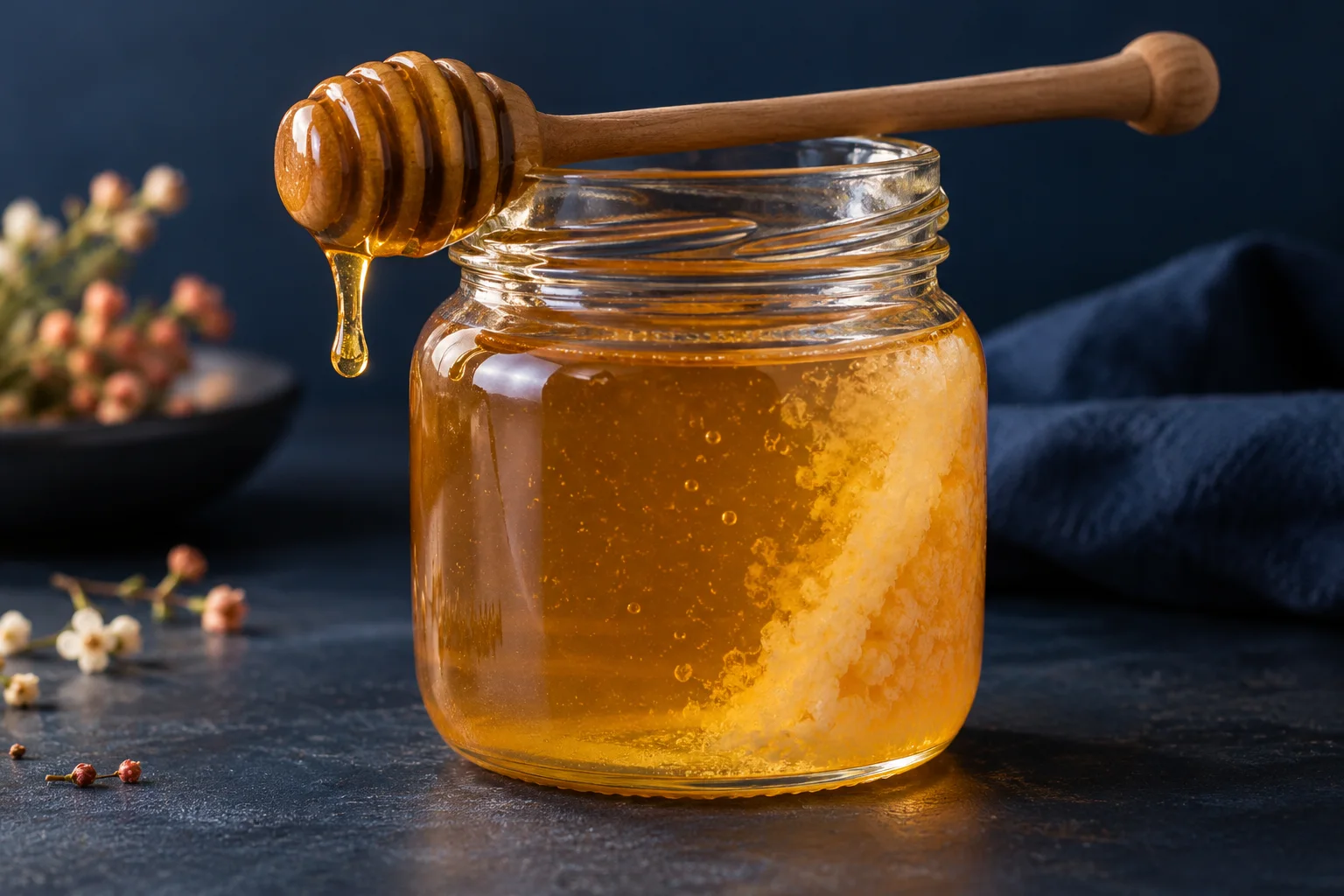
A clear jar can hold a supersaturated liquid
The main ingredients are sugars and water, but the proportions vary with the honey's floral source. A liquid honey can contain more dissolved glucose than remains stable under its current conditions. It can nevertheless stay liquid until crystal growth begins.
Sources: Southern Cross University · European Commission CORDIS
Tiny starting points help crystals grow
Existing crystals and small particles can provide places for glucose crystals to start. More glucose then joins the ordered solid, while some honey remains liquid around it.
Numerous fine crystals can create a smooth, cloudy texture; larger crystals can feel grainy. The changing appearance comes from crystals forming throughout a mixture, rather than the entire jar turning into one pure solid.
Sources: Southern Cross University · European Commission CORDIS
Composition and temperature change the pace
Higher glucose relative to water generally favors crystallization. Temperature also changes both the tendency to form crystals and how readily molecules can move. Colder does not mean indefinitely faster: very sluggish honey can slow crystal growth.
That is why two jars stored side by side can change at different rates, even when both are honey.
Sources: Southern Cross University · European Commission CORDIS
The thing to remember
Graininess records glucose becoming solid inside a concentrated liquid; the jar's composition and conditions determine how that change develops.
What this example leaves out
Crystallization alone neither proves purity nor establishes spoilage, quality or health benefits. This explains the texture change and does not assess an individual jar's safety or authenticity.
Sources & further reading
Source access dates are listed below. Manufacturer descriptions and patents support the specific constructions described, not every product.
- Crystallisation In Honey — Fact Sheet ↗
Southern Cross University · Retrieved 2026-10-18 · Glucose/water composition, particle nucleation and texture of honey crystallization.
Read PDF pages 1–3 (zero-based0–2), Factors affecting crystallisation. Medical/nutritional statements and purity inference not adopted. - Why did my honey crystallise? ↗
European Commission CORDIS · Retrieved 2026-10-18 · Supersaturated honey, glucose precipitation, fructose slowing crystallization and slowing at sufficiently low temperatures.
Read article body lines 54–67; reports named EU-funded project participant. No universal temperature threshold, quality, authenticity or individual safety assessment inferred.