Look a little closer
See the mechanism
A triggered phase change
Read the diagram steps
Ready liquid. A cooled sodium acetate solution can remain metastable. The disc is a trigger, not the heat source.
Crystals grow. Nucleation starts crystal growth. As crystals spread, energy is released as heat.
Heat resets the pack. External heat returns the crystallized contents to liquid. Cooling then prepares another ready state.
Sodium acetate pack model; the microscopic disc-trigger mechanism is not specified. Reset conditions follow the product instructions.
Diagram basis: HotSnapZ contents, crystallization and reuse FAQ.
Sources: HotSnapZ · OpenStax / Rice University · HotHands / Kobayashi
The liquid can wait before crystallizing
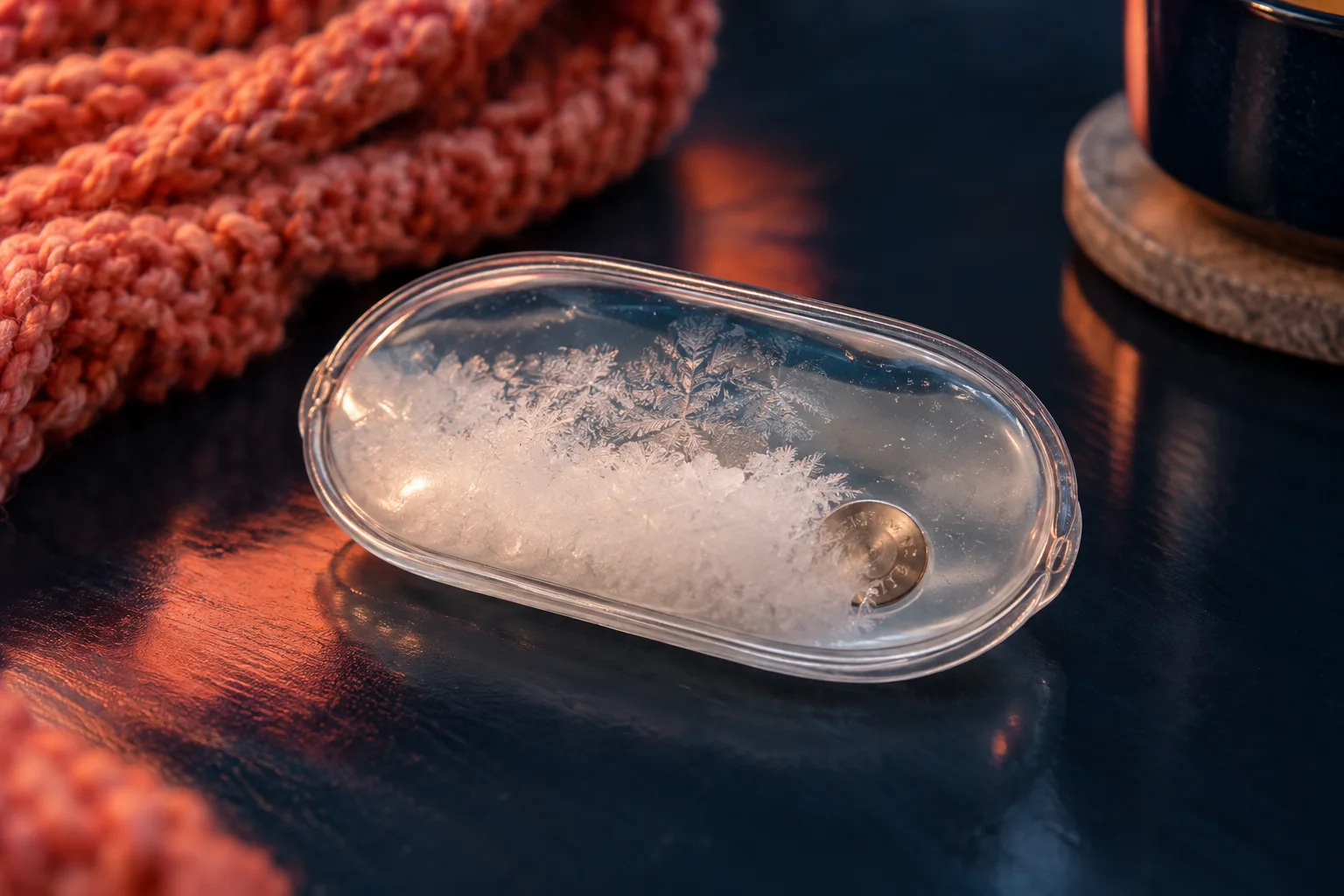
The pack contains sodium acetate and water. Heating returns the crystallized contents to a clear liquid state. After cooling, the concentrated liquid can persist in a metastable state: it can crystallize, but a suitable starting point has not yet set that growth underway.
Sources: HotSnapZ · OpenStax / Rice University
Crystallization releases the heat
Flexing the disc initiates nucleation, the start of crystal growth. Crystals then spread through the contents, changing the clear liquid into an opaque, firmer mass.
The warming accompanies that change of state. A disposable iron hand warmer instead produces heat by reacting with oxygen, consuming its iron supply.
Sources: HotSnapZ · OpenStax / Rice University · HotHands / Kobayashi
Reuse requires energy from outside
Returning the contents to liquid takes an input of heat. Cooling the reset pack prepares it for another triggered release. The cycle moves energy in and out; repeatedly clicking an already crystallized pack cannot recharge it.
Sources: HotSnapZ · OpenStax / Rice University
The thing to remember
The disc triggers a phase change, while the earlier heating cycle supplies the energy later released during crystallization.
What this example leaves out
This describes sodium acetate crystallization packs. The microscopic nucleation behavior depends on the disc and formulation; reset conditions and service life belong to the particular product's instructions.
Sources & further reading
Source access dates are listed below. Manufacturer descriptions and patents support the specific constructions described, not every product.
- What is inside a HotSnapZ pack and how does it work? ↗
HotSnapZ · Retrieved 2026-10-18 · Sodium acetate/water, metastable cooled liquid, disc-triggered crystallization and heat input for reuse.
Read FAQ web lines 265–286. Product example. No assertion of exact seed-release microscopic action, infinite lifetime, guaranteed output or nonburning safety. Manufacturer calls cycle chemistry; article describes physical phase change. - 11.3 Phase Change and Latent Heat ↗
OpenStax / Rice University · Retrieved 2026-10-18 · Energy absorption in melting, heat release on freezing and distinction from temperature rise.
Read Phase Changes and ice-heating Figure 11.10 discussion. Pure-substance phase change model; not a measured gel formulation or sodium-acetate temperature profile. - What are HotHands warmers made of and how do they work? ↗
HotHands / Kobayashi · Retrieved 2026-10-18 · Air-activated oxidation; listed iron powder, water, salt, activated charcoal and vermiculite.
Read homepage FAQ. Ingredient example limited to this manufacturer; no output figures, marketing safety claims or skin-contact assurances adopted.