Look a little closer
See the mechanism
Incoming heat melts the frozen portion
Read the diagram steps
Mostly frozen. A water-based pack starts cold with a substantial frozen portion. Heat flows in from warmer surroundings.
Partly melted. The frozen portion shrinks as ice melts, absorbing latent heat. The gel and ice are distinct parts of the mixture.
Liquid warms. After the ice has melted, the remaining mixture continues absorbing heat as its temperature rises.
Mixtures can melt over a range. Colors do not specify a universal temperature or a safe contact time.
Diagram basis: OpenStax phase change; Nordic water-based pack context.
Sources: Nordic Cold Chain Solutions · OpenStax / Rice University · Cryopak Industries / US patent application via Google Patents
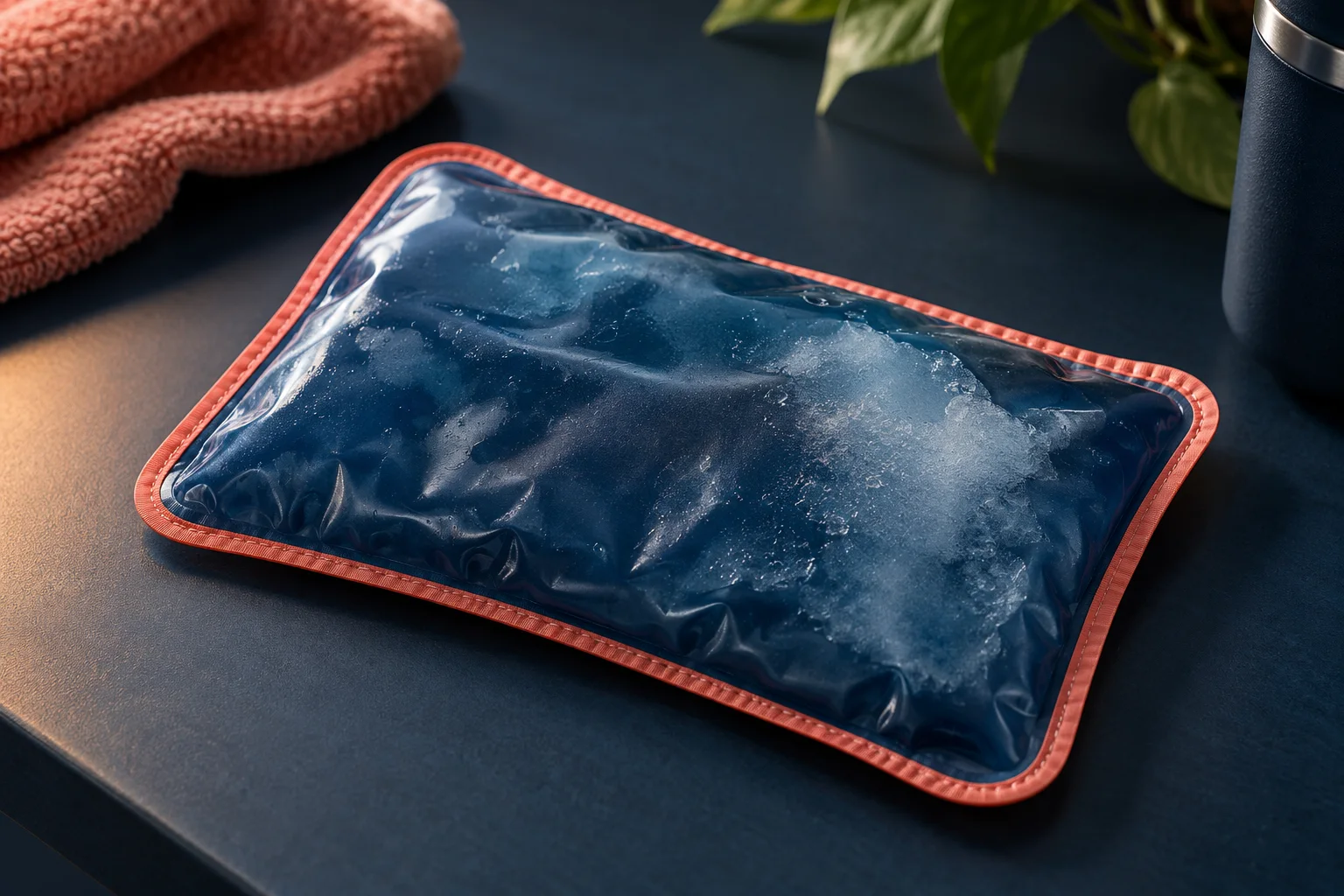
The gel holds a water-based cold store
Many reusable gel packs are water-based. Their thickened contents are contained in a sealed flexible pouch. The gel's consistency and the amount of frozen water are separate properties: a thick material need not be completely frozen.
Sources: Nordic Cold Chain Solutions · OpenStax / Rice University
Softening spends the frozen part
As heat enters, ice within the mixture melts. The energy needed for that change is latent heat. That is why a pack can continue absorbing heat as it becomes softer.
Pure ice has a well-defined melting temperature at a given pressure. A formulated gel pack is a mixture. Dissolved ingredients and the formulation can shift or spread its freezing and melting behavior; one temperature cannot describe every product.
Sources: Nordic Cold Chain Solutions · OpenStax / Rice University · Cryopak Industries / US patent application via Google Patents
The surroundings decide how quickly it warms
After the frozen portion has melted, the liquid still absorbs heat as its temperature rises. Eventually the pack approaches the temperature around it. Its mass, starting condition, insulation and surroundings all affect how long useful cooling lasts.
Sources: Nordic Cold Chain Solutions · OpenStax / Rice University
The thing to remember
A frozen gel pack absorbs heat through both warming and melting. As its frozen portion disappears, part of the incoming energy goes into that change of state.
What this example leaves out
This explains water-based reusable packs, not instant chemical cold packs or dry ice. It establishes neither a universal temperature range nor a safe contact time for skin or food.
Sources & further reading
Source access dates are listed below. Manufacturer descriptions and patents support the specific constructions described, not every product.
- Cold Chain Gel Packs ↗
Nordic Cold Chain Solutions · Retrieved 2026-10-18 · Water-based packs, different conditioning states and duration dependence on mass, starting state and surroundings.
Read conditioning/Common questions, web lines 279–308. Packaging product context only; does not establish a medical contact regime or all packs reusable (page wording varies across sections). - 11.3 Phase Change and Latent Heat ↗
OpenStax / Rice University · Retrieved 2026-10-18 · Energy absorption in melting, heat release on freezing and distinction from temperature rise.
Read Phase Changes and ice-heating Figure 11.10 discussion. Pure-substance phase change model; not a measured gel formulation or sodium-acetate temperature profile. - US20190225853A1 — Water based thermal cooling gels comprising a viscosity modifier and ice nucleating protein ↗
Cryopak Industries / US patent application via Google Patents · Retrieved 2026-10-18 · Gel mixtures can have different phase-change temperatures and latent-heat performance; water plus modifiers is a designed mixture.
Read Background and description of phase-change materials. Proposed formulations are examples, not adopted recipes or evidence for every gel pack.