Look a little closer
See the mechanism
Rolling contacts carry force through the rings
Read the diagram
The rings provide raceways, the balls form rolling load paths, and the cage helps maintain spacing. The highlighted lower region is a qualitative load zone, not an equal-load calculation.
Not a real raceway profile, assembly section or load-rating model. The thin cage circle is symbolic; contact deformation, clearance, shields and lubricant are omitted.
Diagram basis: NSK: components and cage; NSK: loaded zones.
Sources: NSK Global · NSK Global · NSK Global · NSK Americas — Technical Insight
The bearing sits between parts that move differently
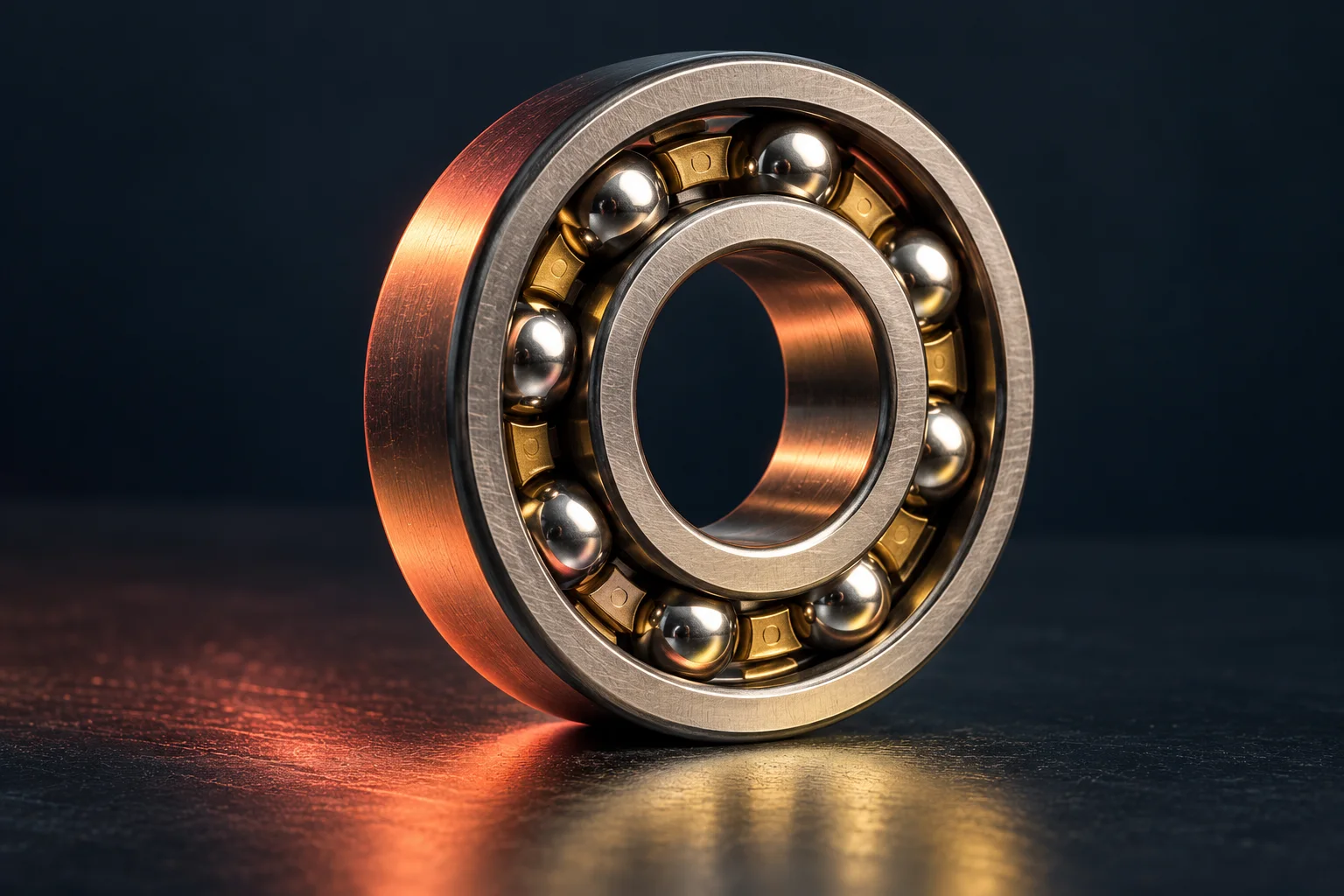
A conventional radial ball bearing has an inner ring and an outer ring, with balls running between them. One ring can belong to a shaft and the other to its surrounding support. Relative rotation then takes place inside the bearing rather than requiring the shaft to rub directly against a broad stationary sleeve. NSK distinguishes this rolling arrangement from plain bearings that use sliding or a supporting film.
The outer ring need not be stationary. Which ring belongs to the moving assembly depends on the application. The mechanism works through relative rotation between the rings, with the rolling elements maintaining contact between their raceways.
Sources: NSK Global · NSK Americas — Technical Insight
Rolling is a way to allow movement while keeping contact
The balls contact shaped tracks called raceways. As the rings move relative to one another, the balls roll along those tracks. A ball is therefore more than a spacer preventing the rings from touching. It forms a moving contact between them, allowing the bearing to keep transmitting force while rotation continues.
A useful comparison is a heavy object moved on rollers. Support does not disappear when it moves; the supporting contact is reorganized as the rollers turn. The bearing contains that idea in a controlled circular track. The comparison is qualitative, not a calculation of friction or load capacity. It explains why the mechanism can serve motion and support at the same time, instead of alternating between touching to carry weight and separating to turn.
Sources: NSK Global · NSK Global
The cage spaces the balls; it is not the main load bridge
NSK describes the cage as a part that keeps rolling elements suitably spaced and helps them move smoothly. Without maintained separation, adjacent balls can crowd or contact one another. The cage coordinates their positions, while the raceway contacts provide the principal route for load through the rolling elements.
Balls, rings and cage have different roles. The rings provide tracks, the balls form rolling contacts, and the cage maintains spacing as the elements move. A cage does not fix the balls in place like spokes. Many bearing designs use one, but its construction depends on the bearing family and operating requirements.
Sources: NSK Global
Turning freely is only half the design question
NSK distinguishes radial load, perpendicular to a shaft, from axial or thrust load along it. A bearing may have to accommodate both. The raceway shape and contact arrangement influence which directions a design can support, so two bearings that look broadly circular are not automatically substitutes.
A deep-groove ball bearing and an angular-contact bearing are separate families with different load-handling characteristics. Choosing a bearing therefore requires more than checking whether it can spin: the direction of the force and the contact arrangement matter too.
Sources: NSK Global · NSK Americas — Technical Insight
Not every ball is carrying an identical share
A ring of evenly spaced balls can suggest that force is divided equally around the entire circle. NSK's loaded-zone explanation shows why that need not be true. Depending on the load and arrangement, force is applied to a portion of the raceway or across its circumference. The positions of the rolling elements relative to that zone affect their role in carrying the load.
For a shaft pushed downward, the supporting force acts through a loaded region rather than being divided equally by visual symmetry. Rolling elements move through that region as the bearing turns. The exact distribution depends on clearances, deformation, contact geometry and operating conditions.
Sources: NSK Global
A rolling bearing still has friction to manage
NSK's lubrication guidance says lubricant reduces internal friction and wear and helps prevent seizure. Rolling elements therefore do not make lubrication irrelevant. A lubricant film changes the surface contact conditions, while the complete bearing can also include seals or shields. The construction and service requirements depend on the device.
Real contact carries load, materials deform, and components move in a lubricated assembly. Resistance and heat can remain even when rolling is advantageous. An unloaded bearing spinning freely by hand demonstrates easy movement in that condition; it does not establish its load capacity or service requirements inside a machine.
Sources: NSK Global · NSK Americas — Technical Insight
Questions you might still have
Are ball bearings frictionless?
No. Rolling reduces some sliding losses, but internal contact and other resistance remain. Manufacturer guidance still requires suitable lubrication.
Sources: NSK Global
What does the cage do?
It keeps rolling elements suitably spaced and guides their movement. The rings and balls form the main load-transmitting contacts.
Sources: NSK Global
Can the outer ring rotate instead of the inner one?
The mechanism depends on relative rotation. Which ring belongs to the moving assembly depends on the application; an illustration's stationary ring is not a universal rule.
Sources: NSK Global · NSK Americas — Technical Insight
The thing to remember
Balls provide rolling load paths between rings; raceways guide them, a cage often spaces them, and lubrication still matters.
What this example leaves out
Conceptual radial ball-bearing end view, not a manufacturing cross-section or selection calculation. Clearances, contact deformation, cage design, load ratings and lubrication requirements depend on the bearing and application.
Sources & further reading
Source access dates are listed below. Manufacturer descriptions and patents support the specific constructions described, not every product.
- Bearing Basics — Components and Cage Role ↗
NSK Global · Retrieved 2026-10-14 · Rings, balls/rollers, cage spacing and rolling versus sliding bearings.
General manufacturer training. No frictionless claim or universal cage requirement. - Loads and Loaded Zones ↗
NSK Global · Retrieved 2026-10-14 · Radial, axial and combined loads; loaded zone rather than identical loading of all rolling elements.
Qualitative load-path explanation; no sizing calculation or measured load limit. - Lubrication — Purpose and Principles ↗
NSK Global · Retrieved 2026-10-14 · Lubricant reduces internal friction/wear and avoids direct surface contact; oil and grease suit different designs.
No lubricant recommendation for a particular device or unsupported efficiency statistic. - Bearing Designs and Construction ↗
NSK Americas — Technical Insight · Retrieved 2026-10-14 · Deep-groove, angular-contact, self-aligning, roller and thrust designs have different load-handling geometry; seals/shields may be fitted.
Design-family distinctions, not purchasing, installation or service-life advice.