Look a little closer
See the mechanism
The stem opens a pressurized liquid path
Read every step
- Released: valve closed. A spring holds the stem up so that the seal covers its lateral inlet. Pressurized vapor occupies the headspace above the liquid, but the closed valve blocks the route to the nozzle.
- Pressed: valve open. Pressing lowers the stem and exposes the inlet below the seal. Headspace pressure drives liquid up the submerged dip tube, through the valve and out the nozzle. Liquid propellant can evaporate to replenish vapor while liquid propellant remains. The button opens a valve rather than pumping each dose.
Original can overview and enlarged valve principle, shown at different scales. The stem inlet moves relative to the fixed seal, and the return spring is compressed; no liquid level or spray rate is invented. Pressure is not asserted perfectly constant across temperature or composition. Compressed-gas and bag-on-valve products differ. This is a mechanism explanation, not a refill, heating or puncturing procedure.
Diagram basis: Aerosol Association of New Zealand: headspace, dip tube and propellant; US10532881B2: sealed lateral stem inlet and spring return.
Sources: Aerosol Association of New Zealand · Lindal France SAS; United States patent publication via Google Patents · Household and Commercial Products Association / Can Manufacturers Institute
Opening a route lets pressure move the liquid
The selected can has a dip tube reaching down into the liquid contents and a valve at the top. Gas pressure acts on the liquid surface. Once a route opens through the valve, the pressure difference moves liquid up the tube and out through the actuator.
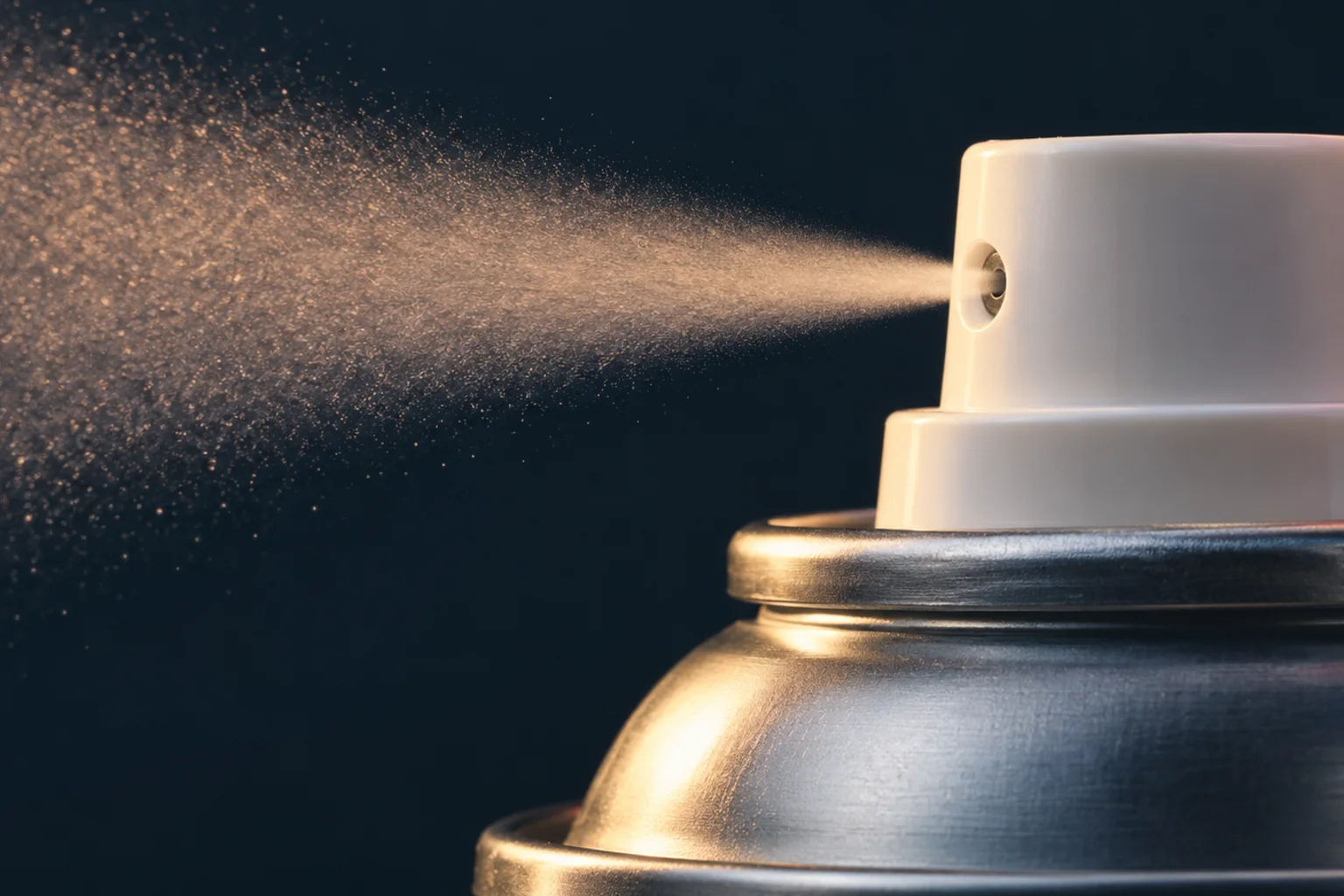
The Aerosol Association of New Zealand describes product mixed with liquefied propellant in the container. As the mixture emerges, expansion and evaporation can help form a mist. Foams and streams use different formulations and outlet designs, so not every aerosol produces the same cloud.
Sources: Aerosol Association of New Zealand
The valve can close without removing the stored pressure
A spring-return valve shuts the outlet when the actuator is released. In one documented Lindal valve, a seal blocks lateral openings in the stem in the closed position, while the spring returns the stem against that seal. The pressure remains inside after flow stops.
Opening the valve connects the pressurized contents to the outlet; releasing it seals that route again. The next spray can begin without a separate intake stroke because pressure remains stored inside the can.
Sources: Lindal France SAS; United States patent publication via Google Patents · Household and Commercial Products Association / Can Manufacturers Institute
Liquid propellant can replace gas that leaves
Liquid and vapor propellant coexist in the chosen design. Evaporation replenishes the gas phase as contents leave, helping keep pressure relatively steady at a given temperature. The reservoir is finite: it cannot continue that behavior after the liquid propellant is exhausted.
Compressed-gas products are different. HCPA's aerosol primer explains that their gas has no corresponding liquid reservoir under the product's operating conditions. As the product leaves and the gas occupies more volume, pressure falls. Liquefied-propellant pressure also depends on temperature and composition, even while both phases remain present.
Sources: Household and Commercial Products Association / Can Manufacturers Institute · Aerosol Association of New Zealand
The thing to remember
The valve opens a route for pressurized liquid to leave. A liquefied propellant can replenish vapor; compressed-gas versions lack that same reservoir.
What this example leaves out
This selects an upright dip-tube aerosol with liquefied propellant and a simplified spring-return valve. Compressed-gas and bag-on-valve products differ. It gives no pressure value, formulation or instructions for modifying a pressurized container.
Sources & further reading
Source access dates are listed below. Manufacturer descriptions and patents support the specific constructions described, not every product.
- How Aerosols Work ↗
Aerosol Association of New Zealand · Retrieved 2026-10-16 · Liquefied-propellant example: headspace gas pushes liquid up dip tube through open valve; evaporation replenishes gas and can aid mist/foam.
Full short page fetched/read via web and directNode. Absolute constant-pressure phrasing qualified; selected upright mixed-product design, not bag-on-valve. - Process for manufacturing an aerosol valve and aerosol valve — US10532881B2 ↗
Lindal France SAS; United States patent publication via Google Patents · Retrieved 2026-10-16 · Spring pushes stem toward closed position where inner seal obstructs lateral stem orifices.
Actual closed-position seal/spring passages and Detailed Description read. Particular retaining-ring manufacturing improvement not generalized; illustration functional not full exact patented assembly. - Aerosol Recycling Initiative White Paper — Aerosol Basics Continued ↗
Household and Commercial Products Association / Can Manufacturers Institute · Retrieved 2026-10-16 · Self-closing valve/actuator roles; liquid propellant and gas-only propellant differ; liquid reservoir replenishment versus gas expansion with product discharge.
Web first-page output insufficient; Python403; actual PDF fetched with Node then piped in memory to existing pypdf, page indices32–33 relevant passages read. No disposal laws, sustainability/CFC claims, exact constant-pressure universal or temperature-safety advice adopted.