Look a little closer
See the mechanism
Separate the flush from the refill
Read every step
- Ready. The tank is full, the float is up and the fill valve is shut. The hinged flapper covers the tank outlet. Water remains in the bowl and the low bend of the trapway; the passage over the crest contains air.
- Flush starts. The handle lifts the flapper. Tank water falls through the flush passage into the bowl. As the tank level falls, the float falls and the separate supply valve opens. The first surge raises bowl water and begins filling the trapway.
- Siphon flows. The trapway is filled across its crest and down toward the drain, supporting siphonic flow out of the bowl. The flapper has reseated as the tank emptied. The supply valve is still open: refill water enters the tank and a smaller branch runs into the overflow tube toward the bowl.
- Refill. Air has entered the trapway and broken the siphon. The supply now raises the tank level and restores the bowl water seal through the refill branch. When the rising float reaches its shutoff level, the fill valve closes and the system returns to Ready.
Original functional schematic of a gravity-fed, hinged-flapper tank with float-cup fill valve and siphonic bowl. It is not a cutaway of a particular toilet model. Rim/jet distribution is collapsed into one flush passage; refill flow and siphon timing can overlap. Levels and passage sizes are qualitative. A siphon starts only after the crest and descending trapway fill; a lower water seal remains after it breaks. This is not a repair or installation guide.
Diagram basis: Kohler: flush and float cycle; Fluidmaster PRO45C: flapper, float cup and above-overflow refill branch.
Sources: Kohler · Fluidmaster · Fluidmaster · Kohler
The handle releases water already in the tank
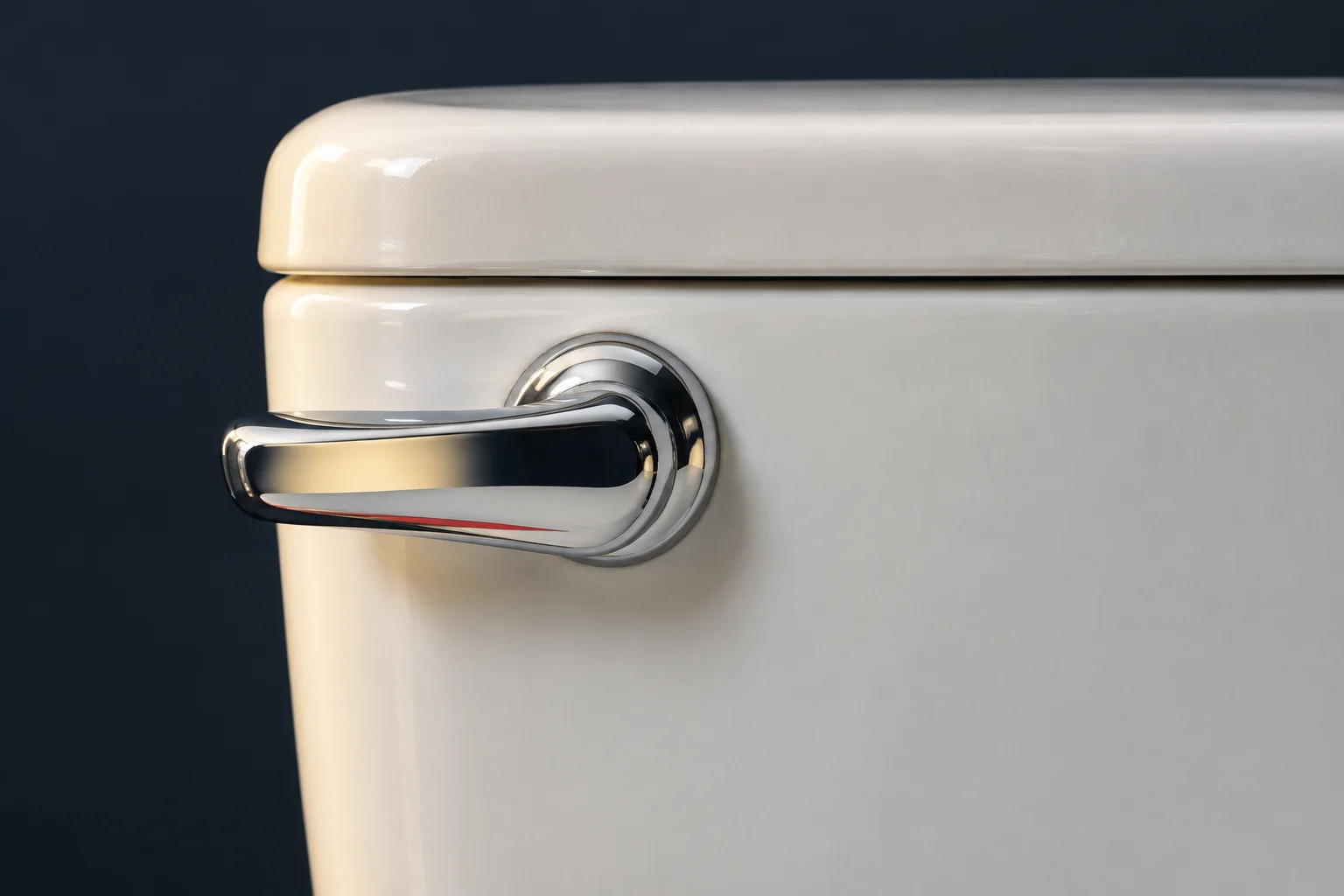
The flush valve sits between the tank and bowl. In this flapper version, the handle lifts the seal from its opening. Water then falls through passages in the toilet into the bowl. The tank supplies a surge; the incoming supply doesn't have to deliver that whole surge through the fill valve at once.
The fill valve controls a different opening: the fresh-water inlet. Keeping the two valves separate makes the cycle easier to follow. One releases stored water toward the bowl; the other replenishes it.
Sources: Kohler · Fluidmaster
The curved outlet becomes a flowing siphon
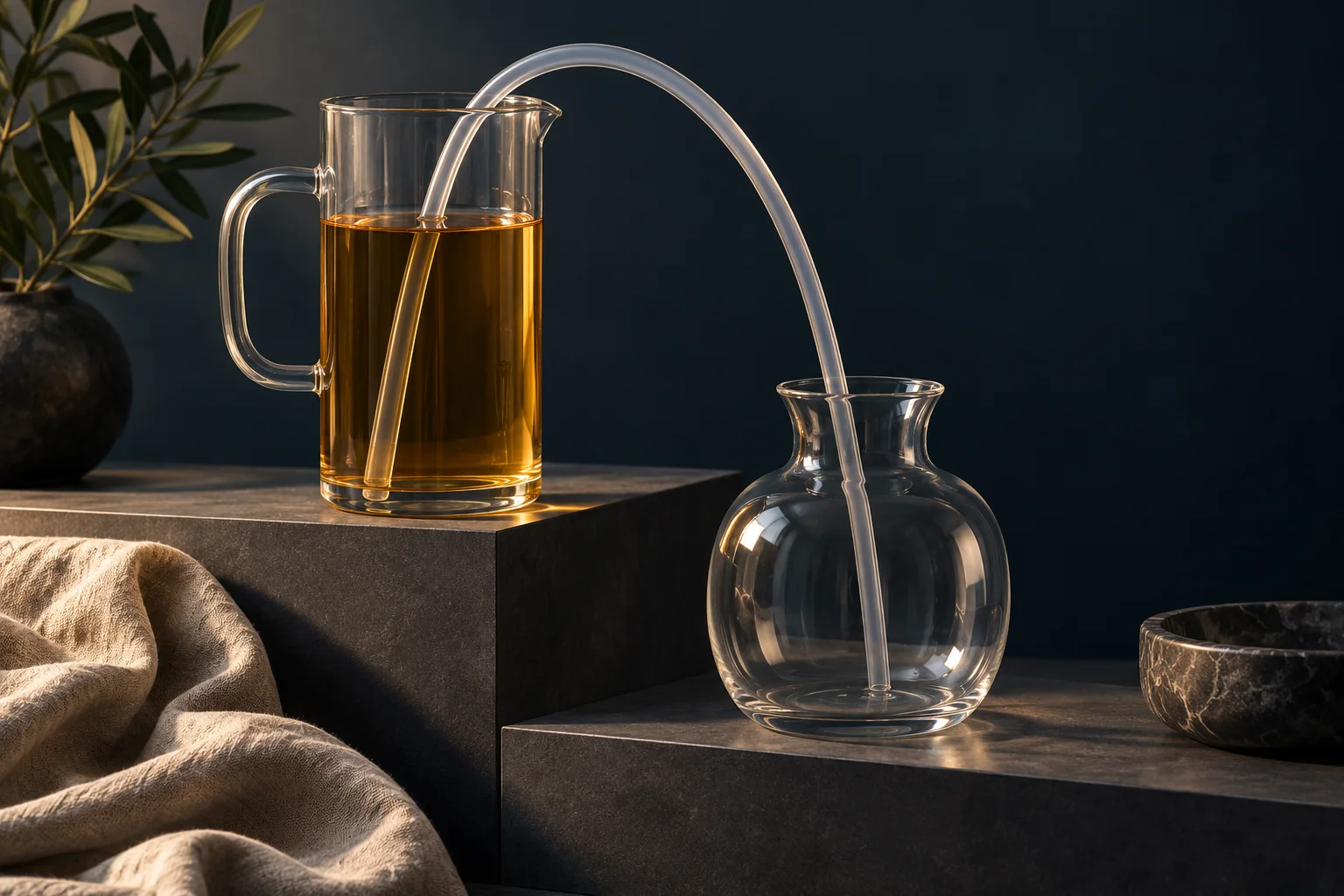
In the siphonic bowl described by Kohler, the surge fills the curved trapway and displaces its air. A siphon forms and carries water and waste toward the drain. Later, air enters that path again and the continuous siphoning flow ends. This bowl action is the part explained more generally in how a siphon works.
The flapper closes as the tank empties, cutting off the large discharge. Refilling can already have begun: the falling tank level lowers the float and opens the fill valve. These events overlap rather than waiting in a perfectly separated queue.
Sources: Kohler
Refilling restores both water levels
The tank needs water for the next flush, and the bowl needs its standing water restored. In a common refill-tube arrangement, some water from the fill valve goes through a small hose toward the overflow pipe and into the bowl. The rest replenishes the tank. Fluidmaster's instructions identify the hose and show its outlet held above the overflow pipe, not pushed below the tank waterline.
As the tank fills, its float rises. At the set level the fill valve shuts. This is why a normal refill stops without another touch of the handle: water level moves the control. The small hose is a refill route, not the large flush opening.
Sources: Fluidmaster · Fluidmaster · Kohler
The thing to remember
Stored water starts the bowl's siphon; falling and rising tank water operate the refill control. The flush valve and fill valve handle separate flows.
What this example leaves out
This selects a gravity tank, flapper flush valve, float-controlled fill valve and siphonic bowl. It does not describe every washdown, canister, pressure-assisted, dual-flush or tankless design. The diagram is a functional cutaway, not installation geometry.
Sources & further reading
Source access dates are listed below. Manufacturer descriptions and patents support the specific constructions described, not every product.
- How a Toilet Flushes ↗
Kohler · Retrieved 2026-10-16 · Gravity tank, flapper release, trapway filling and siphon, air reentry, falling float opening fill valve and rising float shutting it.
Full mechanism paragraphs read, lines 9–14. Article intentionally selects gravity-fed siphonic flapper cycle, excludes universal equivalence with pressure-assisted, commercial and washdown systems. Sequence has overlapping refill. - Toilet Fill Valves ↗
Fluidmaster · Retrieved 2026-10-16 · Fill valves restore tank and bowl water levels after a flush.
Opening product-category explanation read. No market leadership, history, universal compatibility or repair diagnosis adopted. - PRO45K Installation Instructions — refill tube ↗
Fluidmaster · Retrieved 2026-10-16 · Refill hose from fill-valve nipple to overflow-pipe adapter, discharge above pipe; submerged hose can cause unwanted siphoning.
Search-service extracted Step 17 and adjacent labeled diagram text read; direct PDF open returned an internal fetch error. No image inspection claimed. Used only for hose identities/route, corroborated by Kohler hose-position text. - Tank Leak — Fill Valve Hose Position ↗
Kohler · Retrieved 2026-10-16 · Non-canister hose held by clip on tube; incorrect submergence can siphon tank water to bowl; distinction from canister port.
Text sections Tank Leakage from Hose Siphoning and Hose Position Non-Canister Models read. No interval numbers or repair procedure reproduced. This does not establish exact bowl/trap dimensions.