Look a little closer
See the mechanism
The bubble occupies the high region
Read the diagram steps
Reference face horizontal. The curved inner cavity has its highest region at the center when the reference face is horizontal. The bubble settles between the marks.
Right end raised. Tilting the body raises one end. The bubble floats toward that higher end while gravity remains vertical.
Curved tubular-vial principle. Bubble shape and curvature are enlarged; this is one measuring direction and does not establish calibration or tool accuracy.
Diagram basis: US3138878; EP3264037 reference-face relationship.
Sources: Patent office / Google Patents · EPO / Google Patents · SOLA
A tiny curve gives the bubble a middle
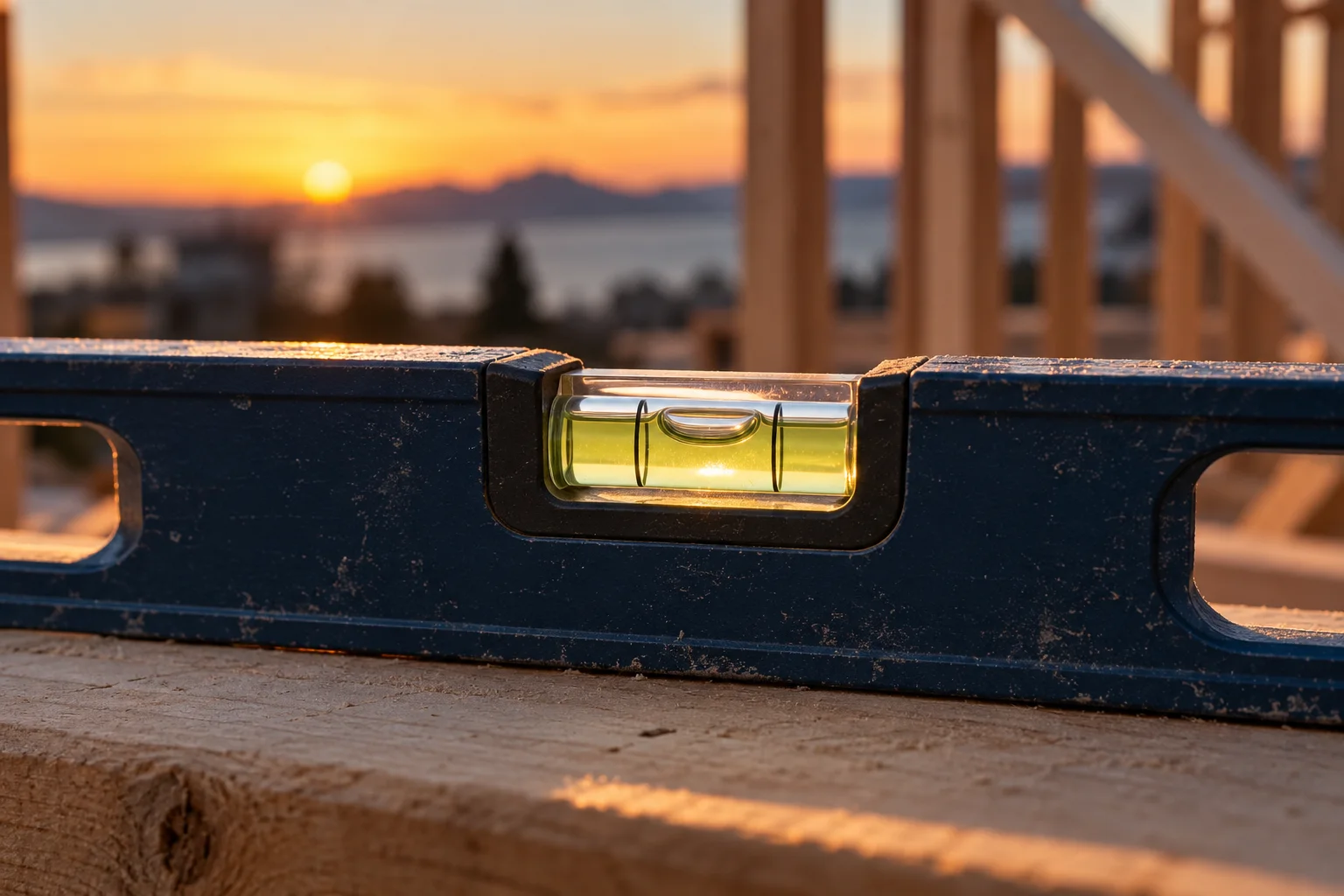
The visible block can have straight outer edges while its inner liquid cavity curves. In the curved-tube example, the middle is slightly higher than the ends when the reference face is horizontal. That gives the floating bubble a definite place to settle.
Tilt the level and the highest region shifts toward the raised end. The liquid redistributes and the bubble moves uphill within the vial. The bubble isn't a weight sliding downhill; it rises through a denser liquid.
Sources: Patent office / Google Patents
The vial must agree with the face below it
The tool rests on a reference face. That face transfers the orientation of the measured surface to the vial. The relationship between cavity curvature, vial mounting and reference face makes a centered bubble meaningful.
A bubble centered in a loose vial tells you about the vial's orientation. A complete spirit level adds a stable body and a defined measuring face. The vial patent EP 3 264 037 describes this calibration relationship explicitly.
Sources: EPO / Google Patents
One vial checks one direction at a time
A tubular vial responds to tilt along its length. Centering it doesn't establish that a broad surface is horizontal in every direction: the surface could still slope across the tool. Vertical vials use their own mounted relationship to the reference face.
The marks make bubble position readable, while the curved cavity produces the movement. They work together, but printed marks alone cannot create an accurate relationship between a damaged body and its vial.
Sources: EPO / Google Patents · SOLA
The thing to remember
Buoyancy moves the bubble to the high point; the mounted vial translates that position into the orientation of a reference face.
What this example leaves out
This describes a curved tubular vial. Cavity shapes and marking systems differ. A centered bubble does not establish universal tool accuracy, and this is not a calibration procedure.
Sources & further reading
Source access dates are listed below. Manufacturer descriptions and patents support the specific constructions described, not every product.
- US3138878A — Spirit level ↗
Patent office / Google Patents · Retrieved 2026-10-18 · Description When using my invention and claim1: floating bubble at uppermost point of curved liquid tube.
Actual HTML read; particular curved tube, not every vial shape or its noncircular crosssection. - EP3264037A1 — Vial for spirit level ↗
EPO / Google Patents · Retrieved 2026-10-18 · BACKGROUND: vial calibrated relative to reference face, bubble centered when face level.
Actual HTML read. Reference-face relationship only; no universal accuracy or calibration procedure. - Spirit Levels ↗
SOLA · Retrieved 2026-10-18 · WHAT IS and HOW DOES sections: liquid/bubble, horizontal/vertical vials, profile and measuring faces.
Search-returned substantial page text read; no precise formulas, warranties or marketing performance claims.