Look a little closer
See the mechanism
A settled string aligns tension and weight
Read the diagram steps
Settled vertical. With negligible sideways forces, string tension and weight oppose along the same vertical line. The taut string marks local gravity.
Displaced and swinging. When displaced, the string is diagonal but weight still acts vertically. A restoring component acts toward the low point; a swinging position is not a settled reference.
Ideal light string and freely suspended bob. Air motion, contact and support movement are excluded; no surveying accuracy or structure assessment is implied.
Diagram basis: NOAA local vertical; OpenStax simple pendulum.
Sources: NOAA National Geodetic Survey · OpenStax / Rice University
The string becomes the reference
The support doesn't need to be horizontal. It only needs to hold the string while the bob hangs freely. Gravity acts on the bob, and tension acts along the string toward the support. At rest, with no significant sideways force, their directions oppose one another.
A stretched diagonal string would supply a sideways component of tension that gravity alone couldn't balance. The freely suspended bob therefore settles below the attachment point, leaving the string aligned with the local vertical.
Sources: NOAA National Geodetic Survey · OpenStax / Rice University
A moving bob is also a pendulum
Displace the bob sideways and it can swing past the lowest point. Gravity supplies a component of force that pulls it back toward that point, but its motion carries it through. During this swing the string keeps changing direction.
Air resistance and other losses reduce the motion in a real hanging system. A passing position is not the same thing as a settled reference. Wind or contact with a nearby surface can also add forces that make the string deviate from the gravity-only direction.
Sources: OpenStax / Rice University
The point is useful, but gravity sets the direction
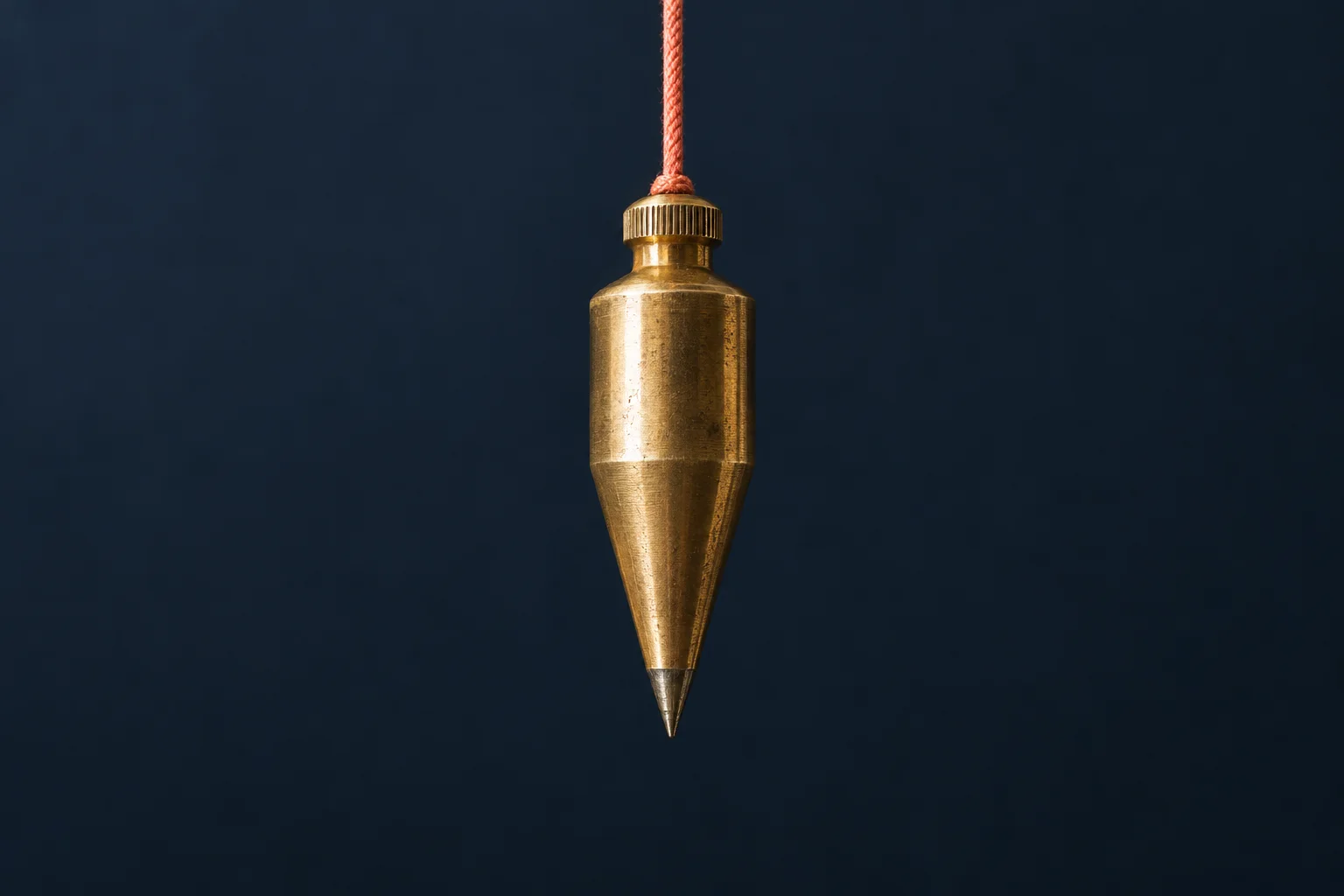
The pointed tip makes the bob's location easier to compare with a point beneath it. The direction comes from the freely suspended system, not from the sharpness of that tip.
Local vertical is also more precise than 'toward the exact center of Earth.' NOAA's geodesy explanation relates plumb lines to the gravity field and geopotential surfaces. At the scale of a room, the familiar straight hanging line is the useful reference; global surveying needs a fuller model.
Sources: NOAA National Geodetic Survey
The thing to remember
A settled plumb line follows local gravity because tension and weight must balance along the same line.
What this example leaves out
The simple account neglects string mass, stretch and significant external forces. It explains the reference principle, not survey accuracy or a method for verifying a structure.
Sources & further reading
Source access dates are listed below. Manufacturer descriptions and patents support the specific constructions described, not every product.
- The Geopotential Surface ↗
NOAA National Geodetic Survey · Retrieved 2026-10-18 · Whole short institutional explanation: gravity-linked local vertical and plumb lines normal to geopotential surfaces.
Actual HTML read; no exact Earth-center direction or globally straight plumb-line claim. - 16.4 The Simple Pendulum — College Physics 2e ↗
OpenStax / Rice University · Retrieved 2026-10-18 · Opening/Figure16.13 and equilibrium discussion: weight/tension, tangential restoring component, equilibrium theta0.
Actual HTML read after wrong /physics/pages/16-4-pendulums path failed. Elementary physics facts paraphrased only; no copied textbook illustrations/exercises. Damping/airforce qualifications are elementary analysis, not measured results.