Look a little closer
See the mechanism
The basket turns; separated water continues
Read the diagram
Top view of separation. The basket accelerates the leaves around the axis. Water that separates from them is no longer forced along the same curved path: it moves away from the turning basket through the holes and is caught by the outer bowl. The drive keeps the basket rotating; it does not pull water through the leaves.
Qualitative top view, not a trajectory or force calculation. The straight arrow is locally tangent to the basket at the release point. Gravity, drag, leaf shape and adhesion also affect water removal.
Diagram basis: CA2622646A1: crank-driven basket; OpenStax: tangential release.
Sources: Kin Yuen Hardware & Plastics Factory Ltd / Canadian patent application · OpenStax / Rice University
The handle gives the basket its speed
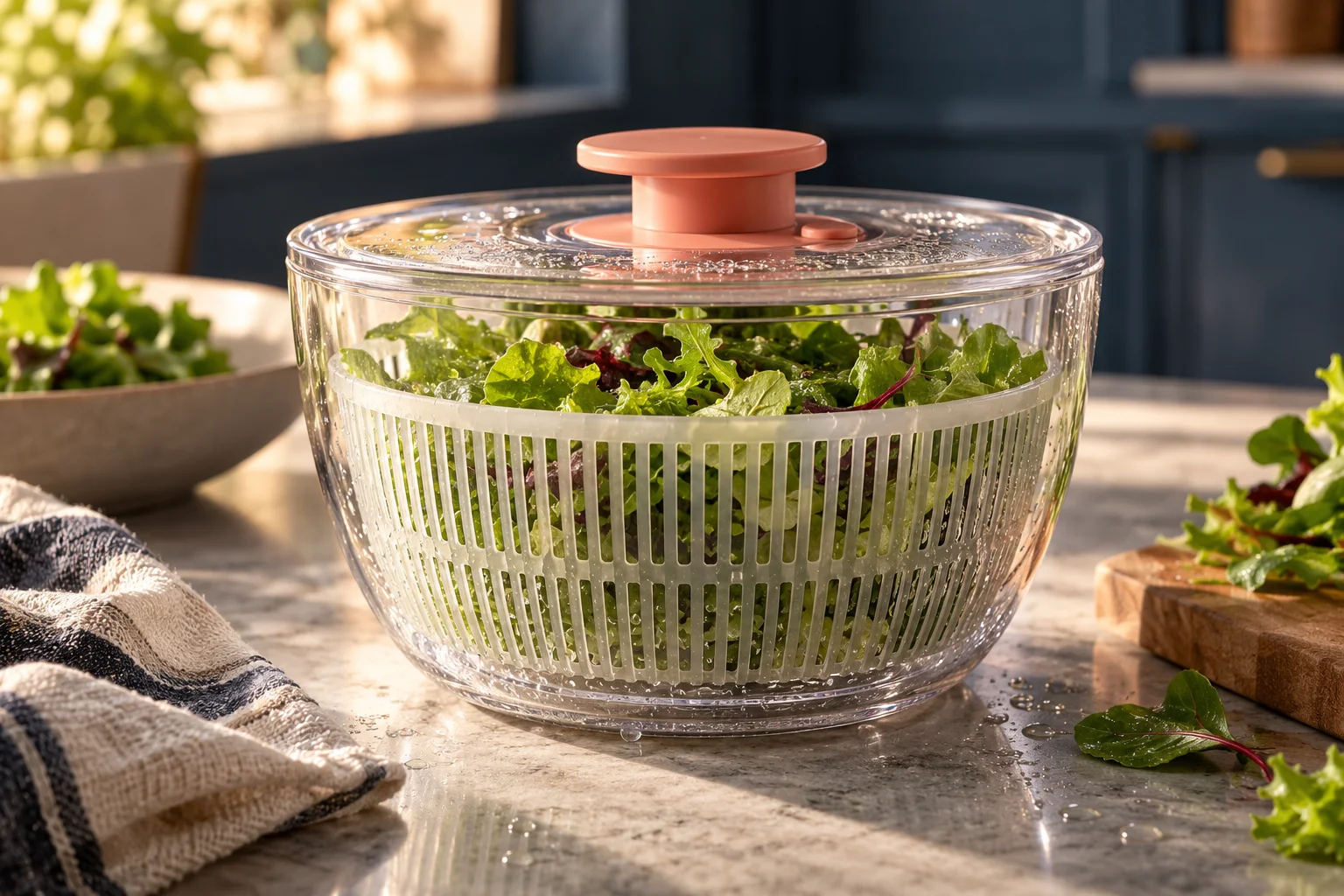
A spinner contains two nested containers with different jobs. The outer bowl rests on the counter and catches water. The inner basket is supported so it can rotate inside that bowl, with room around it for water to leave.
In the hand-cranked example described in patent CA2622646A1, gears in the lid transmit the handle's rotation to the basket through its lid. A one-way ratchet transmits drive in one direction. This is one drive arrangement; push-knob and pull-cord spinners supply the same basket motion through different linkages.
Sources: Kin Yuen Hardware & Plastics Factory Ltd / Canadian patent application
A circle requires a continuing inward force
The leaves do not follow a circle just because they are already moving. Their direction must keep changing. Contact with the basket and other leaves supplies forces that keep them following the rotating container.
Loose water also gains motion as the basket speeds up. But a droplet that separates can pass through a hole instead of being held to the basket's circular path. A droplet moving with the basket has a velocity tangent to its circular path; once freed, it can continue in that direction instead of turning with the leaves. It travels into the space around the basket, meets the outer bowl and loses its motion there.
From the rotating basket, water appears to move outward. From the stationary counter, the useful distinction is between the leaves being continually turned and the freed water no longer receiving the same constraint. No extra outward push has to appear at the hole.
Sources: OpenStax / Rice University
Spinning moves surface water, not the water inside a leaf
Water caught by the bowl runs downward under gravity. The basket holds the leaves above much of that collected water, making it possible to lift them out separately. Stopping the basket does not put the escaped water back on the leaves.
Some water remains in folds or clings as small drops. The spinner removes loose surface water; it does not dry leaf tissue like a heated dryer. Rotation, leaf arrangement and the available escape paths all matter, so the mechanism does not imply a fixed drying time.
Sources: Kin Yuen Hardware & Plastics Factory Ltd / Canadian patent application · OpenStax / Rice University
The thing to remember
The holes let detached water leave the circular route that the basket imposes on the leaves.
What this example leaves out
The drive example is a disclosed crank-and-gear design, not a claim that every spinner uses it. Droplets also experience gravity and air drag; their real paths are not unlimited straight lines.
Sources & further reading
Source access dates are listed below. Manufacturer descriptions and patents support the specific constructions described, not every product.
- CA2622646A1 — Food processing device ↗
Kin Yuen Hardware & Plastics Factory Ltd / Canadian patent application · Retrieved 2026-10-17 · Nested rotating basket and fixed bowl, crank/gears/one-way ratchet drive.
Detailed description of disclosed embodiment, not evidence of every commercial spinner or performance. - 6.3 Centripetal Force — University Physics Volume 1 ↗
OpenStax / Rice University · Retrieved 2026-10-17 · Circular motion requires inward net force; released motion initially tangent; centrifuge explanation.
General physics applied to spinner, not a salad-drying experiment.