Look a little closer
See the mechanism
Two surfaces start the flame
Read the diagram steps
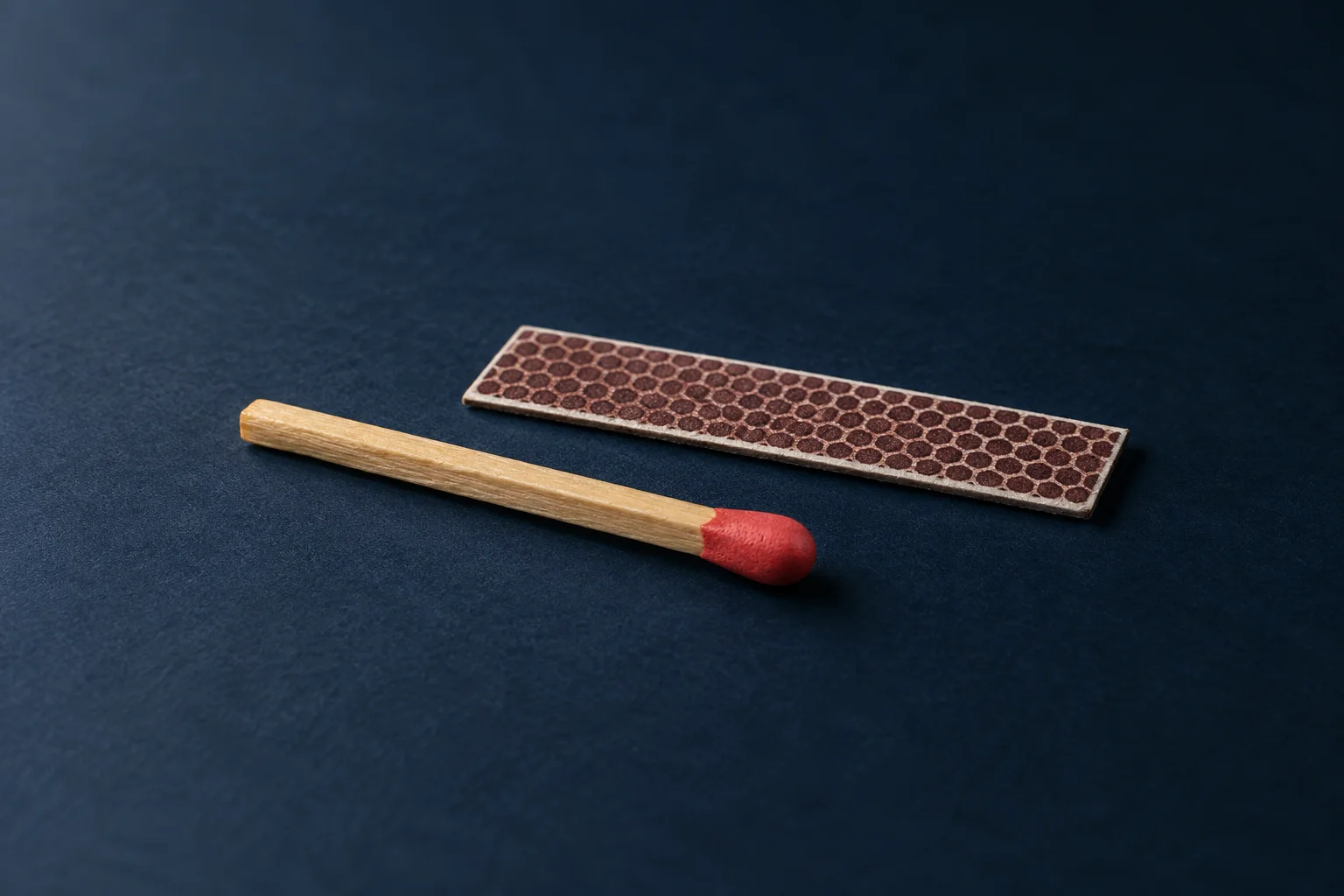
Ingredients kept apart. The striker carries red phosphorus. The head carries an oxidizer and fuel ingredients. The two parts have different roles.
Local ignition spreads. Contact and friction start a hot reactive region. Heat from the head can sustain combustion and spread to the wooden splint.
General ingredient roles only. Formulations and microscopic ignition details vary; this is not a recipe or striking procedure.
Diagram basis: Intermatch patent: background ignition/contact discussion.
Sources: Compound Interest / Andy Brunning · Intermatch Sweden AB / US Patent Office via Google Patents
The chemistry is split between two surfaces
A rough wall supplies friction, but the matching striker supplies chemistry too. In the common safety-match arrangement, red phosphorus is kept on the box's striking surface rather than mixed throughout the head.
The head contains an oxidizing ingredient, commonly potassium chlorate, along with binders and other ingredients. Formulations vary, so a match head's color does not identify a complete recipe.
Sources: Compound Interest / Andy Brunning · Intermatch Sweden AB / US Patent Office via Google Patents
The first reaction heats the rest of the match
The initial hot region starts further reactions in the head. Their released energy makes the ignition continue after the brief rubbing contact has ended. The flame can then spread to the combustible splint.
Separating the starting ingredients makes the intended striker important. It does not turn the finished match into a harmless object: once lit, it is an open flame.
Sources: Compound Interest / Andy Brunning · Intermatch Sweden AB / US Patent Office via Google Patents
The thing to remember
The box is part of the ignition system. It supplies a reactive surface as well as friction.
What this example leaves out
This describes safety matches, not strike-anywhere matches. Ingredient names explain their roles; they are not a formulation or instructions for making, altering or extracting match materials.
Sources & further reading
Source access dates are listed below. Manufacturer descriptions and patents support the specific constructions described, not every product.
- The Chemistry of Matches ↗
Compound Interest / Andy Brunning · Retrieved 2026-10-18 · Safety-match head/striker separation and common ingredient roles.
Read explanatory article and one-page PDF. Supplementary chemistry educator explanation; detailed phosphorus transformation is deliberately omitted. - US4832766A — Method of controlling chemical reactivity and products produced by such method ↗
Intermatch Sweden AB / US Patent Office via Google Patents · Retrieved 2026-10-18 · Background identifies safety-match red phosphorus on friction surface, head oxidizer and friction/contact roles.
Read description lines 104–125. Supports general existing match operation, not proposed formulation or universal microscopic ignition sequence. No formulas, recipes, quantities or manufacturing instructions reproduced.