Look a little closer
See the mechanism
One stroke drives; the return slips
Read the diagram steps
Drive stroke. With this selector position, the pawl bears against a ratchet tooth face. Handle rotation drives the wheel and the bit together.
Return stroke. On the return, the pawl lifts over the tooth ramps while the bit can stay in place. The spring returns the pawl into a following gap; changing the selector reverses which direction drives.
One active stop plate of the selected reversible two-plate ratchet; tooth profile and pawl movement are exaggerated. Only one selector direction is drawn. It is not a torque specification or a complete reversing assembly.
Diagram basis: US5910196A: selectable stop plates and ratchet wheel.
Sources: US patent publication · US patent publication
The catch carries the turning force
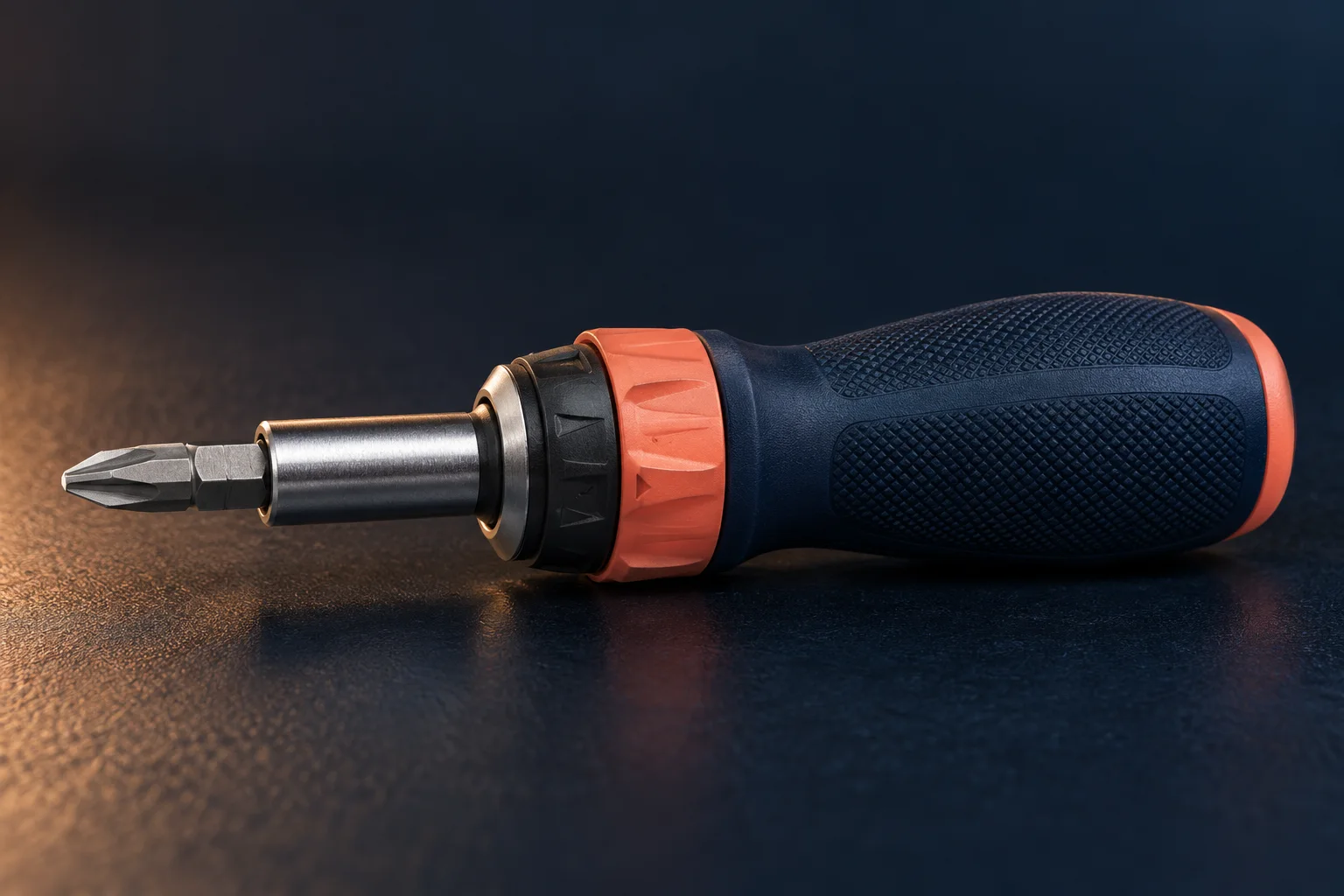
The bit and shank must turn with the handle while you drive. In a pawl-type mechanism, a catch bears against a ratchet tooth and blocks relative rotation in that direction. The load passes through that contact to the shank and bit.
Reverse the handle and the catch can move past the teeth. The shaft does not have to follow the returning handle. That is the useful difference from a rigid screwdriver, whose handle and shaft turn together both ways.
Sources: US patent publication
The selector chooses which direction grips
The reversible design documented in US5910196A uses two opposing stop plates and a shifter. Selecting one plate allows driving one way; selecting the other reverses it. In the middle position, both engage and stop relative rotation in either direction.
Those are changes in the coupling inside the handle. The selector doesn't change the screw's thread or make the same shaft rotation alternately tighten and loosen it.
Sources: US patent publication
Free return is not a brake
The ratchet allows the handle to return without forcing the shaft backward. It does not clamp the screw to the work. If a loosely turning screw follows the bit during the return, the mechanism has no separate fixture holding that screw still.
Sources: US patent publication
The thing to remember
The ratchet saves repeated hand repositioning by separating a driving stroke from a permitted return stroke.
What this example leaves out
The schematic isolates one active catch and its driving and return strokes. The reversible design described in the text has opposing stop plates. Tooth counts, selector arrangements and contact shapes vary; this is not a torque-limiting screwdriver.
Sources & further reading
Source access dates are listed below. Manufacturer descriptions and patents support the specific constructions described, not every product.
- US6076432A — Reversible ratchet screwdriver ↗
US patent publication · Retrieved 2026-10-17 · Pawls engage toothed handle; drive in one direction, idle in reverse.
Functional one-way contact only. Its three-pawl architecture is not the selected two-catch diagram. - US5910196A — Reversible ratchet screwdriver ↗
US patent publication · Retrieved 2026-10-17 · Two opposing stop plates; shifter selects direction or both for direct drive.
Selected FIGS4A,5,6 coupling, not exact current product tooth geometry.