Look a little closer
See the mechanism
The guide sets the taper; the edge removes material
Read the diagram
The tapered bore guides the pencil against a fixed cutting edge. Turning the pencil carries wood and graphite past that edge. Material is shaved away along the taper and the shaving exits beside the blade, rather than being forced through the sharpened point.
Original conventional tapered-bore principle, not the source patent’s full adjustable holder. The blade edge, clearance and shaving are enlarged and not to scale. No universal point angle, feed rate or diagnosis of broken leads is shown.
Diagram basis: US578577A: conical bore, cutting throat and shaving clearance.
Sources: United States patent publication via Google Patents · KUM
The hole is a guide, not a storage compartment
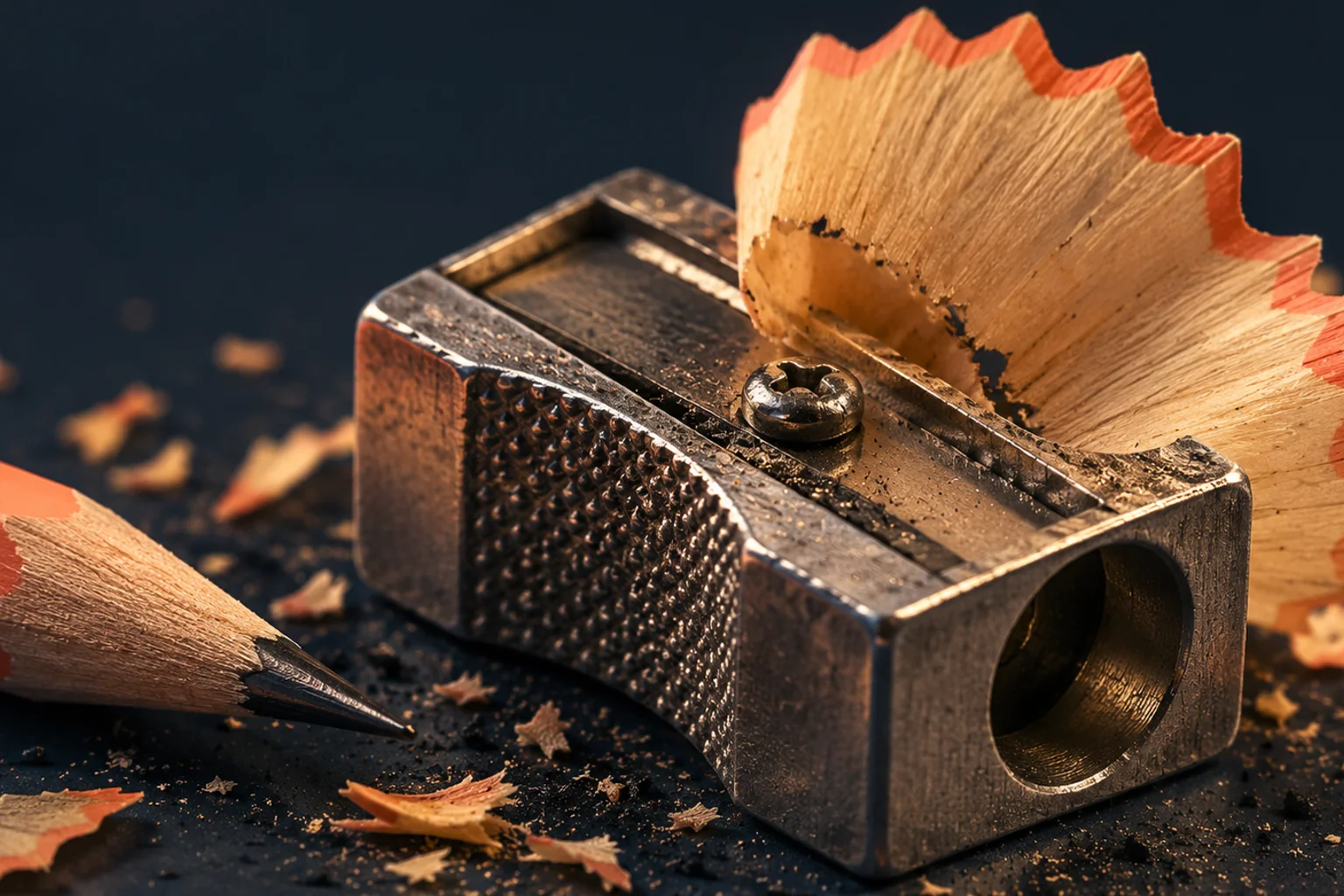
The pencil enters a narrowing passage. A blade crosses an opening at the side of that passage, with its edge reaching into the pencil's path. Rotate the pencil and successive portions pass that same cutting edge.
The conical-bore sharpener described in US578577A explicitly combines the tapered guide, blade seat, throat and clearance beneath the blade. The guide keeps the pencil in relation to the cutter as the point develops. It doesn't sharpen by rubbing against the whole inside wall.
Sources: United States patent publication via Google Patents
Rotation presents fresh material to one edge
As the pencil turns, the blade takes a thin cut from the material passing it. A shaving can curl out through the nearby opening instead of remaining trapped in the guide. The resulting point reflects the guide and cutter geometry; different sharpeners can produce different point shapes.
Sources: United States patent publication via Google Patents · KUM
Fit and blade construction change the result
KUM identifies pencil fit, blade condition, pressure and pre-existing core damage among factors in broken points. A loose pencil can move differently against the edge, so every break cannot be explained by the graphite alone.
KUM's products also include curved blades and separate sharpeners for bare mechanical-pencil leads. Those constructions serve different pencil types. The tapered-bore mechanism here guides a wood-cased pencil past a fixed blade.
Sources: KUM
The thing to remember
The guide controls where the pencil meets the blade. Rotation brings material past the edge and the side opening carries the shavings away.
What this example leaves out
This selects a simple tapered-bore handheld sharpener. Blade mount, guide angle and point shape vary. It does not explain every broken core or provide blade-adjustment or repair instructions.
Sources & further reading
Source access dates are listed below. Manufacturer descriptions and patents support the specific constructions described, not every product.
- Lead-pencil sharpener — US578577A ↗
United States patent publication via Google Patents · Retrieved 2026-10-16 · Tapered/conical bore, blade edge intersecting throat and clearance for shavings; guided rotating pencil passes edge.
Description and claims26–27 read. Historic adjustable mount excluded from simple figure; no universal angle, exact modern mount or helical-cutter equivalence. - Sharpeners — The Blade, Diameter and Questions ↗
KUM · Retrieved 2026-10-16 · Pencil fit and blade/pressure/core condition affect sharpening; curved blade and bare-lead models are distinct variants.
Actual blade/diameter sections and broken-point FAQ read. Maker universal market and numerical hardness claims excluded; no full diagnosis for every broken lead or repair guidance.